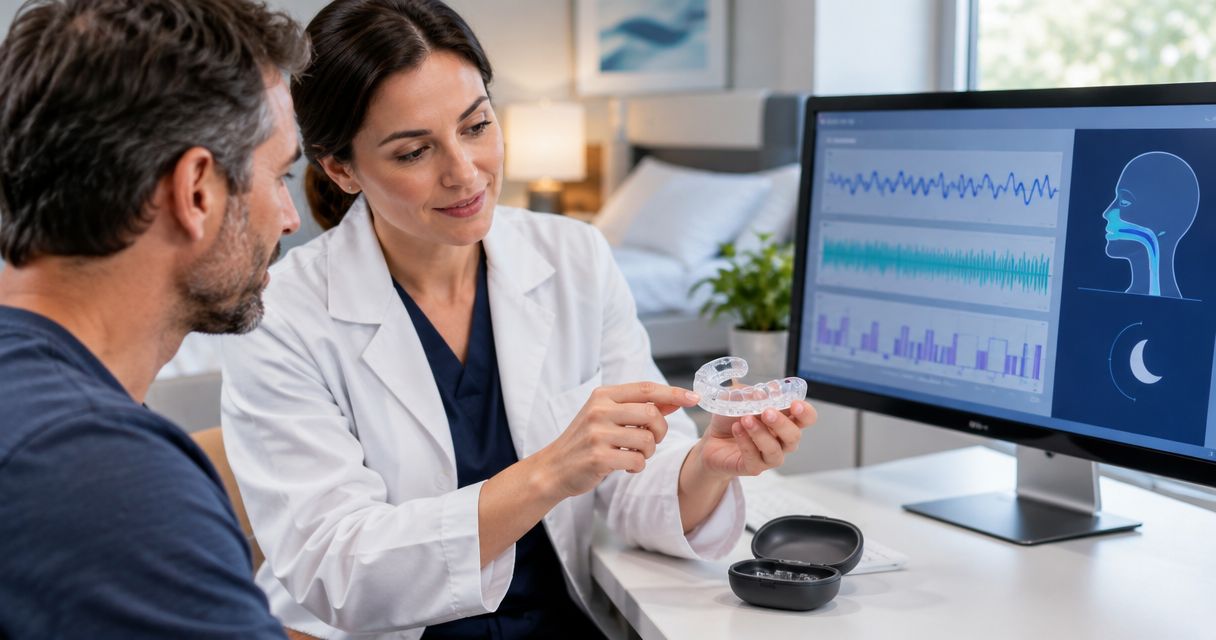
Instead of repeatedly explaining your sleep study results at separate appointments, follow a sleep study to oral appliance for sleep apnea workflow that connects your sleep clinician, a qualified dentist, and follow-up testing. Start with a confirmed diagnosis, check whether an appliance fits your treatment needs, then verify that the fitted device controls your breathing during sleep.
- The sleep study to oral appliance for sleep apnea workflow requires diagnosis, dental assessment, fitting, and follow-up sleep testing.
- Starboard Dental provides general, restorative, and cosmetic dental care for patients in Kennebunk, York, and Saco.
- A custom, adjustable oral appliance treats obstructive sleep apnea; an ordinary night guard does not.
- Feeling better is useful, but follow-up sleep testing checks whether an oral appliance actually controls breathing events.
Why this matters
A sleep study identifies the breathing problem. A dental examination checks whether your teeth, gums, and jaw can support an appliance. Neither replaces the other, and successful treatment needs both medical oversight and dental follow-up.
An oral appliance for obstructive sleep apnea usually holds your lower jaw forward to help keep your airway open. It does not supply air pressure, and it is not interchangeable with a grinding guard. Choosing the wrong type of device leaves the underlying breathing problem untreated.
Starboard Dental is best for patients in Kennebunk, York, and Saco seeking general, restorative, and cosmetic dental care. Start a dental-health discussion with Starboard Dental, and ask your sleep clinician who should provide appliance evaluation and ongoing sleep-apnea care.
For your 2026 treatment plan, keep one distinction clear: this guide explains an adult obstructive sleep apnea pathway. Central sleep apnea and childhood sleep-disordered breathing require different clinical decisions.
Before you start
- Gather your records: Bring the full sleep study report, the interpreting clinician's diagnosis, your medication list, and any current sleep-apnea treatment instructions. Include your experience with prescribed positive airway pressure treatment.
- Arrange the right appointments: You need a sleep clinician to direct diagnosis and treatment, plus a dentist qualified to assess, fit, and monitor sleep-apnea appliances. Ask how the two offices will exchange records before scheduling the fitting.
- Check the easily missed barrier: An appliance needs suitable dental support. Loose teeth, active gum disease, significant jaw pain, or recent dental changes need assessment before impressions or scans; a snoring history alone is not enough to choose treatment.
Keep using your prescribed treatment while discussing an alternative. Do not stop positive airway pressure treatment simply because an appliance appointment is booked.
Sleep study review
Confirm the diagnosis and report details
- Request the complete report. Ask for the interpretation as well as the summary. A screenshot of an event count does not give the dentist the full clinical picture.
- Find the breathing-event measure. Look for Apnea-hypopnea index, often shortened to AHI, on an in-laboratory report. A home sleep apnea test often reports Respiratory event index, or REI. These measures use different denominators and are not identical.
- Review the diagnosis with your sleep clinician. Ask whether the events are obstructive, central, or mixed, and whether oxygen findings or other health conditions change the treatment recommendation.
For adults, the usual AHI severity categories are mild at 5 to fewer than 15 events per hour, moderate at 15 to fewer than 30 events per hour, and severe at 30 or more events per hour. These thresholds describe severity; they do not select a device for you.
Expected result: You have a documented diagnosis and a clinician's explanation of what the report means for treatment.
Turn the report into useful questions
Ask whether the report shows worse breathing when you sleep on your back or during particular sleep stages. Your sleep clinician can explain whether those findings affect the plan rather than leaving you to interpret a graph yourself.
Also describe daytime sleepiness, morning headaches, witnessed pauses in breathing, and any difficulty using your current treatment. Symptoms add context, but neither loud snoring nor an absence of obvious symptoms establishes the diagnosis.
For your 2026 appointment, write these questions beside the report. That keeps the conversation focused on your findings rather than on whether a device sounds convenient.
Treatment selection and referral
Agree on the treatment pathway
- Discuss the medical options. Ask your sleep clinician whether an oral appliance is appropriate, especially if you cannot tolerate prescribed continuous positive airway pressure treatment, or prefer an alternative.
- Request a coordinated referral. Have the sleep clinician share the diagnosis, relevant report findings, and treatment recommendation with the dentist responsible for appliance care.
- Complete the dental assessment. The dentist should review your teeth, gum health, bite, jaw movement, and existing dental work before selecting an appliance approach.
The American Academy of Sleep Medicine and American Academy of Dental Sleep Medicine's joint oral-appliance guideline supports considering oral appliances for adults with obstructive sleep apnea who cannot tolerate CPAP or prefer an alternative. It favors a custom, adjustable appliance over a non-custom device and recommends follow-up sleep testing.
Expected result: Your sleep clinician and dentist agree on the treatment goal, your suitability, and who will arrange follow-up testing.
Compare the treatment trade-offs
CPAP and a custom oral appliance address obstructive sleep apnea differently. Use this comparison to prepare questions, not to choose treatment without your clinician.
| Treatment | Best for | Main benefit | Main limitation |
|---|---|---|---|
| CPAP | Adults whose clinician recommends pressure-based treatment, particularly when strong breathing-event control is needed | Air pressure keeps the airway open; CPAP generally reduces breathing events more than oral appliances | A mask and pressure require adjustment and consistent use |
| Custom, adjustable oral appliance | Adults selected by their clinician who prefer an alternative or cannot tolerate CPAP | Holds the lower jaw forward without a mask or air-pressure machine | Dental suitability matters; jaw discomfort and bite changes need monitoring, and treatment effectiveness requires testing |
CPAP generally wins on breathing-event reduction; an oral appliance is an alternative for appropriately selected adults. Severe obstructive sleep apnea warrants a clear medical discussion rather than an automatic switch to a dental device.
For more detail on device selection, read the oral appliances for sleep apnea comparison. Keep the decision tied to your diagnosis, not to the appearance of the appliance.
Appliance fitting and adjustment
Establish the starting fit
- Complete any necessary dental care first. Ask whether gum treatment, damaged teeth, or planned restorations affect appliance support. Changes to tooth shape after fabrication can change the fit.
- Follow the dentist's recording process. The dentist takes the required impressions or scans and bite records for a custom appliance. The starting jaw position should reflect your examination, not a setting copied from another patient.
- Check the appliance at delivery. Practice inserting and removing it, and review the written instructions for wearing, cleaning, storing, and adjusting your specific device.
Do not force an appliance onto your teeth. If it does not seat properly, the dentist needs to check it rather than having you bite harder to make it fit.
Expected result: You can insert and remove the appliance as instructed, and you know whom to contact about fit problems.
Follow a supervised adjustment plan
A custom, adjustable appliance allows the lower-jaw position to change during treatment. The dentist directs those changes while monitoring comfort, bite, and symptoms; advancing farther is not automatically better.
Record whether you wore the appliance, whether snoring or sleepiness changed, and whether your teeth or jaw hurt. Bring that record to adjustment visits. Do not copy adjustment settings from online instructions for a different device.
For your 2026 treatment record, keep the appliance instructions and adjustment history together. This helps both clinicians understand what configuration you were using when a symptom or test result occurred.
Follow-up testing and ongoing monitoring
Verify the treatment before calling it complete
- Tell both clinicians when the fit is stable. The dentist assesses the appliance and comfort; the sleep clinician determines the appropriate follow-up sleep test.
- Use the appliance during testing as instructed. Follow the testing team's directions so the result measures the intended treatment setup.
- Review the result and next step. If breathing events remain inadequately controlled, your clinicians should reassess adjustment, treatment choice, or additional evaluation.
Less snoring and better mornings are encouraging. They do not prove that breathing events or oxygen problems have resolved.
Expected result: You have objective evidence of treatment response and a documented plan for continued care or further treatment.
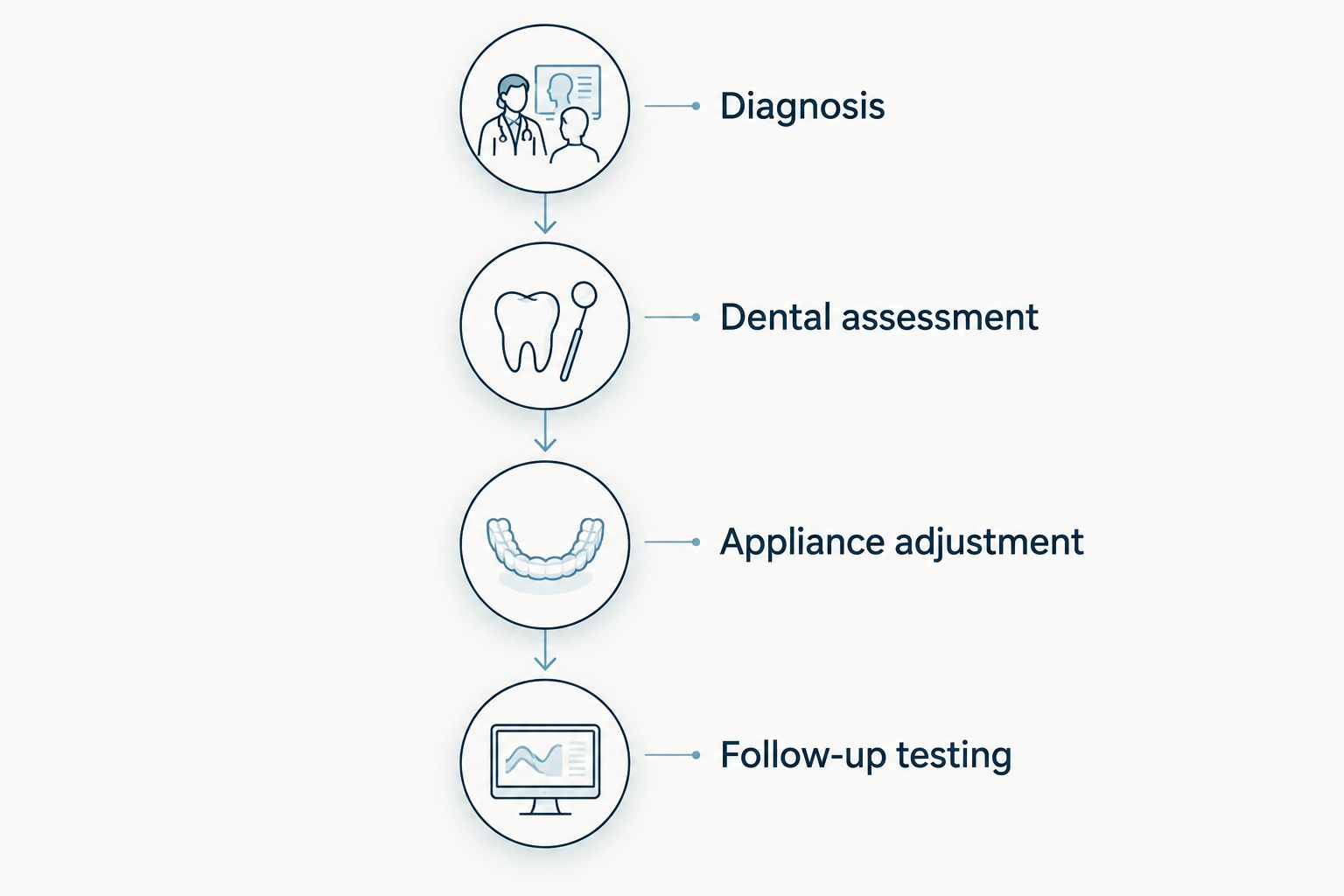
The workflow has four connected stages: Diagnosis, Dental assessment, Appliance adjustment, and Follow-up testing. Skipping the final stage leaves effectiveness unconfirmed.
Keep medical and dental follow-up connected
Continue follow-up with both the sleep clinician and the dentist. Dental visits monitor fit, tooth and gum health, jaw symptoms, and bite changes; sleep follow-up addresses whether treatment still controls the breathing disorder.
Tell the clinicians about returning symptoms, substantial weight changes, new relevant health concerns, or dental work that changes the appliance fit. A result from earlier treatment does not automatically describe your current condition.
When symptoms return or your dental work changes
The second workflow starts with a change rather than a new diagnosis. Use it if snoring returns, daytime sleepiness worsens, the appliance breaks, or dental treatment changes how it fits.
- Identify the change. Write down the symptom, fit problem, or dental procedure and when it began. Include whether you have been wearing the appliance as instructed.
- Contact the appropriate clinician. Fit and jaw problems need dental review; returning sleep-apnea symptoms need sleep-clinician review. Share the change with both when it affects treatment use.
- Update the plan. Your clinicians determine whether you need repair, new dental records, adjustment, repeat sleep testing, or a different treatment approach.
Best for: Adults already using an appliance whose symptoms or dental situation have changed. This pathway focuses the reassessment, but it does not replace urgent evaluation when symptoms are serious.
If you are too sleepy to drive safely, do not drive. Seek prompt medical advice rather than waiting for the next routine adjustment.
Troubleshooting
The dental office has only a sleep-study summary
Ask the testing provider or sleep clinician to send the complete interpreted report through the office's records process. Confirm that the receiving clinician has it before an appliance decision is made.
The appliance causes persistent jaw or tooth pain
Contact the fitting dentist and follow their instructions about use. Do not keep advancing the appliance to chase quieter snoring; persistent pain, restricted jaw movement, or a changed bite needs assessment.
Snoring improves, but daytime sleepiness continues
Tell your sleep clinician and arrange the recommended treatment-effectiveness review. Persistent sleepiness needs evaluation; it is not a reason to assume the appliance has succeeded or to adjust it independently.
Dental work changes the fit
Ask the dentist to inspect the appliance after treatment that changes tooth shape or support. Do not reshape it at home, force it into place, or assume that a familiar device still fits correctly.
Customize your workflow
Build your 2026 care plan around the next decision, not a promised completion date. Each appointment should answer a question: Is the diagnosis clear? Are the teeth and gums ready? Is the fit tolerable? Does follow-up testing show adequate control?
At Starboard Dental, general, restorative, and cosmetic dental care provides a place to discuss the dental-health part of that plan. Your sleep clinician remains responsible for directing sleep-apnea diagnosis and medical treatment.
Keep these items together in your treatment record:
- The interpreted sleep study and diagnosis.
- The current medical treatment recommendation.
- The appliance instructions and adjustment history.
- The follow-up testing result and next appointments.
That shared record helps you explain changes without relying on memory. It also keeps a dental comfort problem from being mistaken for proof that sleep-apnea treatment is working.
FAQ
How do I go from a sleep study to an oral appliance for sleep apnea?
Start with your sleep clinician's diagnosis and treatment recommendation, then complete an assessment with a dentist qualified in sleep-apnea appliance care. A suitable custom appliance is fitted and adjusted, and follow-up sleep testing checks its effectiveness.
Can I use a regular night guard for sleep apnea?
A regular grinding guard is not a substitute for a sleep-apnea oral appliance. An appliance prescribed for obstructive sleep apnea is designed to hold the lower jaw forward, while a grinding guard primarily protects teeth.
Is an oral appliance better than CPAP?
CPAP generally reduces breathing events more than oral appliances, but an oral appliance is an alternative for appropriately selected adults. Your clinician should weigh diagnosis, severity, treatment tolerance, and dental suitability.
Do I need another sleep study after getting an appliance?
Follow-up sleep testing is recommended to confirm that the oral appliance controls obstructive sleep apnea. Your sleep clinician determines the appropriate test and timing after fitting and adjustment.
Can an oral appliance treat central sleep apnea?
A jaw-advancement oral appliance is intended for obstructive sleep apnea, not central sleep apnea. Central events require medical evaluation and a treatment plan directed at their cause.
What should I do if my sleep apnea appliance hurts my jaw?
Contact the fitting dentist for assessment and instructions about continued use. Do not make further adjustments on your own, especially if pain persists or your bite changes.
Should I stop CPAP while waiting for my oral appliance?
Keep using your prescribed treatment unless your treating clinician tells you to change it. An appliance appointment does not establish that the new treatment is ready or effective.
One last thing
Quieter sleep is not the same as confirmed treatment. Before leaving the fitting appointment, ask who will order follow-up testing and how the result will reach the dentist. That handoff completes the pathway from a device you can wear to treatment your clinicians have checked.