Best overall: a custom, adjustable mandibular advancement device for adults prescribed oral appliance therapy. Best for a selected fixed jaw position: a custom, nonadjustable device. Best alternative when jaw advancement is unsuitable: a professionally assessed tongue-retaining device. This 2026 guide compares the best oral appliances for sleep apnea and explains why a self-fit snoring mouthpiece is not a substitute for prescribed treatment.
- The best oral appliances for sleep apnea start with a diagnosis; custom, adjustable mandibular advancement devices are the preferred category.
- Custom fixed-position devices offer fewer adjustment options; tongue-retaining devices require careful patient selection.
- CPAP generally controls breathing events better than oral appliances, especially in severe obstructive sleep apnea.
- Starboard Dental’s guide separates sleep apnea treatment from night guards, snoring mouthpieces, and ordinary dental care.
Starboard Dental provides general, restorative, and cosmetic dental care for patients of all ages in Kennebunk, York, and Saco, Maine. Choosing a sleep apnea appliance requires a separate medical diagnosis and an assessment of whether your teeth, gums, and jaw can support the proposed treatment.
Why this matters
Obstructive sleep apnea happens when your upper airway repeatedly narrows or closes during sleep. An oral appliance changes the position of your jaw or tongue to help keep that airway open; an ordinary grinding guard does not serve the same purpose.
Less snoring does not prove that sleep apnea is controlled. You need follow-up sleep testing to check treatment, not just a quieter bedroom or a more comfortable morning.
This 2026 comparison follows the American Academy of Sleep Medicine and American Academy of Dental Sleep Medicine guideline for adult oral appliance therapy. That guideline favors a custom, adjustable appliance over a noncustom device when a qualified dentist provides treatment prescribed by a sleep physician.
What makes the best oral appliances for sleep apnea?
Choose the treatment pathway before choosing the mouthpiece. These criteria matter more than a product name:
- Diagnosed condition: The appliance must address obstructive sleep apnea, not simply snoring or tooth grinding. Central sleep apnea requires a different medical assessment.
- Custom fit: A dentist evaluates your mouth and creates an appliance fitted to your teeth and oral anatomy.
- Controlled adjustment: An adjustable device lets the dentist change jaw advancement while monitoring comfort and treatment response.
- Dental suitability: Stable teeth, gum health, jaw function, and existing restorations affect what you can safely wear.
- Verified effectiveness: Follow-up sleep testing checks whether the chosen setting controls breathing events.
- Long-term monitoring: Dental reviews look for bite changes, tooth movement, soreness, and appliance wear.
The preferred device is the one you can wear consistently and whose effectiveness has been confirmed. Comfort alone is not enough, and more jaw advancement is not automatically better.
Oral appliances at a glance
| Option | Best for | Standout feature | Key limitation |
|---|---|---|---|
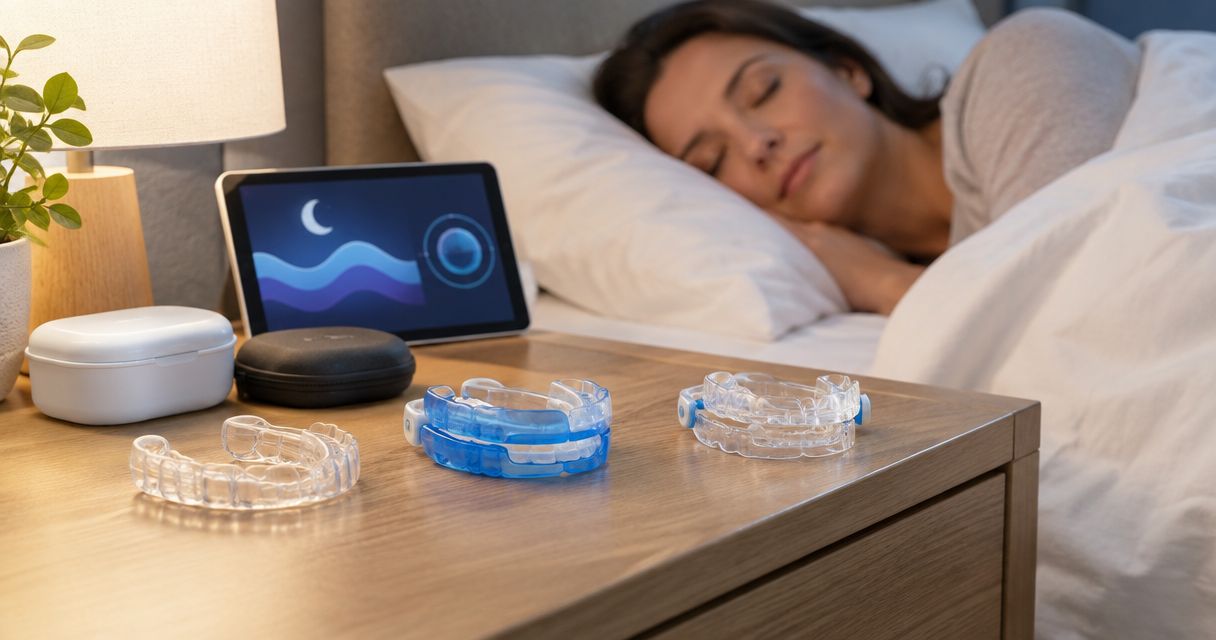
| Custom adjustable mandibular advancement device | Adults prescribed oral appliance therapy who need a tunable jaw position | Dentist-directed changes to lower-jaw advancement | Requires suitable dental support and monitoring for bite changes |
| Custom fixed-position mandibular advancement device | Selected patients whose prescribed jaw position does not need routine adjustment | Holds the jaw at a set position | Cannot be adjusted incrementally in the same way |
| Tongue-retaining device | Selected patients unable to use a tooth-supported jaw-advancement device | Holds the tongue forward rather than relying on jaw advancement | Tongue discomfort and difficulty tolerating the device can limit use |
| Noncustom, self-fit snoring mouthpiece | No recommended role as self-directed sleep apnea treatment | Can be fitted without a custom dental fabrication process | Does not replace diagnosis, professional selection, or effectiveness testing |
These are device categories, not a ranking of individual manufacturers. In 2026, choosing between categories still depends on your diagnosis, dental examination, and response to treatment.
1. Custom adjustable device: best for tailored jaw advancement
A custom adjustable mandibular advancement device holds your lower jaw forward during sleep. Moving the jaw forward helps reduce upper-airway collapse in suitable patients with obstructive sleep apnea.
The adjustable design lets your dentist change the position gradually. That matters because the setting that feels comfortable on the first night is not necessarily the setting that controls your breathing events.
Custom adjustable device pros:
- Fits your individual teeth and oral anatomy.
- Allows incremental changes to jaw advancement.
- Supports adjustment based on symptoms, comfort, and sleep-test results.
- Has the strongest guideline support among these oral appliance categories.
Custom adjustable device cons:
- Can cause jaw soreness, tooth discomfort, dry mouth, or increased saliva.
- Can change your bite or move teeth over time.
- Requires dental suitability, follow-up visits, and effectiveness testing.
Best for: Adults with obstructive sleep apnea whose sleep clinician recommends oral appliance therapy, including those who cannot tolerate CPAP or prefer an alternative after discussing the trade-offs.
CPAP generally reduces breathing events more effectively. A custom adjustable device earns the top oral-appliance position because its fit and adjustability support individual treatment—not because it outperforms CPAP for every patient.
Before proceeding, ask who will adjust the device, how side effects will be managed, and how treatment will be verified. A mouthpiece without that follow-up plan is an incomplete treatment pathway.
Verdict: Choose when prescribed, with dentist-directed adjustment and follow-up sleep testing.
2. Custom fixed-position device: best for a selected stable setting
A custom fixed-position mandibular advancement device also holds your lower jaw forward, but its advancement is not routinely adjustable. The dentist selects the position during the treatment and fabrication process.
Custom fit distinguishes it from a generic mouthpiece. The limitation is flexibility: if your effective or comfortable position changes, modifying treatment is less straightforward than turning an adjustment mechanism.
Custom fixed-position device pros:
- Fits your individual mouth rather than relying on a generic shape.
- Holds the jaw at a prescribed position.
- Avoids routine adjustment of an advancement mechanism.
Custom fixed-position device cons:
- Offers less flexibility when treatment needs further tuning.
- Can cause the same tooth, jaw, and bite-related effects as other jaw-advancement devices.
- Still requires follow-up sleep testing and dental monitoring.
Best for: Selected patients whose treating team has a reason to use a fixed jaw position and a clear plan for checking the result.
A fixed device is not the default recommendation in this 2026 guide. The joint sleep-medicine and dental-sleep-medicine guideline specifically favors custom, adjustable devices over noncustom appliances; the ability to tune advancement is also a practical advantage when your response needs refinement.
Ask what happens if the sleep test shows persistent apnea. You should understand the options for modification, replacement, or a different treatment before committing to a fixed position.
Verdict: Hold until your treating team explains why a fixed setting suits your treatment.
3. Tongue-retaining device: best for selected dental limitations
A tongue-retaining device holds the tongue forward, commonly using suction. Unlike a mandibular advancement device, it does not depend on moving the lower jaw forward in the same way.
This distinction makes it an option to discuss when a tooth-supported appliance is unsuitable. It does not make every tongue-retaining device suitable for every person with missing teeth, dentures, or jaw discomfort.
Tongue-retaining device pros:
- Uses a different airway-opening approach from jaw advancement.
- Can be considered when tooth-supported treatment is unsuitable.
- Does not rely on the same degree of lower-jaw advancement.
Tongue-retaining device cons:
- Can cause tongue irritation, soreness, or increased saliva.
- Keeping the tongue in the device can be difficult to tolerate.
- Has less supporting evidence than custom mandibular advancement therapy.
Best for: Carefully selected patients whose clinician identifies a reason to avoid a tooth-supported mandibular advancement device.
Your tongue comfort, nasal breathing, oral anatomy, and ability to keep the appliance in place all matter. A different mechanism is useful only if you can tolerate it and testing confirms that it treats your apnea.
Do not choose this category solely because you have missing teeth. Discuss your remaining teeth, restorations, dentures, and other treatment options with the clinician assessing your sleep apnea.
Verdict: Consider only after professional selection and a plan to verify effectiveness.
4. Self-fit mouthpiece: best left out of self-directed treatment
A noncustom mouthpiece uses a generic shape or a home-fitting process. Some products are marketed for snoring; that description does not establish that they appropriately treat diagnosed obstructive sleep apnea.
The problem is not simply comfort. Without professional assessment, you cannot establish whether the mechanism, fit, or jaw position is appropriate for your condition.
Self-fit mouthpiece pros:
- Does not require custom dental fabrication.
- Lets the user perform the fitting process at home.
- Offers a simpler fitting process than clinician-made treatment.
Self-fit mouthpiece cons:
- Provides less individualized fit and treatment control.
- Can put pressure on teeth or aggravate jaw discomfort.
- Does not provide diagnosis, supervised adjustment, or confirmation of treatment effectiveness.
Best for: No recommended use as a self-selected substitute for prescribed sleep apnea treatment.
A mouthpiece that reduces snoring can still leave breathing interruptions untreated. Do not stop CPAP or another prescribed treatment because a new mouthpiece seems quieter.
Verdict: Skip as self-directed sleep apnea treatment.
How to choose safely in 2026
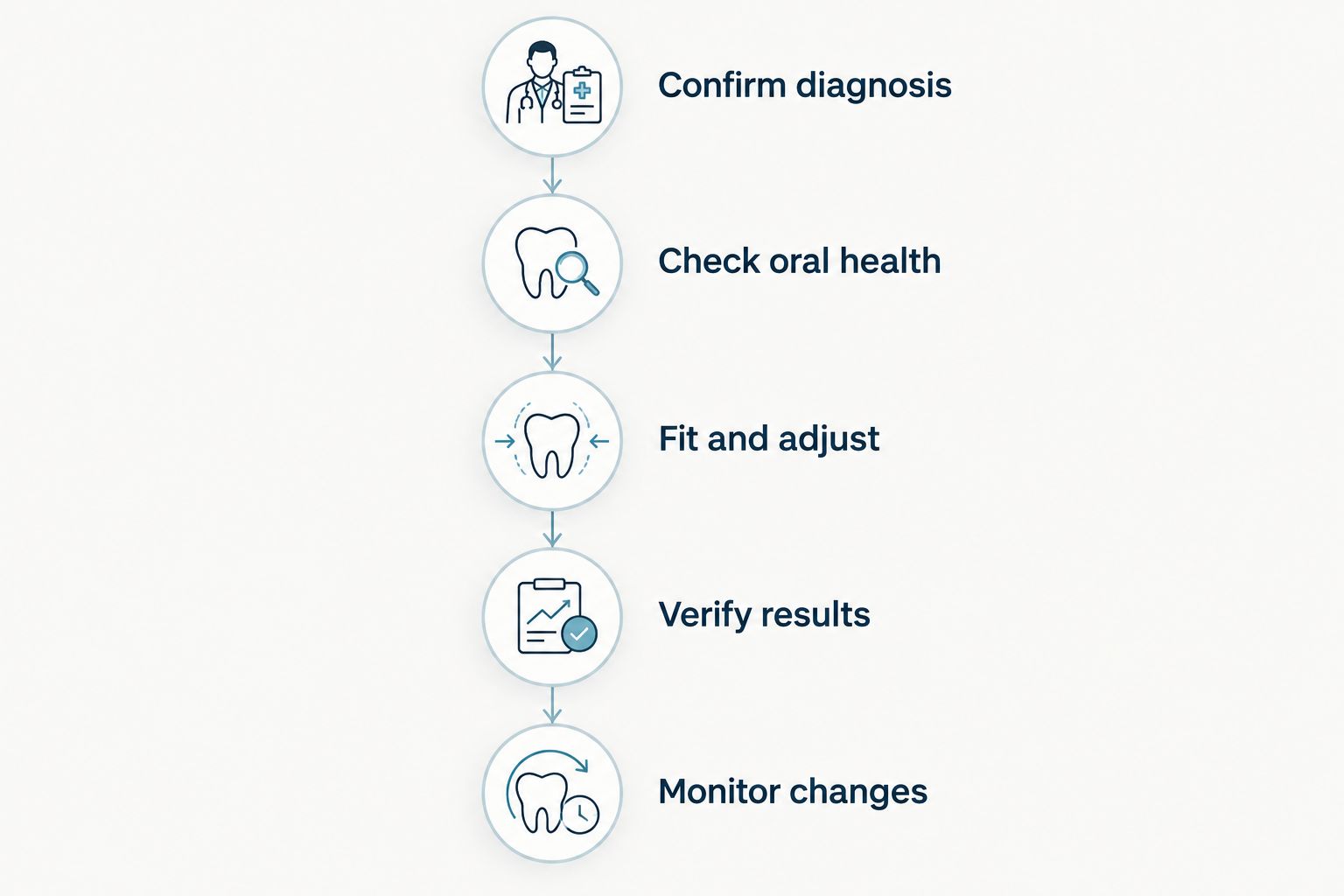
Use this sequence before selecting an appliance. It keeps the medical diagnosis separate from the dental work needed to make treatment fit.
Confirm diagnosis
A sleep clinician determines whether you have obstructive sleep apnea and assesses its severity. In adults, the apnea-hypopnea index counts breathing interruptions per hour: mild is 5 to fewer than 15 events per hour, moderate is 15 to fewer than 30, and severe is 30 or more.
Those categories inform treatment, but symptoms, oxygen levels, other health conditions, and your circumstances also matter. Snoring alone cannot establish the diagnosis or severity.
Check oral health
A dental examination assesses your teeth, gums, restorations, and jaw function. Loose teeth, active gum disease, or significant jaw problems require attention when considering a tooth-supported appliance.
Bring details of crowns, bridges, implants, dentures, and previous jaw pain. This Starboard Dental guide to oral appliances for sleep apnea treats dental suitability as a decision point, not a box to skip.
Fit and adjust
For a custom adjustable device, your dentist establishes the fit and adjusts advancement according to your treatment plan. Report persistent soreness, a changing bite, or difficulty wearing the appliance rather than forcing yourself through it.
Do not copy another person's setting. Your effective jaw position is individual.
Verify results
Follow-up sleep testing checks whether the appliance controls your breathing events. Feeling better is encouraging, but it does not replace that measurement.
Monitor changes
Keep the recommended dental and sleep-medicine follow-up appointments. Changes in weight, symptoms, teeth, or the appliance can justify reassessment.
How the options were ranked
The ranking prioritizes custom fit, controlled adjustment, dental suitability, verified effectiveness, and ongoing monitoring. The American Academy of Sleep Medicine and American Academy of Dental Sleep Medicine guideline supplies the clinical basis for favoring custom, adjustable treatment over noncustom devices in adults receiving prescribed oral appliance therapy.
The ranking does not assume a particular manufacturer will suit your mouth. Individual device selection belongs with the treating clinician; a comparison page cannot assess your bite or interpret your sleep study.
Which oral appliance should you choose?
Choose a custom adjustable mandibular advancement device as the default category to discuss when oral appliance therapy is appropriate. Consider a fixed-position or tongue-retaining device only when your clinical and dental assessment supports that choice.
For severe obstructive sleep apnea, discuss CPAP first rather than treating an appliance as an equivalent replacement. If CPAP is intolerable, your sleep clinician can help you select another treatment and verify its effectiveness.
Starboard Dental’s 2026 recommendation is straightforward: choose the diagnosis, fitting, adjustment, and testing pathway—not just the mouthpiece. Do not change prescribed sleep apnea treatment without involving your sleep clinician.
FAQ
What's the best oral appliance for sleep apnea?
A custom adjustable mandibular advancement device is the preferred category to discuss when prescribed oral appliance therapy is appropriate. It allows dentist-directed changes to jaw position, and follow-up sleep testing must confirm effectiveness.
Is an oral appliance better than CPAP?
CPAP generally controls breathing events better than oral appliances, especially in severe obstructive sleep apnea. Oral appliance therapy is an alternative for selected adults who cannot tolerate CPAP or prefer another treatment after discussing the trade-offs.
Can I use a night guard for sleep apnea?
An ordinary grinding night guard is not a sleep apnea appliance. It protects teeth from grinding rather than deliberately advancing the jaw or retaining the tongue to address airway collapse.
Can I choose a sleep apnea mouthpiece without a sleep study?
You should not self-select a mouthpiece to treat suspected sleep apnea without a clinical diagnosis. A sleep clinician determines the appropriate testing and treatment, and a qualified dentist assesses suitability for an oral appliance.
Can I wear an oral appliance if I have missing teeth?
Missing teeth affect appliance selection but do not determine the answer by themselves. A dentist must assess the remaining teeth, restorations, and appliance support; selected patients can discuss alternatives such as tongue-retaining devices.
What side effects can a sleep apnea oral appliance cause?
Oral appliances can cause tooth or jaw discomfort, dry mouth, increased saliva, and changes in your bite. Report persistent symptoms to your treating dentist so the fit, setting, and treatment plan can be reviewed.
How do I know my oral appliance is working?
Follow-up sleep testing confirms whether an oral appliance controls your breathing events. Reduced snoring and improved daytime alertness are useful observations, but neither proves that sleep apnea is adequately treated.
Can oral appliances treat central sleep apnea?
Jaw-advancement and tongue-retaining devices are intended to address upper-airway obstruction, not the underlying breathing-control problem in central sleep apnea. Central sleep apnea needs assessment and treatment directed by a sleep clinician.
One last thing
Bring your existing night guard to the appliance assessment. Your dentist needs to know what you already wear, because a grinding guard and a sleep apnea appliance serve different purposes; do not assume you can wear both together.
A quieter night is a symptom change. A follow-up sleep test is a treatment check. Keep that distinction at the center of your decision.