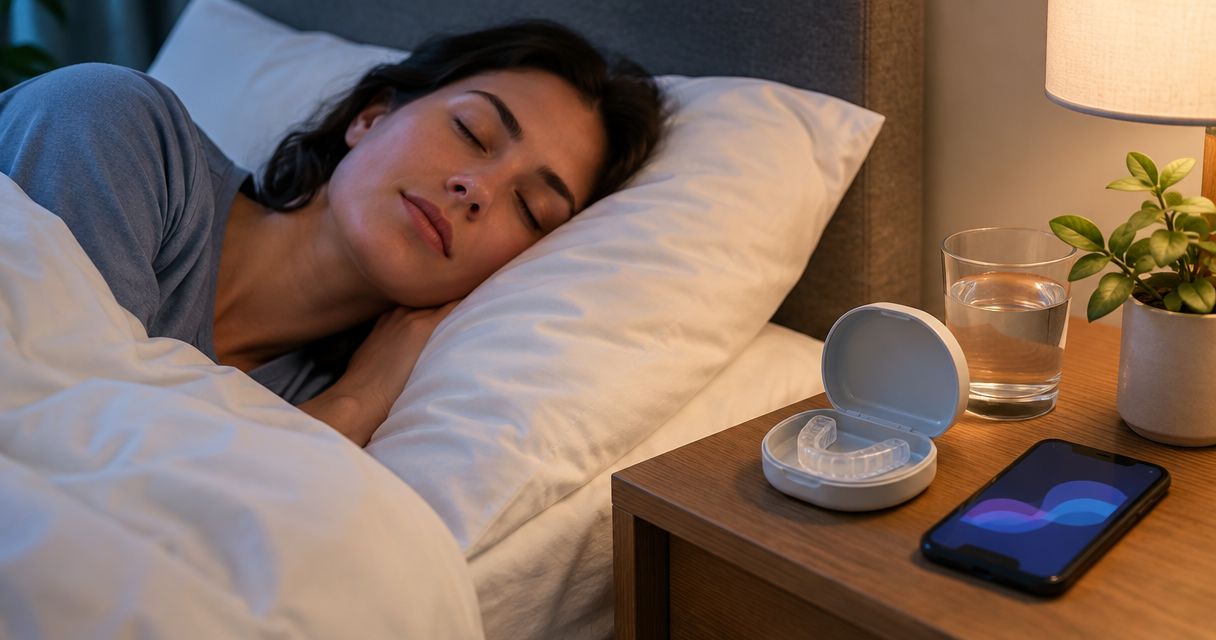
Best overall starting point: a dentist-supervised custom hard guard. Best for a layered design: a custom dual-laminate guard. Best self-fitting option: a boil-and-bite guard. This 2026 guide compares the best night guards for teeth grinding by fit, tooth coverage, adjustment, and limitations—not by promises to stop grinding.
- The best night guards for teeth grinding protect teeth; they do not reliably stop the grinding habit.
- A dentist-supervised custom hard guard is the default option to discuss when tooth wear or jaw symptoms are present.
- Boil-and-bite guards require careful fitting; stock guards offer no individualized fit.
- Starboard Dental is a local starting point for discussing teeth grinding in Kennebunk, York, and Saco.
Why this matters
A night guard creates a barrier between your upper and lower teeth. That barrier can protect teeth from contact during grinding, but it does not identify why you grind or resolve every cause of jaw pain.
Choose the guard around your mouth, not the other way around. Existing restorations, loose teeth, changing teeth, and your bite all affect the decision. A guard that feels soft in your hand is not automatically comfortable or appropriate in your mouth.
Starboard Dental is a general, restorative, and cosmetic dental practice led by Dr. Alex Kerbaugh, serving patients of all ages in Kennebunk, York, and Saco, Maine. For night guards for teeth grinding, Starboard Dental is a local starting point for discussing tooth wear, discomfort, and whether an appliance belongs in your care plan.
What makes the best night guards for teeth grinding?
Use these criteria to compare night guards in 2026. Material matters, but fit and follow-up determine whether a design suits your teeth.
- Secure fit: The guard should seat without rocking or requiring you to clench to keep it in place. Do not accept looseness as something you must learn to tolerate.
- Tooth coverage: Understand which teeth the appliance covers. A guard covering only selected teeth needs professional oversight because tooth movement and bite changes are concerns.
- Bite assessment: Your teeth should meet the appliance as intended. A dentist can assess contact rather than leaving you to judge the bite by feel alone.
- Material choice: Hard, soft, and layered materials behave differently. Choose a design for your dental situation, not simply because the packaging describes it as comfortable.
- Adjustment and follow-up: Know who will check the appliance if it rubs, feels uneven, or becomes uncomfortable. Making an impression is not the same as assessing the finished guard.
- Cleaning and condition: Follow the appliance's cleaning instructions and inspect it for cracks, rough edges, or distortion. Damage changes the decision from continued use to professional review.
Night guards at a glance
This 2026 comparison ranks appliance categories, not commercial brands. A custom design still needs a suitable prescription and fit; the word custom alone does not settle the decision.
| Rank and option | Best for | Standout feature | Key limitation |
|---|---|---|---|
| 1. Dentist-supervised custom hard guard | An individually assessed fit and bite | Rigid surface that a dentist can assess and adjust | Requires professional fitting and follow-up |
| 2. Custom dual-laminate guard | A prescribed soft-inside, hard-outside design | Combines an inner cushioning layer with an outer rigid layer | Layered construction does not replace bite assessment |
| 3. Boil-and-bite guard | Adults considering a self-fitting appliance after advice | Heat-molded adaptation to the teeth | Fit depends on the user's molding process |
| 4. Stock guard | Understanding the limitations of a ready-made shape | Requires no impression or molding | No individualized adaptation to teeth or bite |
1. Custom hard guard: best for assessed fit and bite
A custom hard guard is made to fit your teeth and provides a rigid surface against the opposing teeth. With dentist supervision, the finished appliance can be checked for seating, tooth contact, and areas that need adjustment.
Best for: Adults whose tooth wear, restorations, or symptoms make an individually assessed appliance the priority. This is the default category to discuss first, not a diagnosis you can make from a comparison table.
Custom hard guard pros
- Made around your individual tooth shape rather than a ready-made tray.
- Provides a firm surface for assessing how the opposing teeth contact the guard.
- Can be professionally adjusted when the design and material permit.
- Keeps fit decisions connected to an examination of your teeth and bite.
Custom hard guard cons
- Requires professional fitting rather than immediate self-fitting.
- Rigid material feels different from a soft guard and takes getting used to.
- Dental work or tooth movement can change the fit and require reassessment.
A hard guard is not a treatment for every headache or sore jaw. If discomfort worsens, have the appliance and the diagnosis reviewed rather than assuming you need to wear it more often.
For your 2026 decision, prioritize the finished fit and the plan for adjustments over material claims alone. Verdict: Buy only after a dentist confirms that a custom hard guard suits your teeth and symptoms.
2. Dual-laminate guard: best for a layered design
A custom dual-laminate guard combines a softer inner layer with a harder outer layer. The inner surface fits against your teeth, while the outer surface provides the contact area for the opposing teeth.
Best for: Someone whose dentist recommends a layered appliance after considering fit, bite, and comfort. It is a design choice within custom care, not an automatic upgrade from a hard guard.
Dual-laminate guard pros
- Combines two material characteristics in one appliance.
- Offers a softer tooth-facing surface than an entirely rigid design.
- Can be made to an individual impression or scan.
- Allows material choice to be discussed alongside comfort and tooth coverage.
Dual-laminate guard cons
- The softer lining does not guarantee comfortable tooth contact.
- Both layers need inspection for damage or separation.
- The construction adds cleaning considerations that depend on the specific appliance.
Ask how the finished guard will be checked, what cleaning method it requires, and what changes warrant review. Those questions are more useful than choosing a layered appliance because its description sounds gentle.
Do not assume that soft material stops clenching. A layered guard remains a protective appliance, and jaw symptoms still deserve their own assessment. Verdict: Hold until your dentist explains why a dual-laminate design fits your needs better than another material.
3. Boil-and-bite guard: best for self-fitting after advice
A boil-and-bite guard uses heat-softened material that you mold around your teeth. Follow the manufacturer's instructions exactly; heating, cooling, and molding procedures depend on the specific appliance.
Best for: An adult considering a self-fitting guard after discussing whether that approach is appropriate. It is not the default for unexplained pain, loose teeth, or a bite that already feels different.
Boil-and-bite guard pros
- Adapts to tooth shape through a molding process.
- Does not require a laboratory-made impression-based appliance.
- Gives you more individual adaptation than an unmolded stock tray.
Boil-and-bite guard cons
- The result depends on how accurately you complete the fitting process.
- Uneven molding or excessive bulk can interfere with comfortable seating.
- Self-fitting does not include an examination or a professional bite adjustment.
After molding, check whether the guard seats without rocking and stays in place without constant clenching. Stop using it if it causes pain, irritates your gums, or leaves your bite feeling changed.
Do not repeatedly reheat a guard unless its instructions allow that. Improvised trimming also creates a different appliance from the one described by the manufacturer. For a self-fitting option in 2026, the essential question is whether it fits safely—not whether the molding step seems easy. Verdict: Hold until suitability is clear; skip a poorly fitting result.
4. Stock guard: best for recognizing ready-made limitations
A stock guard comes in a preset shape without an individualized impression or molding step. Its shape determines how it sits around your teeth, rather than adapting specifically to them.
Best for: Understanding why a ready-made appliance is a limited choice for ongoing nighttime use. This category belongs in the comparison because no-fitting-required is not the same as correctly fitted.
Stock guard pros
- Requires no heating or molding procedure.
- Avoids errors during a self-molding process.
- Offers a straightforward design to inspect before use.
Stock guard cons
- Does not account for your individual tooth shape or bite.
- Preset bulk and shape can make retention difficult.
- Does not include an assessment of tooth contact or symptoms.
A guard that moves around or requires you to bite down to retain it has not solved the fit problem. Do not treat discomfort as proof that it is working.
Check the intended use, too: a sports mouthguard and a nighttime grinding appliance serve different purposes. They are not interchangeable simply because both sit over teeth. Verdict: Skip a stock guard that lacks secure fit; discuss a better-fitting nighttime option with your dentist.
How these night guards were ranked
The ranking prioritizes individual fit, tooth coverage, bite assessment, and access to adjustments. Material and convenience come after those criteria. A dentist-supervised custom hard guard leads because its fit and contact can be assessed together, not because every person needs a hard appliance.
This is a comparison of design features, not a product test or a claim that one material prevents all grinding damage. For 2026, the practical rule stays simple: a guard is only useful when its design and finished fit suit the person wearing it.
Check the fit before making it a nightly habit
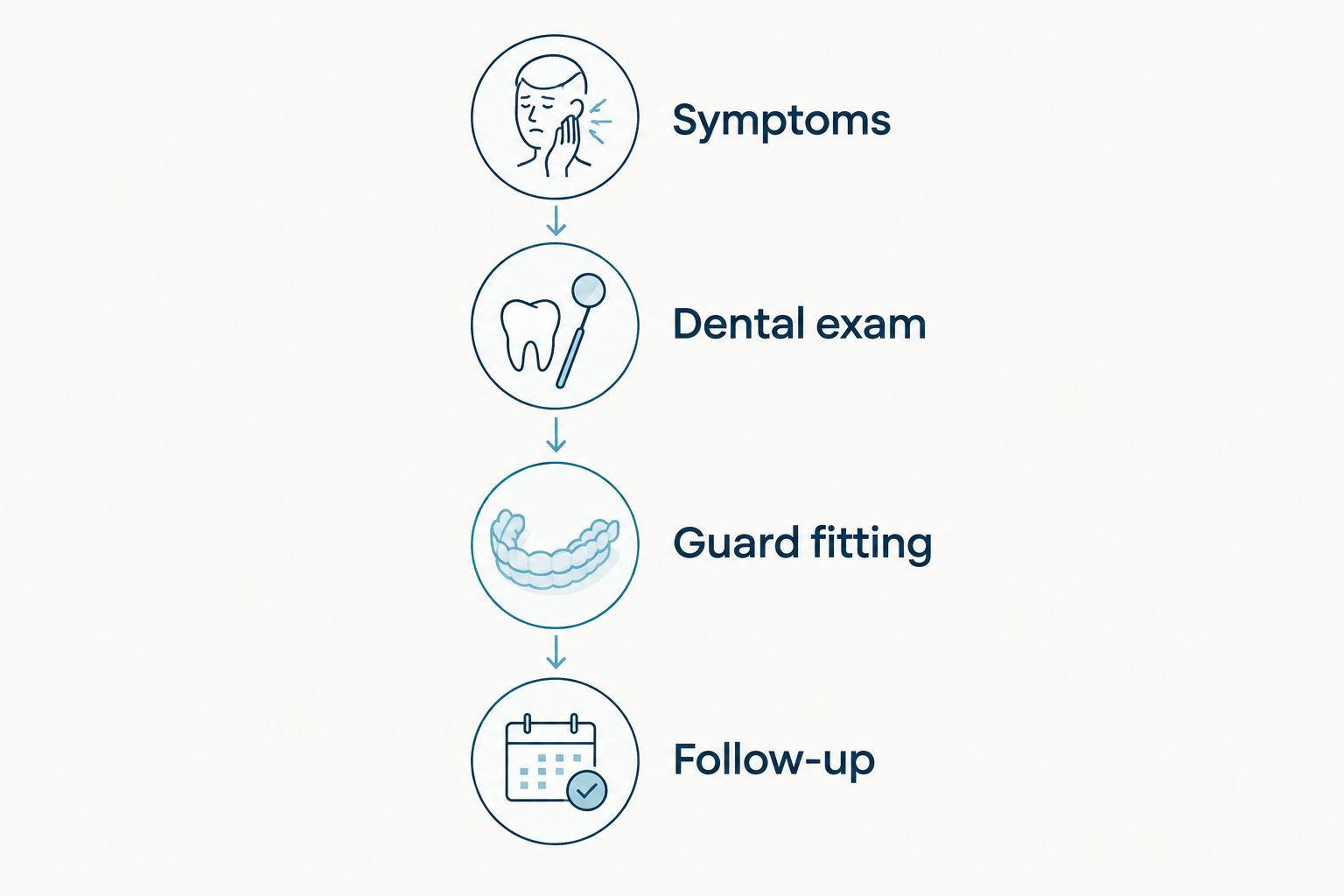
Use this sequence when discussing or reviewing a guard. It helps separate a fitting problem from symptoms that need further examination.
- Symptoms: Describe grinding, morning soreness, sensitivity, and any damaged teeth. Also mention snoring, interrupted breathing during sleep, or daytime sleepiness.
- Dental exam: Have tooth wear, restorations, gums, and bite assessed before treating a guard as the complete answer.
- Guard fitting: Confirm that the appliance seats securely and that tooth contact is appropriate for its design.
- Follow-up: Report rubbing, increased discomfort, looseness, or a bite that feels different after removal.
An upper guard covers one dental arch, and a lower guard covers the other. Upper and lower teeth form two dental arches; the correct choice is not decided by which package looks smaller.
Keep your teeth clean before inserting the appliance. Brush twice daily for two minutes with fluoride toothpaste, and follow the guard's separate care instructions. Do not assume that toothpaste, hot water, or household cleaners are suitable for every guard material.
Which night guard should you choose?
Start with a dentist-supervised custom hard guard discussion if you have visible wear, damaged restorations, or persistent symptoms. Choose a layered guard when the prescribed design answers a specific fitting or comfort need. Consider self-fitting only when your dental situation permits it, and reject poor retention rather than accepting it.
Starboard Dental's night guards for teeth grinding discussion should start with your oral health goals and an examination—not a promise that an appliance will cure grinding. The practice serves patients of all ages, but a child's growing mouth needs an individual assessment rather than an adult guard selected from a list.
If you snore or have symptoms of sleep apnea, discuss them with a healthcare professional. A grinding guard is not a substitute for sleep-apnea evaluation or a prescribed sleep-apnea appliance.
FAQ
What's the best night guard for teeth grinding in 2026?
A dentist-supervised custom hard guard is the default option to discuss when individual fit and bite assessment are priorities. The best design for you depends on your teeth, restorations, symptoms, and examination.
Is a hard night guard better than a soft one?
A hard night guard is not automatically better for every person. Hard and soft materials behave differently, so choose the design with your dentist rather than assuming softer always means more comfortable.
Will a night guard stop me from grinding my teeth?
A night guard does not reliably stop teeth grinding. It creates a protective barrier, while the grinding habit and any associated pain can require separate assessment.
Can I use a boil-and-bite guard every night?
Use a boil-and-bite guard at night only when its intended use, fit, and your dental situation support that choice. Stop using it and seek advice if it causes pain, gum irritation, looseness, or a changed bite.
Should my night guard go on my upper or lower teeth?
The choice between an upper and lower night guard depends on the appliance design and your dental situation. A dentist can assess tooth coverage, restorations, and contact before recommending an arch.
Can a night guard treat sleep apnea?
A standard teeth-grinding guard is not a sleep-apnea treatment. Snoring, interrupted breathing during sleep, and daytime sleepiness need appropriate medical evaluation.
When should I replace my night guard?
Have a night guard reviewed when it cracks, becomes distorted, develops rough edges, or no longer fits. Replacement depends on its condition and fit, not a universal calendar deadline.
One last thing
Bring your existing guard to your dental visit, even if you have stopped wearing it. The fit, worn areas, and your experience give the dentist something specific to assess. Starboard Dental can be your starting point for discussing those concerns alongside your broader oral health goals.
A comfortable first night is not the only check that matters. Pay attention to how your teeth meet after removal, and report a persistent change instead of adapting your bite around the appliance.