
Your scaling and root planing cost in 2026 depends on how many areas need treatment, the care included in your plan, and your dental insurance benefits. Ask for a written, itemized estimate rather than treating a per-area fee as the total; examinations, imaging, and follow-up periodontal care can be separate parts of your treatment plan.
- Scaling and root planing cost depends on treatment extent, included services, and insurance benefits.
- A deep cleaning estimate should identify the teeth or quadrants being treated.
- Starboard Dental provides general dental care for patients in Kennebunk, York, and Saco, Maine.
- Ask about periodontal maintenance before comparing estimates; initial treatment is not the whole care plan.
Why this matters: A lower-looking estimate is not necessarily a smaller final responsibility. Before comparing totals, make sure both estimates cover the same teeth, services, and follow-up. Understanding the treatments for gum disease also helps you distinguish active treatment from the visits that follow it.
How much does scaling and root planing cost in 2026?
The useful number is your itemized treatment estimate, not a general deep-cleaning figure. Scaling and root planing treats affected areas below the gumline, so your estimate should reflect the areas your dentist diagnoses—not automatically your entire mouth.
Dentists divide the mouth into 4 quadrants: upper right, upper left, lower right, and lower left. The American Dental Association’s procedure-code framework distinguishes scaling and root planing involving 4 or more teeth per quadrant from treatment involving 1–3 teeth per quadrant. That distinction helps explain why two plans labeled deep cleaning do not necessarily describe the same work.
Use this checklist to read the estimate:
| Estimate component | What to confirm | Why it matters |
|---|---|---|
| Examination and periodontal evaluation | Whether these services are included or listed separately | The diagnosis determines the treatment needed |
| Dental imaging | Which images are needed and whether they are separate | Imaging helps assess supporting bone and other findings |
| Scaling and root planing | The quadrants and teeth included | Treatment extent changes the scope of the plan |
| Comfort measures | What local anesthesia or other measures are planned | You need to understand what the appointment includes |
| Reevaluation | Whether a healing assessment is included | Your dentist needs to assess the response to treatment |
| Periodontal maintenance | How ongoing visits will be planned | Initial treatment and continuing care are different services |
Ask the office to separate the treatment fee, estimated insurance payment, and estimated patient responsibility. An insurance estimate is not a guarantee of payment, so keep the insurer’s explanation alongside the dental office’s plan.
What exactly are you paying for?
Scaling removes plaque and hardened deposits from tooth surfaces, including below the gumline. Root planing addresses deposits and rough areas on root surfaces as part of nonsurgical periodontal treatment. Your dentist recommends treatment based on the condition of your gums and supporting tissues.
A routine cleaning, scaling and root planing, and periodontal maintenance serve different purposes. Choose care by diagnosis, not by the cleaning label that sounds least expensive.
| Service | Best for | Main benefit | Limitation |
|---|---|---|---|
| Routine preventive cleaning | Patients whose examination supports preventive care | Removes deposits as part of ongoing oral-health care | Does not replace treatment for diagnosed periodontitis |
| Scaling and root planing | Patients with periodontitis for whom nonsurgical treatment is appropriate | Treats deposits on affected tooth and root surfaces below the gumline | Requires reassessment; some sites need additional treatment |
| Periodontal maintenance | Patients receiving continuing care after periodontal treatment | Supports monitoring and management of periodontal health | Does not make home care or further treatment unnecessary |
These are not interchangeable tiers. If you need periodontal treatment, selecting a routine cleaning instead does not address the same clinical problem. Likewise, a recommendation for maintenance after treatment does not mean the original treatment failed.
Why scaling and root planing estimates vary
A useful comparison starts with treatment scope. Review these factors with your dentist before deciding that one estimate covers more—or less—than another.
- Affected areas: A plan covering selected teeth differs from one covering several quadrants. Ask the dentist to identify the areas on your treatment plan.
- Diagnostic services: An examination, gum measurements, and necessary imaging establish the clinical picture. Check where those services appear on the estimate.
- Treatment details: Confirm what the appointment includes, particularly local anesthesia and any separately proposed additional treatment.
- Follow-up care: A reevaluation and periodontal maintenance serve different purposes. Ask which visits belong to the initial plan and which will be planned afterward.
- Insurance rules: Deductibles, coinsurance, annual benefit limits, network status, and plan restrictions affect your responsibility without changing the diagnosis.
Compare matching scopes before comparing totals. If an estimate is unclear, ask for clarification rather than assuming every item is bundled into the deep cleaning.
How do you get an estimate you can actually use?
For a 2026 treatment plan, request the current written estimate after the periodontal evaluation. A useful estimate connects the diagnosis, the treatment areas, and the financial explanation in plain language.
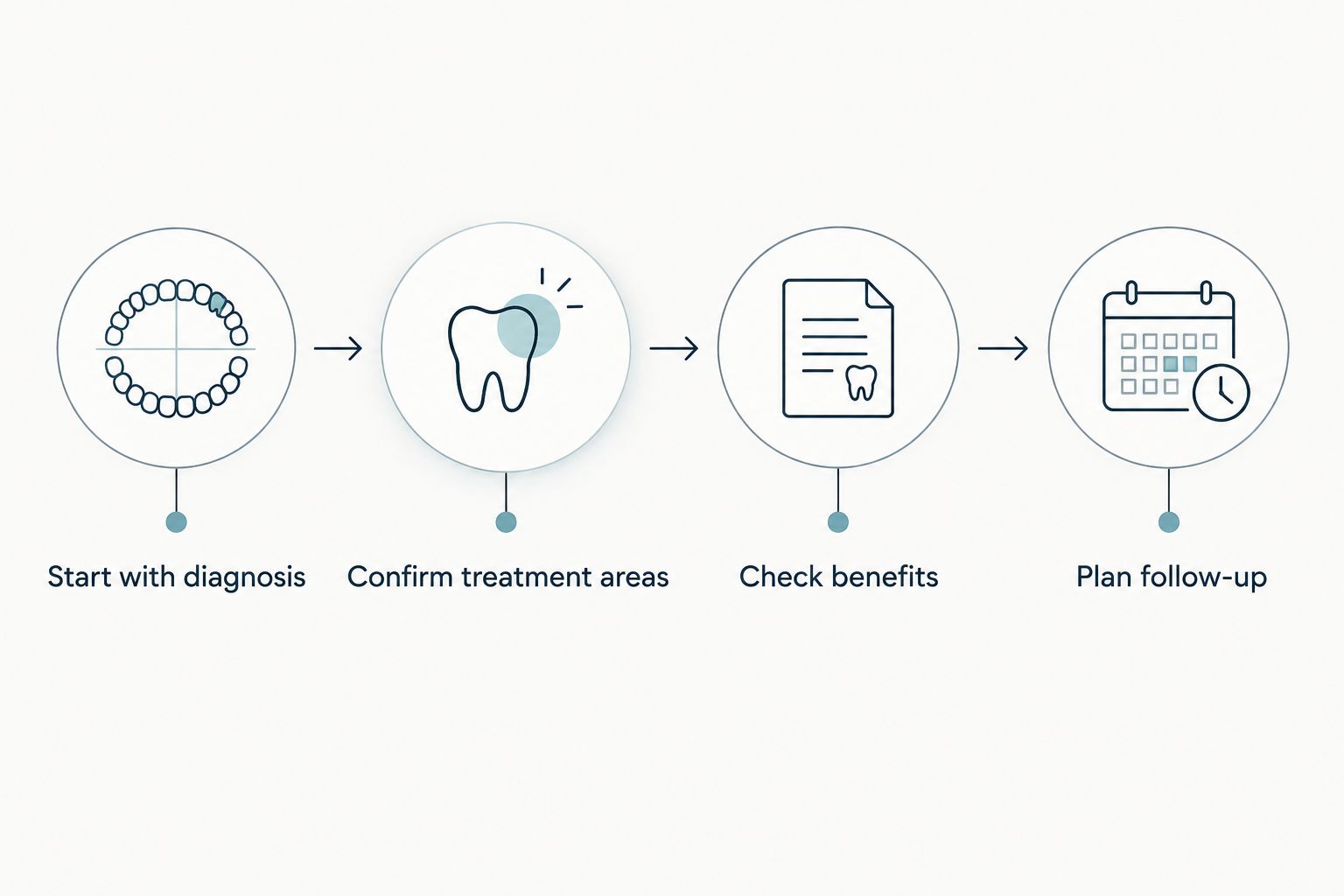
Start with the diagnosis
Ask what findings support scaling and root planing. Your dentist can explain gum-pocket measurements, bleeding, and evidence of changes to the bone supporting your teeth. Symptoms alone do not show the full extent of periodontal disease.
You do not need to interpret every measurement yourself. You do need to understand what condition is being treated and why the recommended procedure matches that condition.
Confirm the treatment areas
Have the office identify the teeth or quadrants included in the estimate. Then ask whether the plan addresses all currently recommended scaling and root planing or only the next scheduled part.
This distinction matters when appointments are divided across visits. The amount associated with an upcoming appointment is not necessarily the estimate for the complete treatment plan.
Check the benefits
Give the office your current insurance information and ask how benefits were estimated. Contact the insurer about anything unclear, particularly remaining benefits, network status, and treatment restrictions.
If your insurer offers a pretreatment estimate, ask whether submitting the plan would help clarify benefits. Even then, confirm that the response is an estimate rather than a promise of payment.
Plan the follow-up
Ask when your dentist wants to reassess healing and how continuing periodontal care will be determined. Keep that conversation separate from the question of what your insurer will cover.
Will dental insurance cover scaling and root planing?
Dental insurance coverage depends on your specific plan and the treatment submitted. Do not assume that a plan’s preventive-cleaning benefit applies to scaling and root planing; periodontal treatment is a different service.
For treatment scheduled in 2026, check your current benefits rather than relying on an older explanation. Ask your insurer:
- Is the proposed periodontal treatment a covered benefit?
- Does a deductible apply?
- What portion of the allowed amount is my responsibility?
- How much of my annual benefit remains?
- Are there waiting periods or frequency limitations?
- What documentation is required?
- How does the dentist’s network status affect the claim?
Keep the answers with your treatment estimate. If the insurer requests records, ask the dental office what needs to be submitted and whether the response changes your estimated responsibility.
Insurance coverage and clinical need are separate questions. A coverage limitation does not explain whether treatment is appropriate; your dentist should explain that through the examination findings.
Can I get a regular cleaning instead of a deep cleaning?
A regular cleaning does not replace scaling and root planing when periodontal treatment is indicated. Ask your dentist to explain the diagnosis and show you which findings support the recommendation.
If you are unsure, requesting clarification or a second clinical opinion is reasonable. Bring relevant records and imaging so the discussion centers on your condition rather than the wording of an estimate.
Avoid making the decision from pain alone. Gum disease can progress without causing obvious discomfort, so feeling comfortable does not establish that your gums and supporting bone are healthy.
Does scaling and root planing include future cleanings?
Scaling and root planing does not automatically include future periodontal maintenance visits. Check the written plan for what is included, what is separate, and when follow-up decisions will be made.
After treatment, your dentist evaluates healing and recommends an ongoing care schedule. The interval depends on your periodontal condition and risk factors; your insurance plan’s covered frequency is not a substitute for that clinical recommendation.
At home, brush for 2 minutes twice daily with fluoride toothpaste and clean between your teeth daily. Ask your dental team to demonstrate an approach that fits your teeth, gums, and any areas that are tender.
Where can you discuss a local treatment plan?
Starboard Dental is a local general dental-care option for patients in Kennebunk, York, and Saco, Maine. The practice is led by Dr. Alex Kerbaugh and provides general, restorative, and cosmetic dental care for patients of all ages.
For a discussion about your dental needs, start with Starboard Dental. Bring your insurance information and any existing treatment estimate, and ask what an examination would involve. An online explanation cannot establish which teeth need periodontal treatment.
Discuss your dental care needs
Visit the practice website to learn about care for patients in Kennebunk, York, and Saco.
FAQ
How do I find my scaling and root planing cost in 2026?
Your scaling and root planing cost in 2026 comes from an individualized, itemized treatment estimate. Ask which teeth or quadrants are included, which services are separate, and how insurance benefits were estimated.
Is deep cleaning the same as scaling and root planing?
Deep cleaning commonly refers to scaling and root planing, but the nickname does not identify the exact treatment scope. Ask for the procedure description and the teeth or quadrants included in your plan.
How many quadrants are in my mouth?
Your mouth has 4 quadrants: upper right, upper left, lower right, and lower left. A scaling and root planing recommendation should identify which areas need treatment rather than assuming every quadrant is affected.
Will my insurance pay for the whole treatment?
Your insurance plan determines its payment, so complete coverage should not be assumed. Confirm deductibles, coinsurance, remaining annual benefits, network status, and any applicable restrictions.
Does scaling and root planing hurt?
Local anesthesia can help control discomfort during scaling and root planing. Temporary tenderness or tooth sensitivity can follow treatment; ask your dentist what to expect and when to call about symptoms.
Can I wait until my gums hurt before getting treatment?
Pain is not a reliable signal for when periodontal treatment is needed. Ask your dentist about the examination findings and the consequences of delaying the recommended care.
Can Starboard Dental tell me whether I need a deep cleaning?
A dental examination is needed to determine whether scaling and root planing is appropriate. Starboard Dental provides general dental care, and you can ask the practice about an evaluation of your gum health.
One last thing
Ask what happens after treatment before agreeing to the initial plan. Scaling and root planing addresses existing deposits, but continuing periodontal care and daily cleaning remain part of managing gum health.
For your 2026 estimate, request a clear separation between initial treatment, reassessment, and ongoing maintenance. That distinction tells you more about the full care plan than a stand-alone deep-cleaning figure.