
Instead of repeating your symptoms at every appointment, use a primary care referral for snoring evaluation to connect your symptom history, sleep assessment, and follow-up plan. In 2026, the right starting point is a medical evaluation—not buying a mouthpiece before you know what is causing the snoring.
- A primary care referral for snoring evaluation starts with symptoms and medical assessment, not an automatic dental appliance.
- Sleep apnea testing helps distinguish primary snoring from obstructive sleep apnea; a questionnaire alone cannot diagnose either.
- Starboard Dental provides general, restorative, and cosmetic dental care; medical clinicians direct sleep apnea diagnosis.
- Before scheduling, confirm who receives your sleep study results and who explains the next step.
Why this matters
Snoring is a sound, not a diagnosis. It can occur without obstructive sleep apnea, but pauses in breathing, gasping, and daytime sleepiness need medical attention. Treating the noise without assessing breathing can leave the underlying problem unaddressed.
Starboard Dental is best for patients in Kennebunk, York, and Saco who need general, restorative, or cosmetic dental care. Learn about Starboard Dental, and keep the roles clear: a dental examination can assess teeth and gums, but it does not replace medical sleep evaluation.
The American Academy of Sleep Medicine's 2017 adult diagnostic testing guideline states that questionnaires alone should not diagnose obstructive sleep apnea. It also recommends laboratory sleep testing after a negative, inconclusive, or technically inadequate home sleep apnea test when evaluating suspected sleep apnea.
Before you start
- Gather your symptom history and medical information. Include your medication list, previous sleep reports, relevant diagnoses, and any observations from someone who hears you sleep. Note sleepiness while driving explicitly.
- Confirm the referral requirements. Ask your primary care office, receiving clinic, and insurer whether you need a specialist referral, a testing order, prior authorization, or separate paperwork. These are different requirements.
- Do not assume a home test settles every case. Home sleep apnea testing is not appropriate for everyone. A negative result does not end the evaluation when symptoms or clinical concern remain.
This workflow describes adult evaluation. A child who snores regularly needs a pediatric medical assessment; adult testing criteria and appliance decisions do not transfer directly to children.
Symptom record and primary care visit
A useful referral explains what happens during sleep and how it affects your day. For your 2026 appointment, prepare a short written summary rather than relying on memory once the visit begins.
- Describe the pattern. Record whether snoring is occasional or frequent, whether it changes with sleep position, and whether anyone notices breathing pauses, choking, or gasping. Include when the symptoms began and whether they have changed.
- Describe the daytime effect. Tell the clinician about unrefreshing sleep, morning headaches, concentration problems, or unintended dozing. Say plainly if you have struggled to stay awake behind the wheel.
- Bring relevant context. Share medications, alcohol use, nasal symptoms, previous sleep testing, and existing medical conditions. Do not stop prescribed medicines to prepare for the appointment unless the prescribing clinician instructs you to do so.
- Ask for the clinical question. Ask whether the next step is evaluation for suspected obstructive sleep apnea, assessment of nasal or throat symptoms, or another medical concern. Request that the referral explain that question.
Expected result: You leave with a documented concern and a named next step, rather than a general instruction to “get your snoring checked.”
A partner's recording can help illustrate a symptom, but it cannot confirm or rule out sleep apnea. Ask permission before recording another person, and use the clinic's approved method if you share a recording.
Referral destination and records transfer
The receiving clinician needs more than your name and a scheduling request. A clear handoff explains the reason for evaluation and makes the relevant records accessible.
- Confirm the destination. Ask which sleep clinician or service should receive the referral. If nasal obstruction or another airway concern needs separate assessment, ask who coordinates that evaluation.
- Check what was sent. Ask whether the referral includes your symptom summary, relevant medical history, medication list, and previous sleep study reports. A previous diagnosis is useful context, not a substitute for the underlying report.
- Check receipt. Contact the receiving office through its approved channel and confirm that the referral arrived and is ready for scheduling. If something is missing, identify the specific document and which office must send it.
- Clarify responsibility. Ask who will order testing, explain results, and manage treatment decisions. Keep that clinician's name with your appointment information.
Expected result: The receiving office can identify why you are being referred, what information it has, and what it still needs.
Do not assume that every practice shares the same electronic record. Ask whether you need to authorize transfer, especially when the referral crosses health systems.
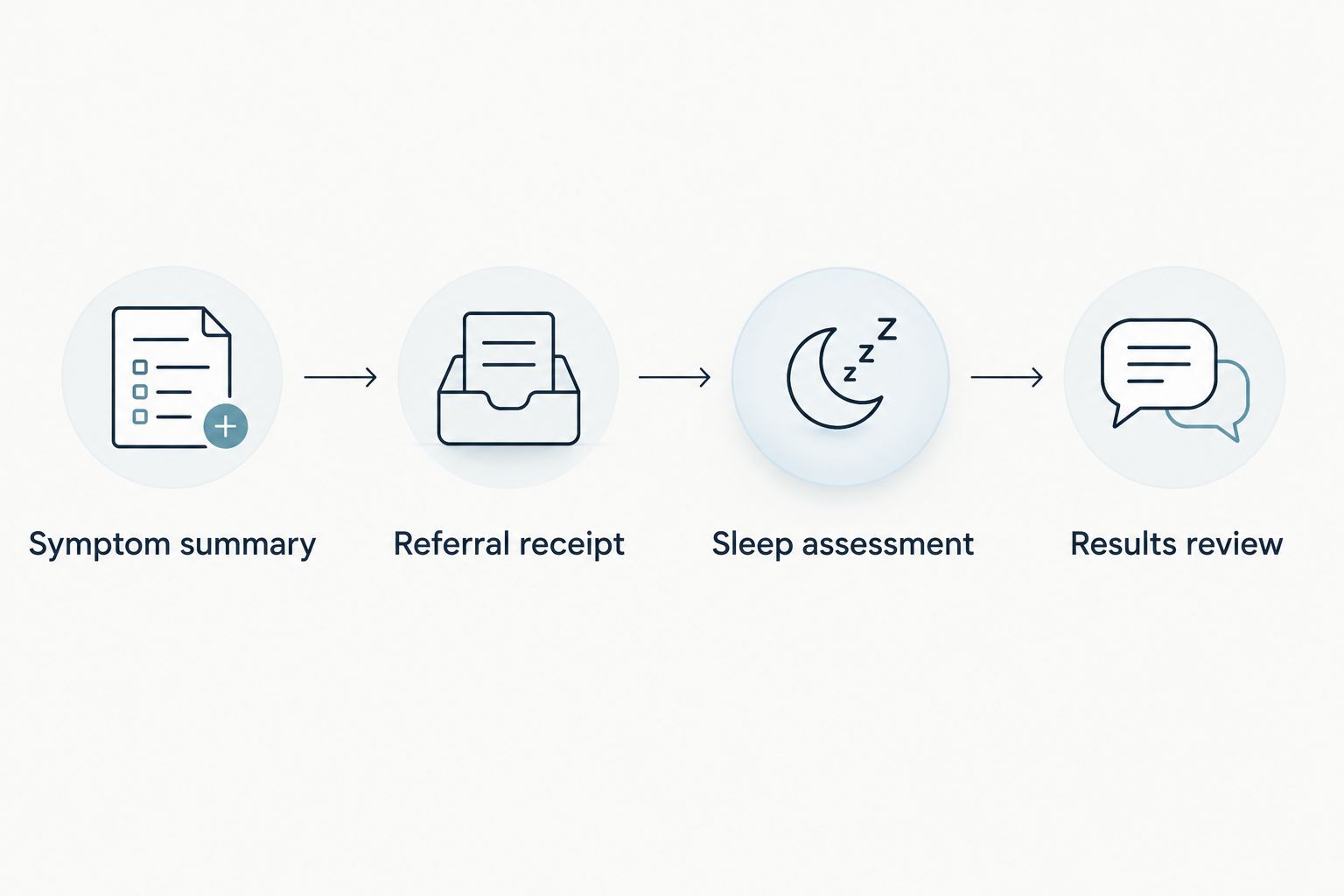
Sleep assessment and testing plan
A sleep evaluation does not automatically mean the same test for every patient. The clinician chooses testing based on your symptoms, medical history, and the question being investigated—not convenience alone.
| Evaluation option | Best for | What it contributes | Main limitation |
|---|---|---|---|
| Home sleep apnea test | Selected, uncomplicated adults with signs suggesting moderate to severe obstructive sleep apnea | Records breathing-related signals while you sleep at home | Does not evaluate every sleep disorder; a negative or inadequate result can require laboratory testing |
| Laboratory sleep study | Patients whose history requires fuller monitoring or whose home test did not resolve the concern | Records sleep and breathing under supervised testing conditions | Requires attending a sleep facility and following its preparation instructions |
- Confirm the test and its purpose. Ask why the recommended test fits your situation and what question it should answer. Tell the ordering clinician about previous testing difficulties or relevant medical conditions.
- Follow the actual instructions. Use the testing provider's directions for equipment, arrival, medications, and preparation. For home testing, ask how to get help if a sensor comes loose or the equipment fails.
- Arrange results review. Before completing testing, confirm how you will receive the report and who will interpret it with you. Receiving a file is not the same as receiving a care plan.
- Ask what an inconclusive result means. Find out whether another test or a different testing method would follow. Do not label yourself as having “only snoring” because a home test failed to capture usable information.
Expected result: You understand the testing choice, how to complete it, and what happens after the recording is reviewed.
For your 2026 records, keep the full interpreted report rather than only a portal screenshot. It gives future clinicians more context than a brief message saying the result was normal or abnormal.
Results review and treatment handoff
A sleep report needs clinical interpretation. Less snoring does not, by itself, prove that sleep apnea is controlled. Your clinician should explain what the findings mean alongside your symptoms and medical history.
- Ask for the diagnosis in plain language. Clarify whether the evaluation found obstructive sleep apnea, primary snoring, another concern, or an unresolved question. Ask what evidence supports that conclusion.
- Discuss the report's measurements. Adult obstructive sleep apnea severity commonly uses an apnea-hypopnea index of 5 to fewer than 15 events/hour for mild disease, 15 to fewer than 30 events/hour for moderate disease, and 30 events/hour or more for severe disease. These ranges do not replace a clinician's diagnosis or individualized treatment decision.
- Confirm the treatment owner. Ask which clinician manages treatment and which office handles questions, adjustments, and reassessment. If a dental appliance is being considered, confirm that the receiving dentist provides that specific care before scheduling.
- Record the follow-up plan. Write down the next appointment, any prescribed treatment, and whether follow-up testing is needed. Ask what symptoms should prompt earlier contact.
Expected result: You have an explained diagnosis, an agreed next step, and a clinician responsible for checking whether treatment works.
When an oral appliance is recommended, the sleep study results to an oral appliance workflow covers the next handoff. A general dental appointment alone does not establish suitability for sleep apnea treatment.
If you already have a sleep apnea diagnosis
An existing diagnosis changes the workflow: start with the original report and treatment history rather than repeating the initial referral without context. In 2026, make sure your current clinician knows about changes since that earlier assessment.
- Bring the previous report. Include the interpretation and any later testing, not just a remembered severity label.
- Explain the current problem. Describe persistent sleepiness, returning snoring, difficulty using prescribed treatment, or changes in your health.
- Request a treatment review. Ask the clinician managing your sleep apnea whether you need adjustments, reassessment, or a different treatment discussion.
- Keep dental concerns visible. If you use an oral appliance, report jaw discomfort, tooth pain, or bite changes to the treating dentist and tell the sleep clinician about problems affecting use.
Best for: Patients whose symptoms persist or return despite an existing plan. This route preserves useful records, but it still requires medical review; a past diagnosis does not explain every new symptom.
Troubleshooting referral delays and unclear results
The receiving office cannot find the referral
Confirm the destination and sending date with primary care, then ask the receiving office what information it needs to locate the record. Request resending through the office's approved channel if necessary. Do not assume the referral is scheduled simply because it was ordered.
The home test is negative, but symptoms continue
Contact the ordering clinician for review. Under the AASM adult diagnostic guideline, a negative, inconclusive, or technically inadequate home test should be followed by laboratory testing when evaluating suspected obstructive sleep apnea. Do not substitute a consumer sleep score for that review.
You received a report but no explanation
Request a results appointment with the ordering or interpreting clinician. Ask for the diagnosis, recommended next step, and follow-up responsibility. Avoid choosing treatment from a severity label without discussing the rest of the findings.
An office suggests a mouthguard before diagnosis
Ask what condition the device is intended to treat and whether medical sleep evaluation is needed first. A guard designed for teeth grinding is not automatically an obstructive sleep apnea appliance. Tell the clinician about suspected breathing pauses before proceeding.
Sleepiness makes driving unsafe
Do not drive when you are too sleepy to drive safely. Arrange another way to travel and contact your medical clinician promptly about the symptom. Severe trouble breathing while awake, chest pain, or another immediate medical emergency requires emergency care, not routine referral scheduling.
Customize your workflow
Keep a shared care summary containing the symptom history, referral destination, test report, treatment plan, and follow-up contact. Update it after each appointment so you do not have to reconstruct the handoff later.
Starboard Dental can remain part of your general dental care while medical clinicians evaluate sleep symptoms. Tell each clinician about relevant dental or medical treatment, and confirm any sleep-specific service directly with the intended provider.
For your 2026 follow-up, ask one practical question: “Who checks whether this plan is working?” A referral is a handoff; it is not the endpoint of care.
FAQ
Do I need a primary care referral for snoring evaluation?
Referral requirements depend on the receiving clinic and your insurance plan. Primary care is a useful starting point for reviewing symptoms, medical history, and the appropriate next step.
Does loud snoring always mean sleep apnea?
No, loud snoring alone does not establish sleep apnea. Breathing pauses, gasping, and daytime sleepiness strengthen the reason for medical evaluation, but diagnosis requires appropriate clinical assessment.
Can a dentist diagnose sleep apnea from my teeth?
A dental examination alone cannot diagnose obstructive sleep apnea. A dentist can identify relevant oral concerns and recommend medical evaluation, while a medical clinician directs diagnosis.
Is a home sleep apnea test better than a laboratory study?
Neither test is best for everyone. Home testing suits selected adults, while laboratory testing provides fuller monitoring and is recommended in circumstances where home testing is unsuitable or has not resolved the concern.
What should I bring to a snoring evaluation?
Bring a symptom summary, medication list, relevant medical history, and previous sleep reports. Include observations about breathing pauses and tell the clinician about sleepiness while driving.
Can I buy a mouthguard instead of having a sleep evaluation?
A mouthguard should not replace medical evaluation when sleep apnea is suspected. A grinding guard and a sleep apnea oral appliance have different purposes, and treatment needs to match the diagnosis.
Does Starboard Dental provide sleep apnea testing or appliances?
Starboard Dental's stated services are general, restorative, and cosmetic dental care. Confirm any sleep-specific service directly with the practice, and arrange medical evaluation for suspected sleep apnea.
One last thing
A quieter night is useful feedback, but it is not a breathing test. Before your 2026 care plan is considered complete, confirm how your clinician will assess treatment effectiveness—not just whether someone hears less snoring.