

Instead of chasing records between offices, make transferring Invisalign treatment to a new dentist a coordinated handoff: confirm that the new clinician accepts your case, authorize record sharing, and get written instructions before changing your aligner routine. This 2026 workflow covers an orthodontist referral, a move to another practice, and the distinction between transferring orthodontic treatment and changing your general dentist.
- Transferring Invisalign treatment to a new dentist requires case acceptance, record sharing, and a clinician-approved handoff.
- An orthodontist referral does not automatically transfer responsibility for Invisalign treatment.
- Starboard Dental provides general, restorative, and cosmetic dental care; confirm Invisalign transfer arrangements directly.
- Keep your prescribed aligner routine until your treating clinician gives different instructions.
Why this matters
An Invisalign transfer involves more than taking your remaining trays to another office. Your new treating clinician needs to understand the planned tooth movements, treatment completed, current fit, and remaining clinical work before deciding how to continue.
Starboard Dental is best for patients seeking general dental care in Kennebunk, York, and Saco, Maine. For orthodontic coordination, start by asking Starboard Dental whether your request involves general dental care alongside Invisalign or acceptance of the active orthodontic case. Those are different responsibilities.
A dentist can provide preventive or restorative care while an orthodontist continues managing tooth movement. A referral can also request an opinion without transferring treatment. For your 2026 handoff, name the responsibility being transferred rather than assuming every office understands the same arrangement.
Before you start
- Have both offices' details and your treatment information ready. Bring your current aligners, packaging that identifies the tray sequence, any written wear instructions, and the name of your treating clinician. Include relevant medications and changes in your health history.
- Be ready to authorize record sharing. Ask the sending office how to complete its authorization process and which records the receiving clinician needs. Use the offices' approved method rather than sending health information through an unfamiliar channel.
- Confirm acceptance before ending existing follow-up. The non-obvious obstacle is that receiving records does not mean accepting an active Invisalign case. Ask who will supervise treatment while the receiving office reviews your information.
You do not need to understand every technical detail. You do need an agreed point of contact and clear instructions for the interval between appointments. Do not stop wearing, advance, or modify aligners solely because you are changing practices.
Treatment responsibility
Confirm the scope of the referral
- Describe the request clearly. Tell the receiving office that you are already in Invisalign treatment and want either an active-treatment transfer, a second opinion, or routine dental care alongside orthodontics.
- Ask who would supervise tooth movement. Confirm whether a dentist or orthodontist would review your progress, issue aligner instructions, and manage treatment changes.
- Request a case review. Explain your current treatment stage and any problems, including poorly fitting trays, broken attachments, or a changed bite. The clinician decides whether the case fits the care they provide.
- Agree on interim responsibility. Ask your current office who to contact for aligner problems until the new clinician formally takes over. Do not cancel necessary follow-up before that arrangement is clear.
Expected result: You know whether the receiving office is reviewing a transfer or providing a separate dental service. You also know which clinician remains responsible during the handoff.
Choose the arrangement that matches your goal
These arrangements solve different problems. None replaces a clinical review, and a referral alone does not establish which one applies.
| Arrangement | Best for | Advantage | Limitation |
|---|---|---|---|
| Active-treatment transfer | Patients changing the clinician managing Invisalign | Places ongoing orthodontic decisions with the receiving clinician | Requires case acceptance and review; the existing plan is not automatically continued |
| Shared dental and orthodontic care | Patients changing general dentists while retaining their orthodontist | Keeps orthodontic supervision with the existing clinician | Requires communication when dental treatment affects aligner fit or planned movement |
| Retention follow-up | Patients whose active tooth movement is complete | Focuses on maintaining the treatment result | Does not replace assessment if teeth have moved or retainers no longer fit |
Choose an active-treatment transfer only when the receiving clinician agrees to manage the active case. Shared care is appropriate when you need a new general dentist but want your orthodontist to remain responsible for Invisalign. Retention follow-up addresses a different treatment stage.
Record handoff
Assemble the clinical information
- Ask the receiving office for its record requirements. Relevant information includes the treatment plan, progress notes, available photographs, scans or impressions, and clinically relevant X-rays. Let the receiving clinician determine what is necessary.
- Authorize direct sharing. Complete the sending office's required process and confirm the destination. Ask whether digital treatment information needs separate coordination between the practices.
- Identify your current treatment position. Record the aligner you are wearing and when you started it. Describe whether you are in the original sequence, additional corrective aligners, or retention.
- Include completed and planned procedures. Ask the sending office to document attachments, tooth reshaping between teeth, extractions, and other treatment relevant to the plan. Do not attempt to reproduce these procedures yourself.
- Confirm receipt. Ask the receiving office whether the material arrived and whether anything else is needed before the clinical review. Keep a copy of your authorization and any instructions provided to you.
Expected result: The receiving clinician has enough information to review the case, or has identified exactly what is still needed. Your current tray position and treatment stage are documented rather than reconstructed from memory.
For a 2026 transfer, keep a dated personal summary of symptoms and instructions. This is a communication aid, not a substitute for the clinical record. A short note about when a tray stopped fitting helps the clinician ask more useful questions.
Separate record transfer from case acceptance
A copy of your dental chart and access to the existing digital orthodontic plan are not necessarily the same thing. Ask the offices to confirm both the clinical-record handoff and any Invisalign-specific case-transfer requirements that apply.
Do not assume that possession of your aligners proves the transfer is complete. The practical checkpoint is acceptance by the receiving clinician, supported by access to the information they need. Ask for confirmation in plain language rather than trying to manage a professional account yourself.
Clinical review and continuation plan
Attend the receiving clinician's assessment
- Bring your aligners and written instructions. Include the current tray and any remaining trays you have been given. Keep their sequence identifiable so the office can understand what you brought.
- Explain symptoms and interruptions honestly. Tell the clinician about missed wear, lost trays, discomfort, gum bleeding, or changes in your bite. This information helps distinguish a record problem from a treatment problem.
- Have oral health and aligner fit assessed. The clinician checks whether the existing treatment can continue and whether dental or gum problems need attention. New records are taken when clinically necessary, not simply because the office changed.
- Review the proposed next step. Ask whether you will continue the current sequence, need additional assessment, or receive a revised plan. Confirm who manages attachments and any planned procedures.
- Get written instructions. Request your next review arrangement, the aligner you should wear, the change schedule, and the contact route for problems. Repeat the instructions back if anything is unclear.
Expected result: You leave with a clinician-approved continuation plan, not an assumption that the previous schedule still applies unchanged.
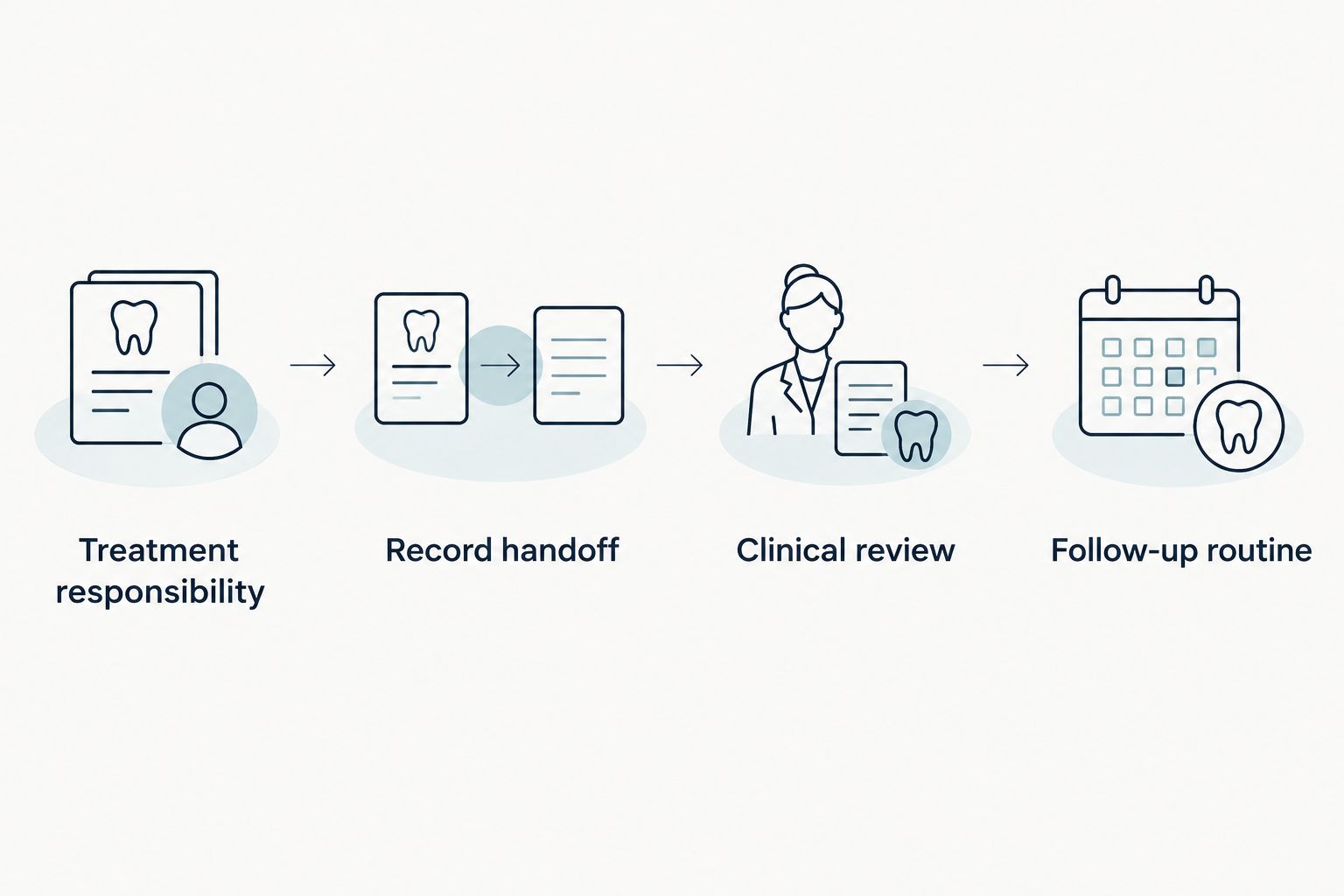
The core sequence is straightforward: establish responsibility, transfer records, review the case, and confirm the next instructions. Each stage answers a different question, so skipping one leaves a gap even when your trays feel comfortable.
Follow-up routine
Put the continuation plan into practice
- Follow the prescribed wear schedule. Invisalign patient guidance generally calls for 20–22 hours of daily aligner wear; your treating clinician's instructions govern your case. A transfer is not a reason to create a different routine yourself.
- Change trays only as directed. Do not advance because the next tray is already in your possession. Report a poor fit before assuming that moving forward will solve it.
- Keep ordinary dental care in place. American Dental Association guidance recommends brushing for 2 minutes twice daily and cleaning between teeth daily. Orthodontic reviews do not replace preventive dental visits.
- Confirm the next contact before leaving. Know which office handles tooth movement, general dental problems, and urgent concerns. Save the instructions somewhere you can find them when an office is closed.
Expected result: You know what to wear, when to seek help, and which office to contact. Your 2026 care plan includes both orthodontic supervision and ongoing dental health.
The benefit of this routine is clarity. Its limitation is that reminders cannot judge whether teeth are following the plan; that requires clinical assessment. Keep review appointments even when your aligners seem to fit well.
Variant: keep your orthodontist and change your general dentist
If you are moving locally or changing dental practices, you do not automatically need to transfer Invisalign treatment. You can ask your orthodontist to continue supervising the aligners while a new general dentist manages preventive, restorative, or other dental care.
For this 2026 shared-care arrangement, tell both offices that orthodontic treatment is active. Authorize relevant communication and identify planned dental work before it begins. A restoration that changes a tooth's shape can affect how an aligner fits, so the clinicians need to coordinate the sequence.
Starboard Dental provides general, restorative, and cosmetic dental care for patients of all ages. Ask how those services would be coordinated with your existing orthodontist rather than treating a general dental appointment as an automatic Invisalign transfer.
The advantage is continuity with your current orthodontic clinician. The drawback is maintaining communication between offices. Keep your orthodontist responsible for aligner changes unless another clinician has explicitly accepted that role.
Troubleshooting
Records arrived, but treatment has not been accepted
Ask whether the receiving clinician still needs an examination, additional records, or confirmation from the sending office. Keep your current clinician involved until responsibility is settled. Record receipt is an administrative milestone, not permission to advance trays.
Your current aligner does not fit properly
Contact the clinician responsible for your Invisalign treatment and describe where the tray is lifting or failing to seat. Do not force a poorly fitting tray, trim it, or skip ahead without instructions. Bring the tray to the assessment.
An attachment has come off or a tray is missing
Tell the treating office which tooth or tray is affected and when the problem occurred. Ask which aligner to wear while the issue is addressed. Do not glue an attachment back onto your tooth or choose a replacement stage yourself.
Dental treatment is scheduled during the handoff
Tell both clinicians before an extraction, crown, or other procedure that affects the teeth involved in treatment. Ask who will assess aligner fit afterward and whether orthodontic instructions need changing. Coordination matters more than keeping the original calendar unchanged.
Pain is more than ordinary pressure
Seek prompt dental assessment for severe or worsening pain, swelling, fever, or a suspected infection. Trouble breathing or swallowing requires emergency medical care. Do not wait for transfer paperwork to be completed before getting help.
Customize your workflow
Build your handoff around the decision you actually need. A move requires a new supervising clinician; a second opinion requires an assessment; a general dental change requires coordination. Calling all three a transfer makes the request harder to resolve.
For your 2026 appointment, bring a short question list:
- Who is responsible for my active Invisalign treatment now?
- Has the receiving clinician accepted that responsibility?
- Which aligner should I wear until the next review?
- Does any planned dental treatment affect my aligners?
- Who should I contact if a tray stops fitting?
If discomfort is part of the reason for changing offices, describe its location, triggers, and timing. The guide to options for treating sensitive teeth explains a related concern, but sensitivity during orthodontic treatment still needs an individual assessment.
FAQ
Can I transfer Invisalign treatment to a new dentist?
Yes, if the receiving clinician accepts your active case after reviewing the relevant information and assessing your needs. Confirm responsibility, record sharing, and interim aligner instructions before ending existing follow-up.
Does an orthodontist referral automatically transfer my Invisalign case?
No, a referral does not automatically transfer responsibility for Invisalign treatment. It can request a consultation, general dental care, or an active-treatment transfer, so ask both offices to clarify its purpose.
Do I need to start Invisalign again when I change dentists?
Changing dentists does not automatically mean restarting Invisalign. The receiving clinician decides whether the current sequence remains appropriate or whether new records and a revised plan are needed.
Should I keep wearing my aligners while the transfer is being arranged?
Follow your treating clinician's wear instructions while the transfer is arranged. Contact that clinician if an aligner is lost, damaged, painful, or no longer fitting; do not invent an interim schedule.
Can my general dentist and orthodontist share my care?
Yes, general dental care and orthodontic supervision can remain with different clinicians. Both offices need to coordinate when dental treatment affects the teeth being moved or the fit of an aligner.
What records should I bring to an Invisalign transfer appointment?
Bring your current aligners, identifiable tray packaging, written instructions, and relevant health information. Ask the receiving office which clinical records should be sent directly, including treatment notes, images, and available digital planning information.
Can Starboard Dental take over my Invisalign treatment?
Ask Starboard Dental directly whether the practice can review and accept your active Invisalign case. Its general, restorative, and cosmetic dental services do not by themselves confirm an orthodontic transfer arrangement.
One last thing
The useful handoff question is not simply whether your records arrived; it is who is responsible for your next treatment decision. Before changing trays after a transfer, make sure you can name that clinician and find their written instructions. That small check turns an administrative handoff into a clear care plan.