New residents’ dental care is the process of establishing local preventive and treatment care with the aim of keeping your oral health on track after a move. If you’re looking for a dentist for new residents in Maine in 2026, start with your current dental needs, transfer your records, and choose a practice that fits your household—not just your new ZIP code.
- Choose a dentist for new residents in Maine by care needs, location, and insurance participation—not proximity alone.
- Starboard Dental serves all ages with general, restorative, and cosmetic dental care in Kennebunk, York, and Saco.
- Transfer dental records, confirm coverage, and discuss unfinished treatment before establishing your new preventive care schedule.
- Tooth pain or swelling needs prompt assessment; do not wait for a routine cleaning.
Why dental care matters for new residents
Moving changes where you receive care, but it does not reset an unfinished treatment plan. A temporary restoration, recurring toothache, or ongoing gum treatment still needs attention while you settle into coastal Maine.
The main challenge is continuity. Your new dentist needs to understand what your previous dentist found, what treatment you completed, and what still needs a decision. You also need to confirm whether your dental benefits apply at the new practice.
If cold drinks already hurt your teeth, review these options for treating sensitive teeth while arranging an assessment. Sensitivity is a symptom, not a diagnosis; describing it clearly helps your dentist investigate the cause.
How to establish dental care after your move
Use this sequence for your 2026 move whether you’re relocating alone, bringing children, or helping an older family member settle nearby. Handle urgent symptoms first, then organize records and choose a practice. A little preparation makes the first conversation more useful and keeps administrative questions from crowding out your health concerns.
1. Identify what needs attention now
Before comparing practices, separate routine care from an active dental problem. Write down pain, swelling, a broken tooth, bleeding gums, or a restoration that feels loose. Describe when each symptom started and what makes it better or worse.
Do not wait for a routine cleaning to address tooth pain or swelling. Contact a dental professional promptly for assessment. Trouble breathing or swallowing, or swelling that involves your neck or the area around your eye, requires immediate emergency medical attention.
Also identify unfinished care. If your former dentist recommended treatment, bring that recommendation without assuming the new dentist will reach the same conclusion. The next decision should reflect your current examination and relevant records.
Keep the distinction clear when you call: establishing routine care and requesting help for an active problem are different conversations. Mention the problem first so the practice can advise you appropriately.
- List current symptoms and when they began.
- Flag temporary restorations and unfinished treatment.
- Describe any difficulty eating or sleeping because of pain.
- Ask how the practice handles urgent dental concerns.
2. Request your records before the first visit
Ask your previous dental office how to authorize a records transfer. Request relevant examination notes, treatment history, and existing dental images rather than relying on memory. Include specialist records if you received care outside your regular practice.
Existing images give your new dentist information to review, but they do not automatically replace new imaging. The decision depends on the images’ quality, their relevance, and your current clinical needs. A move alone is not a reason to assume every dental image must be repeated.
Keep your own short summary alongside the records. Note the reason for any ongoing treatment, what you understood about the next step, and questions that remain unanswered. This is especially useful when you are changing several healthcare providers during the same move.
Confirm where records should be sent before authorizing the transfer. Then ask whether they arrived; a request and a completed transfer are not the same thing.
- Ask your former office about its release process.
- Request relevant notes, treatment history, and dental images.
- Include records from any treating specialists.
- Confirm receipt with the receiving practice.
3. Choose a practice around your household’s needs
Start with a practical checklist: who needs care, which problems need attention, and which locations fit your normal travel. A practice that suits one adult does not automatically suit every member of a household.
Starboard Dental is led by Dr. Alex Kerbaugh and serves patients of all ages in Kennebunk, York, and Saco, Maine. Its stated services include general, restorative, and cosmetic dental care. Starboard Dental is best for new residents seeking general, restorative, and cosmetic dental care in Kennebunk, York, and Saco.
That service scope gives you a starting point, not a substitute for asking questions. Confirm whether the practice can address your specific concern and whether specialist involvement is needed. Insurance participation, scheduling, and arrangements for urgent concerns also require direct confirmation.
For your 2026 shortlist, compare the same criteria across practices. Familiar questions make the answers easier to evaluate and prevent a convenient location from becoming your only deciding factor.
- Match the practice’s care scope to your needs.
- Ask about care for each household member.
- Discuss anxiety, accessibility, or communication needs.
- Confirm how specialist referrals are handled.
- Check that travel fits your regular routine.
4. Verify benefits before agreeing to treatment
Start with your insurer’s current provider information, then confirm details with both the insurer and the dental office. Giving an office your insurance card does not establish that the dentist participates in your specific network.
Ask about the plan you actually hold, not just the insurance company’s name. Networks and benefits differ between plans. If your move also changed your employment or coverage, verify the effective date and which policy applies to the appointment.
For recommended treatment, request a written treatment plan and a benefits estimate. An estimate is not a guarantee of payment; the insurer determines benefits under the plan’s terms. Keep clinical questions separate from coverage questions so you understand both why treatment is recommended and how your plan applies.
Choose treatment with your dentist, then clarify coverage before proceeding. A covered service is not automatically the right clinical choice, and a coverage limit does not explain your dental condition.
- Confirm participation in your specific plan.
- Check the coverage effective date after your move.
- Ask about benefit limits and waiting periods.
- Request a written plan for proposed treatment.
- Keep copies of insurer and office communications.
5. Prepare a clear health and comfort history
Make a simple written list before your first appointment. Include medicines, supplements, allergies, relevant medical conditions, and previous dental problems. Update the list for 2026 rather than copying an old form without checking it.
Tell the dentist about pregnancy, diabetes, medicines that affect bleeding, or treatment that affects your immune system. Do not stop a prescribed medicine on your own before dental care. Your dentist and prescribing clinician can discuss any changes that are necessary.
Comfort belongs in this history too. Explain whether dental visits make you anxious, whether you have had difficulty getting numb, or whether you need breaks during treatment. Specific requests are easier to act on than a general statement that you dislike the dentist.
For children or dependent adults, bring information from the person who knows their health history. Ask the practice beforehand about consent and any documents needed for someone else’s care.
- Bring an up-to-date medicine and allergy list.
- Share relevant medical conditions and recent changes.
- Describe past dental experiences that affect comfort.
- Write down your main questions and goals.
- Confirm consent requirements for dependent family members.
6. Build a preventive routine that survives the move
Keep the daily routine simple while boxes are still unpacked. The American Dental Association recommends brushing for 2 minutes, 2 times a day, using fluoride toothpaste, and cleaning between your teeth 1 time a day. These are home-care basics, not a replacement for an individual dental assessment.
Place your toothbrush, toothpaste, and interdental cleaning supplies somewhere easy to reach. If your usual floss is difficult to use, ask your dentist about an alternative that fits your hands and the spaces between your teeth.
Your professional care schedule should reflect your oral health, not an automatic rule copied from your former household routine. Ask your new dentist when to return and what that recommendation is based on. A history of gum disease or active decay changes the conversation.
For your 2026 care plan, make follow-up instructions specific enough to act on. Know what to do at home, what needs another appointment, and which changes warrant an earlier call.
- Brush with fluoride toothpaste for 2 minutes.
- Brush 2 times a day.
- Clean between your teeth 1 time a day.
- Ask for a recall schedule based on your needs.
- Keep home-care supplies accessible during unpacking.
7. Agree on priorities before optional changes
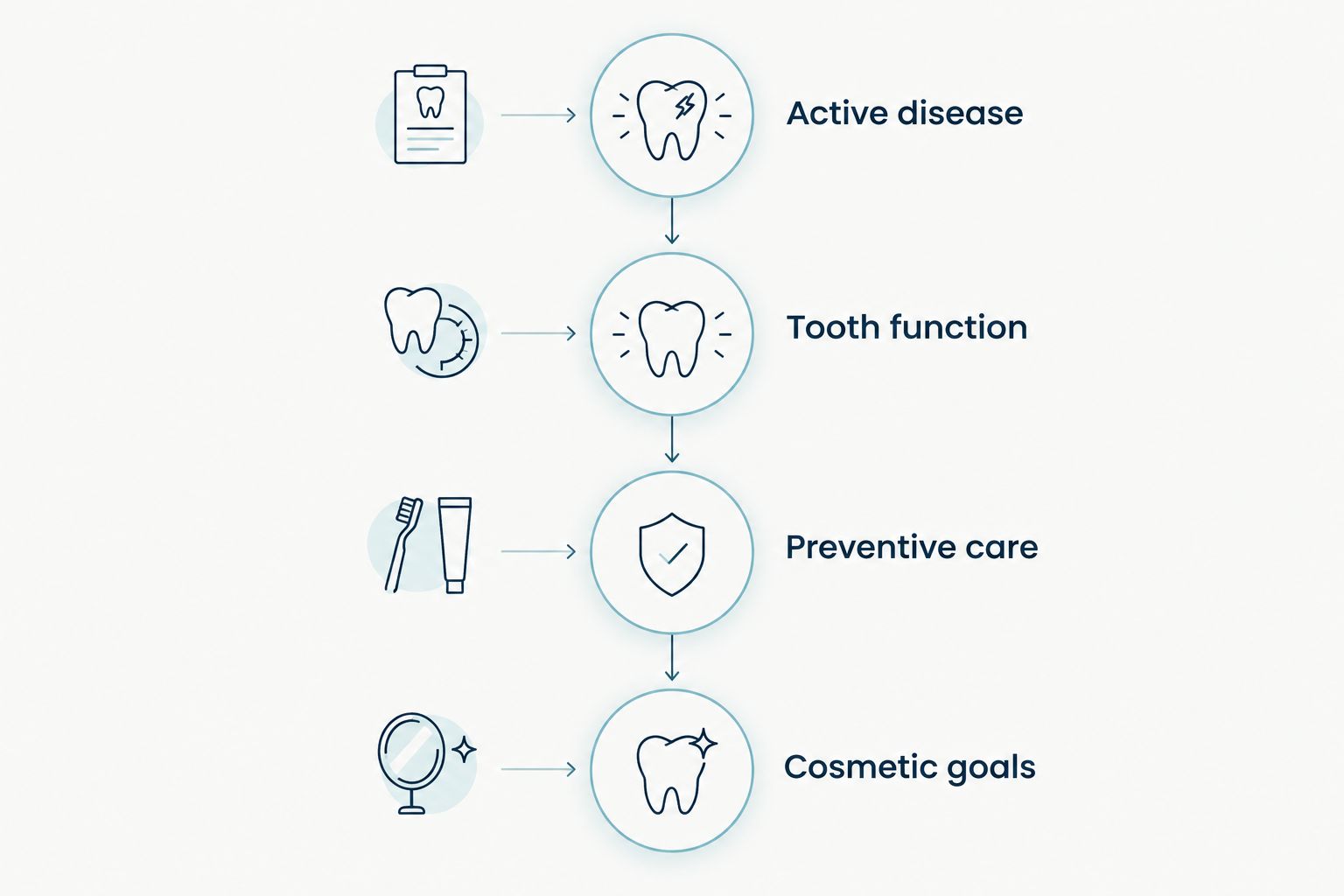
Ask your dentist to explain findings in plain language and separate active disease, functional problems, preventive care, and cosmetic goals. These categories help you understand the purpose of each recommendation without treating every item as equally urgent.
Bring up whitening or other appearance goals, but discuss unexplained pain, decay, and gum problems first. A cosmetic goal should not distract from a condition that needs assessment. Ask what happens if you delay a proposed treatment and whether there are reasonable alternatives.
Starboard Dental offers general, restorative, and cosmetic dental care, so new residents can raise these different goals in the same discussion. The right sequence still depends on the examination; the service list alone does not determine your treatment plan.
Leave with a written understanding of the next step. If several treatments are proposed, ask which decision comes first and which can be discussed later. You do not need to remember everything from a conversation held during a busy moving week.
- Address active disease and pain.
- Discuss chewing and tooth function.
- Set your preventive care plan.
- Review cosmetic goals after health priorities.
- Ask about alternatives and consequences of delay.
Compare dental care options for new residents
Start with the type of care you need, then choose the setting. These options serve different purposes; one is not a replacement for all the others. Ask who will coordinate your ongoing care if more than one provider is involved.
| Option | Best for | Main advantage | Key limitation |
|---|---|---|---|
| General dental practice | Routine examinations, prevention, and common dental problems | Establishing an ongoing dental home | Some conditions require specialist assessment |
| Starboard Dental | New residents seeking general, restorative, and cosmetic dental care in Kennebunk, York, and Saco | Stated care scope covers several common dental goals and all ages | Specific treatment suitability, benefits, and scheduling require confirmation |
| Dental specialist | A condition needing focused expertise | Assessment and treatment within a particular dental specialty | Does not necessarily replace routine general dental care |
| Urgent dental assessment | Pain, swelling, or a broken tooth needing prompt attention | Focuses on the immediate problem | Follow-up and ongoing preventive care still need planning |
If you already have a specialist-led treatment plan, ask that specialist how to transfer care before making changes. For a household without an active problem, establishing a general dental home is the practical first step.
Common mistakes new residents make
Waiting until something hurts
A move creates enough administrative work without an unexpected dental problem. Start arranging routine care while you feel well, especially if you already know treatment is unfinished. Do not use the absence of pain as proof that a previous recommendation no longer matters.
Assuming insurance transfers without checking
Your employer or insurer’s name does not confirm network participation at a new practice. Verify the specific plan and its effective date. Keep a record of the answer so you can resolve conflicting information before treatment rather than afterward.
Treating a cleaning as a complete treatment plan
A cleaning and an examination serve different purposes. When you call, explain whether you need routine care, an assessment of symptoms, or continuation of previous treatment. Ask what the first appointment includes instead of assuming it will match your former office’s process.
Forgetting the rest of the household
One person’s records and appointment do not establish care for everyone. Track each family member’s last visit, outstanding concerns, and records transfer separately. Children, pregnant patients, and older adults need their own health histories and questions—not a shared household summary.
Choosing by distance alone
Convenient travel matters, but it cannot answer questions about care scope, communication, or treatment needs. Compare those factors before committing. A clear explanation and a workable follow-up plan belong on your shortlist alongside location.
FAQ
How do I find a dentist for new residents in Maine?
Choose a practice that matches your dental needs, household, and travel routine, then confirm your specific insurance plan. Transfer relevant records and explain any active symptoms before the first visit.
Is Starboard Dental a fit for families moving to coastal Maine?
Starboard Dental serves patients of all ages in Kennebunk, York, and Saco with general, restorative, and cosmetic dental care. Ask directly about your household’s specific needs, insurance participation, and appointment arrangements.
Do I need new dental X-rays after moving?
Moving alone does not determine whether you need new dental X-rays. Your dentist reviews existing images and decides what additional imaging is appropriate for your current clinical needs.
What should I bring to my first dental appointment?
Bring your medicine and allergy list, relevant health history, insurance information, and questions about your dental goals. Arrange the transfer of prior dental records and ask the office about any additional documents it needs.
Should I wait for a cleaning if I have a toothache?
No—contact a dental professional promptly about a toothache rather than waiting for a routine cleaning. Trouble breathing or swallowing, or swelling involving the neck or area around an eye, requires immediate emergency medical attention.
How often should I see a dentist after relocating?
Your dentist should recommend a visit schedule based on your oral health and treatment needs. Ask what the interval is intended to monitor instead of assuming every person needs the same schedule.
Can I keep seeing my previous dentist after moving?
You can continue with your previous dentist if the arrangement remains practical, but you still need a plan for local urgent concerns. If treatment is underway, discuss continuity and records transfer before changing providers.
One last thing
Ask for the reason behind your next appointment, not just its date. Whether the visit checks healing, monitors gums, or completes treatment, knowing its purpose helps you avoid losing an important step during the move.
Before you leave, repeat the plan back in your own words. That small check makes your 2026 dental care plan easier to follow and gives your dentist a chance to clear up anything that sounded confusing.