

A root canal should not cause sharp pain once the tooth is fully numbed; you can still feel pressure, movement, or vibration during treatment. Tenderness afterward is common, but severe pain, increasing swelling, or symptoms that worsen need a call to your dentist rather than an assumption that recovery is on track.
- Is a root canal painful? With effective local anesthesia, treatment should not cause sharp pain.
- Pressure during treatment and tenderness afterward are different from uncontrolled tooth pain.
- Tell your dentist immediately if you feel pain; treatment can pause while numbness is reassessed.
- Starboard Dental provides general and restorative dental care for patients in coastal Maine.
Is a root canal painful?
A properly numbed root canal should not hurt sharply, and you do not need to push through pain. The injection can briefly sting, and keeping your mouth open can leave your jaw tired. Those sensations differ from pain inside the tooth.
For patients considering Starboard Dental, the useful starting point is a conversation about symptoms, past experiences with numbing, and dental anxiety—not a promise that every appointment feels identical.
The American Association of Endodontists explains in its patient guidance that modern anesthesia makes root canal treatment comfortable for most patients. This 2026 guide separates the experience into 3 stages so you know what to report and when.
| Stage | What you can feel | What needs attention |
|---|---|---|
| Before treatment | Throbbing, temperature sensitivity, or pain when biting; some teeth have no symptoms | Swelling, worsening pain, or difficulty opening your mouth |
| During treatment | A brief injection sting, pressure, vibration, and jaw fatigue | Sharp pain or a sensation that the tooth is not numb |
| After treatment | Tenderness around the tooth and discomfort when chewing | Severe or worsening pain, visible swelling, or a bite that feels uneven |
These are general patterns, not a diagnosis. Your symptoms and examination determine whether root canal treatment is appropriate.
Why this matters
Fear of pain can make a dental appointment feel harder than it needs to be. Understanding the difference between pressure, soreness, and warning signs gives you something specific to discuss with your dentist.
A root canal treats inflamed or infected tissue inside a tooth that can still be restored. Its benefit is preserving the natural tooth; its limits include the need for follow-up restoration and the possibility of persistent infection or later retreatment. Saving the tooth is the goal, not a guarantee.
Pain disappearing on its own does not prove that a damaged tooth has healed. An examination remains important even if a previously painful tooth suddenly becomes quiet.
What happens before and during a root canal?
Your 2026 treatment conversation should cover how the dentist will confirm numbness and what happens if you feel discomfort. You do not need to know dental terminology to ask for a pause.
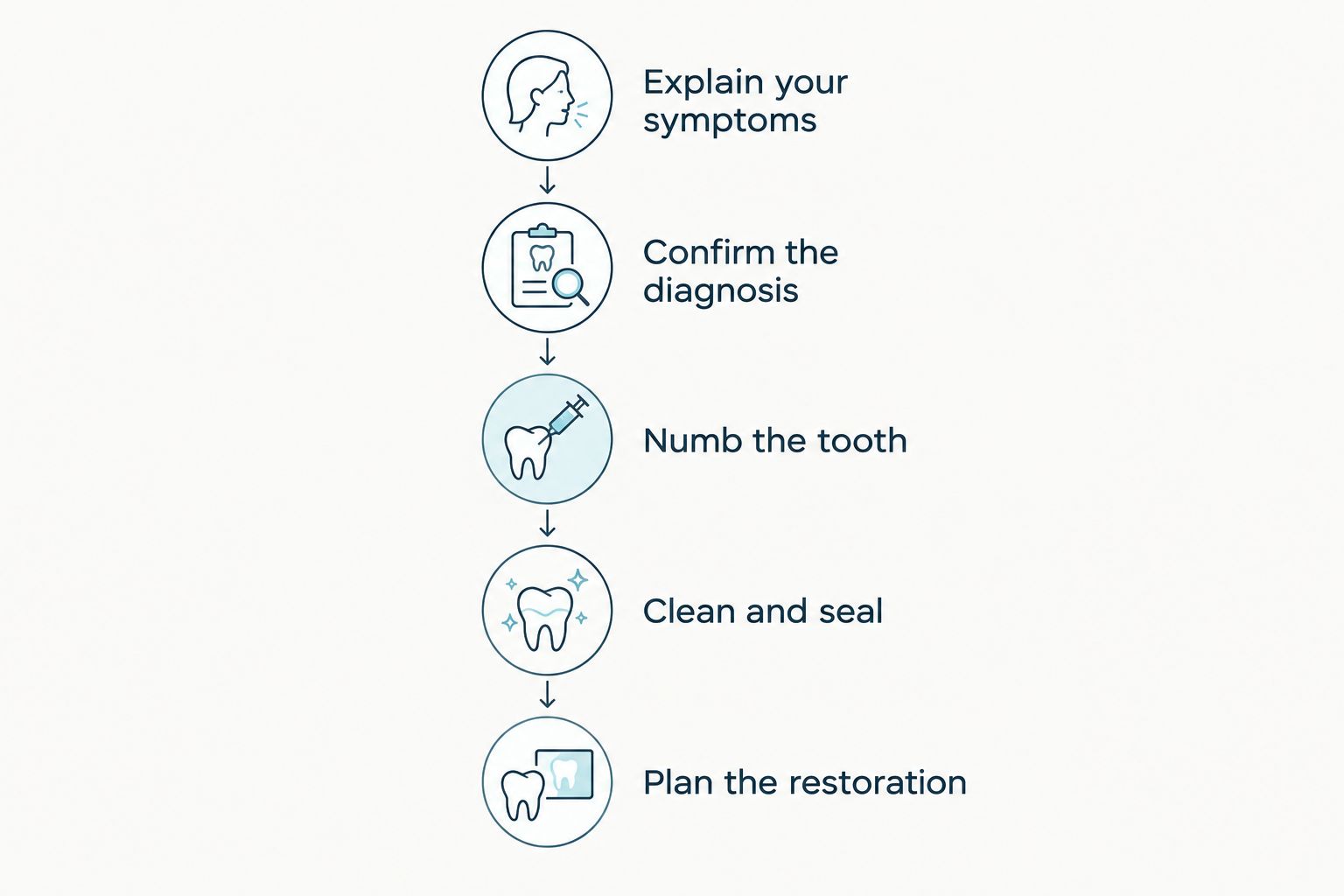
- Explain your symptoms. Describe whether pain happens spontaneously, with heat or cold, or when biting. Mention swelling, previous treatment, medications, allergies, and any difficulty getting numb during past dental visits.
- Confirm the diagnosis. The dentist examines the tooth and uses appropriate tests and imaging. Tooth pain alone does not establish that you need a root canal.
- Numb the tooth. Local anesthetic blocks pain in the treatment area. The dentist checks the response before starting; a numb lip alone does not establish that the tooth is fully numb.
- Clean and seal the canals. The dentist isolates the tooth, removes the affected tissue, cleans the canal spaces, and fills and seals them. Pressure or vibration is different from sharp pain.
- Plan the restoration. The tooth needs an appropriate final restoration to protect and seal it. Depending on the tooth and remaining structure, that can include a crown.
Agree on a stop signal before treatment starts, such as raising your hand. This gives you a clear way to communicate when your mouth is open and speaking is difficult.
Local anesthesia and sedation: what is the difference?
Local anesthesia controls pain in the treatment area. Sedation addresses anxiety and awareness; it does not replace the need to numb the tooth for a root canal.
The distinction matters when you ask for help. Tell the dentist whether your main concern is feeling pain, feeling panicked, or both, rather than requesting a particular medication without discussing your health history.
| Approach | Best for | Main benefit | Limitation |
|---|---|---|---|
| Local anesthesia | Blocking pain in the tooth being treated | Numbs the treatment area while you remain awake | Does not directly treat anxiety; additional anesthetic techniques are sometimes necessary |
| Sedation, when appropriate | Patients whose anxiety needs additional management | Helps reduce anxiety or awareness, depending on the method | Requires individual assessment, has method-specific precautions, and does not replace local anesthesia |
Not every practice offers every sedation method, and not every patient needs sedation. Ask what is appropriate for your medical history and what preparation or transportation arrangements would be required.
Why root canal discomfort varies
There is no single sensation that every patient experiences. These factors help explain why one person describes an easy appointment while another needs more attention to comfort:
- Inflammation before treatment. A very inflamed tooth can be harder to numb and can require additional anesthetic techniques.
- Tenderness around the root. Removing tissue inside the tooth does not immediately settle inflammation in the surrounding tissues.
- Previous treatment. A tooth undergoing retreatment has a different treatment history from one receiving its first root canal.
- Bite pressure. An uneven bite or repeated chewing on a tender tooth can make the area uncomfortable.
- Jaw strain. Keeping your mouth open can leave the muscles sore, even when the tooth itself was numb.
- Anxiety and past experiences. Fear can make the appointment more distressing. Sharing that history lets the dental team discuss communication and comfort measures.
These factors explain differences; they do not mean you should accept uncontrolled pain. Tell your dentist what you feel and where you feel it.
How painful is recovery after a root canal?
Some tenderness after a root canal is expected, especially when the tissues around the root were inflamed beforehand. The overall direction should be toward improvement, not increasing pain or swelling.
Your dentist should give instructions matched to your treatment and medical history. Follow those instructions rather than copying a medication schedule from someone else's experience.
For your 2026 recovery plan, discuss these practical points before leaving:
- Eating while numb: Wait until numbness wears off before chewing to avoid biting your cheek or tongue or injuring yourself with hot food.
- Protecting the tooth: Avoid hard chewing on the treated tooth until your dentist says it is adequately restored.
- Managing soreness: Use only pain relief that is appropriate for your health conditions, medications, and the dentist's directions.
- Checking the bite: Report a tooth that seems to hit first when you close your mouth.
- Keeping follow-up care: Complete the recommended restoration and any reassessment rather than treating symptom relief as the finish line.
Keep cleaning your mouth, but be gentle around a sore area and follow any specific instructions. Standard daily prevention includes brushing for 2 minutes, twice a day, and cleaning between teeth once a day; your dentist can explain how to work around the treated tooth.
Antibiotics are not automatically needed after a root canal. They do not replace treatment that removes the source of a dental infection, and the decision to prescribe them depends on the clinical situation.
When should you call about pain after a root canal?
Call your treating dentist if pain is severe, gets worse, or returns after improving. Also report visible swelling, a lost temporary restoration, or a bite that feels uneven. You do not need to wait for a scheduled follow-up to raise a new concern.
Contact the dental team promptly if you develop fever or feel unwell alongside dental pain or swelling. Those symptoms need assessment rather than a home-care experiment.
Difficulty breathing or swallowing, or rapidly spreading swelling involving the face or neck, requires emergency medical care. Do not wait for a routine dental appointment in that situation.
A useful call includes where the pain is, whether it is improving, whether you have swelling, and whether you can bite normally. That information helps the team decide the next step; it does not replace an examination.
Is a root canal more painful than a filling?
With effective local anesthesia, neither a filling nor a root canal should cause sharp pain during treatment. A root canal can involve a longer appointment and more tenderness afterward, particularly when the tooth was already inflamed.
The comparison is not a reason to dismiss your concern. Ask how the dentist will check numbness and what the plan is if you feel discomfort.
Can you avoid a root canal if the tooth stops hurting?
A tooth that stops hurting still needs assessment if it previously had significant pain, lingering sensitivity, or swelling. Symptoms can change when the tissue inside a tooth becomes nonvital, so silence is not proof of recovery.
Whether the tooth needs a filling, root canal, extraction, or another approach depends on the diagnosis and whether it can be restored. Do not choose treatment based only on today's pain level.
What should you ask before your appointment?
Bring a short description of your symptoms and a current medication list. If you are anxious, say so when arranging the visit rather than waiting until treatment begins.
Useful questions for a root canal discussion in 2026 include:
- How will you confirm that the tooth is numb?
- What should I do if I feel pain during treatment?
- What restoration will the tooth need afterward?
- Which symptoms mean I should call, and whom should I contact outside office hours?
Starboard Dental is a fit for coastal Maine families seeking general and restorative dental care. Dr. Alex Kerbaugh leads the practice, which serves patients of all ages in Kennebunk, York, and Saco. An examination is the right place to establish what is causing pain and what care is appropriate.
FAQ
Is a root canal painful in 2026?
A root canal should not cause sharp pain when effective local anesthesia is in place. Pressure, vibration, and some tenderness afterward are different from uncontrolled pain; tell your dentist immediately if treatment hurts.
Does the numbing injection for a root canal hurt?
The numbing injection can cause a brief sting or pressure. Tell your dentist if injections worry you so you can discuss how the anesthetic will be given and how numbness will be checked.
Can I still feel something during a root canal?
Yes, you can feel pressure, movement, or vibration during a root canal even when the tooth is numb. Sharp pain is a reason to signal the dentist and pause for reassessment.
Is it normal for a tooth to hurt when biting after a root canal?
Some tenderness when biting can occur after a root canal because tissues around the root remain inflamed. Report severe or worsening pain, or a tooth that feels higher than the others when you bite.
Do I need to be asleep for a root canal?
No, being asleep is not routinely necessary for a root canal; local anesthesia controls pain in the treatment area. If anxiety is a concern, ask which additional approaches are appropriate and available.
Can antibiotics cure a tooth that needs a root canal?
Antibiotics do not replace root canal treatment when an infected tooth needs its internal source of infection treated. A dentist determines whether antibiotics are also necessary based on the examination and signs of spreading infection.
Can Starboard Dental assess my tooth pain?
Starboard Dental provides general and restorative dental care under Dr. Alex Kerbaugh for patients in coastal Maine. Ask for an assessment of your symptoms so the cause and appropriate treatment can be established.
One last thing
A numb lip is not the same as a fully numb tooth. Before treatment begins, ask how the dentist will confirm that the tooth itself is ready—and agree on your stop signal.
That small conversation gives you a clear role in your care. You do not need to stay quiet or endure sharp pain to get through a root canal.