
Best for reversible pulp irritation: a protective restoration. Best for selected teeth with living pulp: vital pulp therapy. Best when a tooth cannot be saved: extraction with a replacement plan. The best root canal alternatives in 2026 depend on whether the tissue inside your tooth can recover—not simply which treatment you prefer.
- The best root canal alternatives depend on pulp health, tooth structure, and whether the tooth can be restored.
- Vital pulp therapy preserves living tissue in selected teeth; it cannot rescue every infected tooth.
- Extraction removes the tooth; implants, bridges, and removable dentures address the resulting gap.
- Starboard Dental provides general and restorative dental care for patients in Kennebunk, York, and Saco, Maine.
Why this matters
A root canal treats damaged or infected tissue inside a tooth while preserving the tooth itself. Avoiding the procedure is not the same as avoiding treatment: a filling cannot resolve an infection in dead pulp, and pain relief does not prove the problem has healed.
Starboard Dental serves patients seeking general and restorative dental care in Kennebunk, York, and Saco, Maine. If you are weighing root canal alternatives, start with an examination and a clear explanation of what is happening inside the tooth. You can learn about the practice at Starboard Dental.
This 2026 guide separates treatments that preserve a tooth from choices that remove and replace it. Those are different decisions, with different consequences.
What makes the best root canal alternative?
Judge each option against these criteria before comparing procedures:
- Pulp health: Is the tissue inside the tooth alive, inflamed, or dead? This determines whether pulp-preserving treatment belongs in the discussion.
- Restorability: Enough sound tooth structure must remain to support a lasting repair. A crack extending into the root changes the decision.
- Infection control: The treatment must address the source, not just quiet the pain.
- Chewing function: Removing a tooth creates a separate question about replacing it and maintaining a useful bite.
- Treatment burden: Surgery, preparation of neighboring teeth, removable appliances, and follow-up care involve different commitments.
- Long-term maintenance: Every option requires home care and dental review. None makes future dental problems impossible.
The best alternative is the least invasive treatment that actually addresses your diagnosis. A smaller procedure is not a better choice when it leaves diseased tissue untreated.
Root canal alternatives at a glance
The order below moves from preserving the natural tooth to managing tooth loss. It is not a claim that the first option works for every patient.
| Option | Best for | Standout feature | Key limitation |
|---|---|---|---|
| Protective restoration | Reversible pulp irritation | Repairs the cause while retaining the pulp | Does not treat dead or infected pulp |
| Vital pulp therapy | Selected teeth with living pulp | Preserves some or all remaining healthy pulp | Requires careful assessment and monitoring |
| Extraction with an implant | An unsalvageable tooth with suitable replacement conditions | Replaces the missing tooth without using neighboring teeth as supports | Requires surgery and assessment of bone and health |
| Extraction with a bridge | A missing tooth where neighboring teeth can support a restoration | Provides a fixed replacement without an implant | A conventional bridge involves preparing supporting teeth |
| Extraction with a removable partial denture | Tooth loss suited to a removable replacement | Can replace multiple missing teeth | Must be removed and cleaned |
| Extraction without replacement | Selected gaps that do not require replacement | Avoids another replacement procedure | Not appropriate for every bite or tooth position |
1. Protective restoration: best for reversible pulp irritation
A filling or other protective restoration addresses decay, a defective restoration, or exposed tooth structure when the pulp can still recover. The dentist removes or manages the cause and seals the tooth appropriately. This is not a substitute for root canal treatment when the pulp has died.
Best for: A tooth with reversible irritation and enough remaining structure for a reliable repair.
Protective restoration pros:
- Retains the natural tooth and its living pulp.
- Addresses a local cause such as decay or a leaking restoration.
- Avoids removing pulp tissue when that treatment is unnecessary.
Protective restoration cons:
- Cannot treat an established infection in dead pulp.
- Persistent symptoms can lead to further treatment.
Pain alone cannot tell you whether this option fits. Brief sensitivity and lingering pain provide clues, but your dentist must interpret them alongside examination findings and tests.
Verdict: Hold off on choosing a filling alone until the dentist confirms that the pulp can recover.
2. Vital pulp therapy: best for selected teeth with living pulp
Vital pulp therapy aims to preserve living tissue inside a tooth. Depending on the diagnosis, it can involve protecting exposed pulp or removing an inflamed portion while retaining healthy tissue. Procedures include pulp capping and pulpotomy; these are not interchangeable treatments.
Best for: A carefully selected tooth whose remaining pulp is alive and suitable for preservation.
Vital pulp therapy pros:
- Preserves living pulp when the clinical conditions support it.
- Can retain the natural tooth without a full root canal procedure.
- Supports continued root development in suitable immature permanent teeth.
Vital pulp therapy cons:
- Is not appropriate for every painful or infected tooth.
- Requires follow-up; root canal treatment or extraction can still become necessary.
For this 2026 comparison, vital pulp therapy is the main tooth-preserving option to ask about—not a promise that you qualify. Your dentist assesses the exposure, tissue condition, ability to control bleeding, and whether the tooth can receive an effective seal.
Verdict: Hold the decision until your dentist confirms that vital pulp therapy is appropriate for your tooth.
3. Extraction with an implant: best for replacing an unsalvageable tooth
Extraction removes the tooth rather than treating its root canals. An implant-based replacement uses a fixture in the jaw to support a replacement tooth. The extraction and replacement need a coordinated plan; an implant is not automatically placed at the same appointment.
Best for: A tooth that cannot be predictably restored, when your bone, gum health, and overall health support implant treatment.
Extraction with an implant pros:
- Removes an unsalvageable tooth.
- Provides a fixed replacement for the resulting gap.
- Does not require neighboring teeth to serve as bridge supports.
Extraction with an implant cons:
- Involves surgery and a healing process.
- Requires ongoing cleaning and monitoring of the surrounding tissues.
An implant is a replacement for a missing tooth, not an improved version of a healthy natural tooth. Ask whether the original tooth is genuinely beyond repair before making an irreversible choice.
Verdict: Skip extraction solely to avoid a root canal when the natural tooth has a reasonable treatment outlook.
4. Extraction with a bridge: best when neighboring teeth suit a fixed repair
A conventional dental bridge replaces a missing tooth by attaching the replacement to supporting teeth beside the gap. It does not treat the original tooth; extraction comes first when that tooth cannot be retained. The supporting teeth need adequate strength and gum support.
Best for: A missing tooth where neighboring teeth are suitable supports, particularly when those teeth also need substantial restoration.
Extraction with a bridge pros:
- Provides a fixed replacement rather than a removable appliance.
- Avoids implant placement surgery.
- Can address the gap alongside restorative needs of supporting teeth.
Extraction with a bridge cons:
- A conventional bridge requires preparation of supporting teeth.
- Cleaning beneath the replacement tooth requires extra attention.
A bridge changes more than the empty space. Ask what treatment the neighboring teeth need independently and how the bridge will affect their future care. Healthy, untouched neighbors deserve particular consideration before preparation.
Verdict: Hold the bridge decision until the condition of the supporting teeth has been assessed.
5. Extraction with a removable partial denture: best for a removable plan
A removable partial denture replaces missing teeth with an appliance you take out for cleaning. Its design depends on the remaining teeth, gums, and bite. It can address several gaps rather than replacing each missing tooth separately.
Best for: Patients whose tooth-loss pattern and preferences suit a removable replacement.
Removable partial denture pros:
- Can replace multiple missing teeth in one appliance.
- Can restore chewing contact and appearance in suitable cases.
- Does not require an implant for every replacement tooth.
Removable partial denture cons:
- Requires removal, cleaning, and an adjustment period.
- Its fit and supporting teeth need continued review.
Do not treat a partial denture as an afterthought to extraction. Discuss the intended design before removing a tooth so the replacement plan accounts for the remaining teeth and any expected changes during healing.
Verdict: Hold until you understand the appliance design, daily care, and expected adjustment process.
6. Extraction without replacement: best for selected gaps
Not every extracted tooth needs a replacement. Wisdom teeth are a familiar example, while decisions about other teeth depend on their position, the remaining bite, and your chewing needs. Leaving a gap requires assessment, not an assumption that it will cause no problems.
Best for: An unsalvageable tooth whose removal does not create a replacement need after assessment of the bite.
Extraction without replacement pros:
- Removes the diseased tooth.
- Avoids a separate tooth-replacement procedure.
- Avoids maintenance of an additional restoration or appliance.
Extraction without replacement cons:
- Permanently loses the natural tooth.
- Can affect chewing, appearance, or tooth position, depending on the gap.
Ask your dentist to explain the consequences for that specific tooth. A recommendation about a wisdom tooth does not automatically apply to a front tooth or a chewing tooth.
Verdict: Skip leaving the gap unplanned; choose no replacement only after assessing its effect on your bite.
How these alternatives are ranked
This 2026 ranking prioritizes appropriate preservation of the natural tooth, treatment of the disease source, and useful chewing function. Replacement options follow tooth-preserving options because they address a different problem: what happens after extraction.
There is no universal winner. A protective restoration ranks first for reversible irritation but is the wrong treatment for dead pulp. An implant belongs in a tooth-replacement discussion, not as an automatic reason to remove a restorable tooth.
Which root canal alternative should you choose?
If your tooth is restorable but the pulp cannot recover, discuss root canal treatment before extraction. If the pulp remains suitable for preservation, ask about a protective restoration or vital pulp therapy. If the tooth cannot be saved, plan extraction and the resulting gap together.
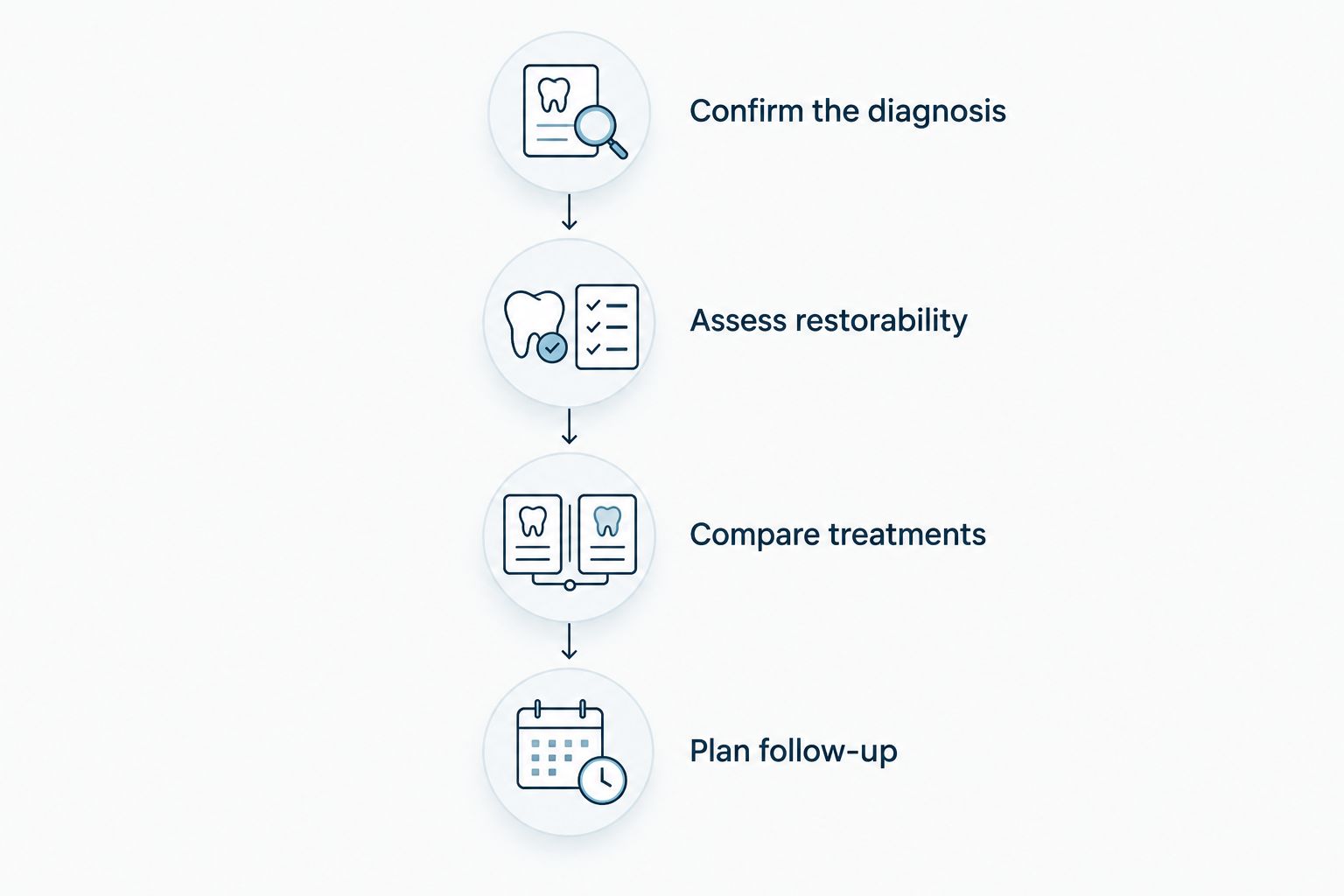
Use this sequence at your appointment:
- Confirm the diagnosis: Ask what the examination, X-rays, and pulp tests indicate.
- Assess restorability: Ask whether decay, a crack, or lost structure prevents a reliable repair.
- Compare treatments: Separate pulp-preserving care from root canal treatment and extraction.
- Plan follow-up: Understand the final restoration, monitoring, and home care each choice needs.
A cracked tooth needs its own assessment because crack location affects whether the tooth can be retained. Read about options for a chipped or cracked tooth if damage started your symptoms.
Starboard Dental provides general, restorative, and cosmetic dental care led by Dr. Alex Kerbaugh. Bring your questions about saving the tooth, replacing it, and managing treatment anxiety rather than committing to a procedure before your examination.
Discuss your tooth treatment options
Start with an examination and questions about preserving your tooth or planning a replacement.
What does not replace treatment?
Antibiotics, pain medicine, and home remedies do not repair a tooth or remove diseased pulp. Antibiotics have a role in selected dental infections, but they do not replace treatment of the source. Do not use leftover antibiotics or delay care because the pain temporarily improves.
Seek emergency medical care for difficulty breathing or swallowing, or swelling extending toward the eye or neck. Facial swelling, fever, or feeling unwell alongside tooth pain requires urgent assessment.
While awaiting dental advice, avoid chewing on the painful tooth and follow medication instructions. For routine prevention in 2026, brush with fluoride toothpaste for 2 minutes per session, 2 times per day, and clean between your teeth 1 time per day. These habits protect oral health; they do not cure an existing pulp infection.
FAQ
What's the best root canal alternative in 2026?
The best root canal alternative depends on whether the pulp can recover and whether the tooth is restorable. Protective restorations and vital pulp therapy preserve selected teeth; extraction is a different choice that permanently removes the tooth.
Can I get a filling instead of a root canal?
A filling can be appropriate when the pulp can recover after the cause of irritation is treated. A filling alone cannot resolve an infection in dead pulp, so the decision requires examination and pulp assessment.
Can a pulpotomy replace a root canal in an adult tooth?
A pulpotomy is an option for selected adult permanent teeth with suitable living pulp. It is not appropriate for every diagnosis, and follow-up is needed to assess healing.
Is pulling a tooth better than having a root canal?
Extraction is not automatically better than root canal treatment. Root canal treatment preserves a restorable tooth, while extraction is appropriate when retaining the tooth is not a sound option or when an informed patient chooses removal.
Can antibiotics cure a tooth that needs a root canal?
Antibiotics do not replace treatment of infected or dead pulp. A dentist determines whether antibiotics are needed alongside treatment of the source, such as root canal treatment or extraction.
Do I need an implant after a tooth is pulled?
An implant is not required after every extraction. A bridge, removable partial denture, or no replacement can be appropriate depending on the missing tooth, remaining teeth, and bite.
Can I wait if my tooth stops hurting?
Pain stopping does not prove that the tooth has healed. Arrange assessment rather than using symptoms alone to decide whether treatment is necessary.
Does Starboard Dental provide restorative dental care?
Starboard Dental provides general, restorative, and cosmetic dental care led by Dr. Alex Kerbaugh. The practice serves patients of all ages in Kennebunk, York, and Saco, Maine.
One last thing
A quieter tooth is not always a healthier tooth. Pain can diminish when pulp tissue dies even though infection remains. Before deciding that you have avoided a root canal, ask your dentist what explains the change and whether the tooth still needs treatment.