Best starting option for mild dental anxiety: nitrous oxide. Best for avoiding an IV needle: oral sedation; best for adjustable sedation during demanding treatment: IV sedation; best for selected patients who need unconsciousness: general anesthesia. This 2026 guide compares the best sedation dentistry options for anxious patients and explains what to discuss with Starboard Dental before deciding on care.
- The best sedation dentistry options for anxious patients depend on medical history, anxiety severity, and planned treatment.
- Nitrous oxide is a practical starting option for mild anxiety when clinical assessment supports its use.
- Oral sedation avoids an IV needle but is less adjustable once medication is taken.
- IV sedation and general anesthesia require appropriate monitoring, trained providers, and individualized preparation.
- Starboard Dental provides general, restorative, and cosmetic care; ask which dental anxiety support options fit your needs.
Why this matters
Dental anxiety is not a personal failing. Fear of pain, needles, gagging, or losing control can make even arranging an appointment difficult. The right plan addresses your particular concern rather than treating every anxious patient alike.
Sedation reduces anxiety or awareness; local anesthesia numbs the treatment area. These are different jobs. Receiving sedation does not mean you can skip a discussion about pain control, and feeling relaxed does not necessarily mean being asleep.
The best choice in 2026 is the least intensive approach that lets you receive necessary care safely. Your health history and the procedure matter as much as how frightened you feel.
What makes the best sedation dentistry option?
Use these criteria before choosing a method:
- Anxiety fit: Match the approach to your trigger, whether that is needles, sounds, gagging, or a previous difficult experience.
- Clinical assessment: Review medical conditions, medications, sleep apnea, pregnancy, and previous anesthesia reactions before making a plan.
- Adjustability: Ask whether the dental team can change the sedation level during treatment and how quickly the method responds.
- Awareness: Understand whether you should expect to remain responsive, feel drowsy, or be unconscious. Memory and awareness are not the same.
- Safety and monitoring: Confirm who administers sedation, who monitors you, and how the team responds if sedation becomes deeper than intended.
- Recovery needs: Clarify fasting, transportation, supervision, and restrictions before taking medication or attending treatment.
Do not choose by the name alone. Oral and IV describe how medication enters your body, not a guaranteed level of sedation.
Sedation dentistry options at a glance
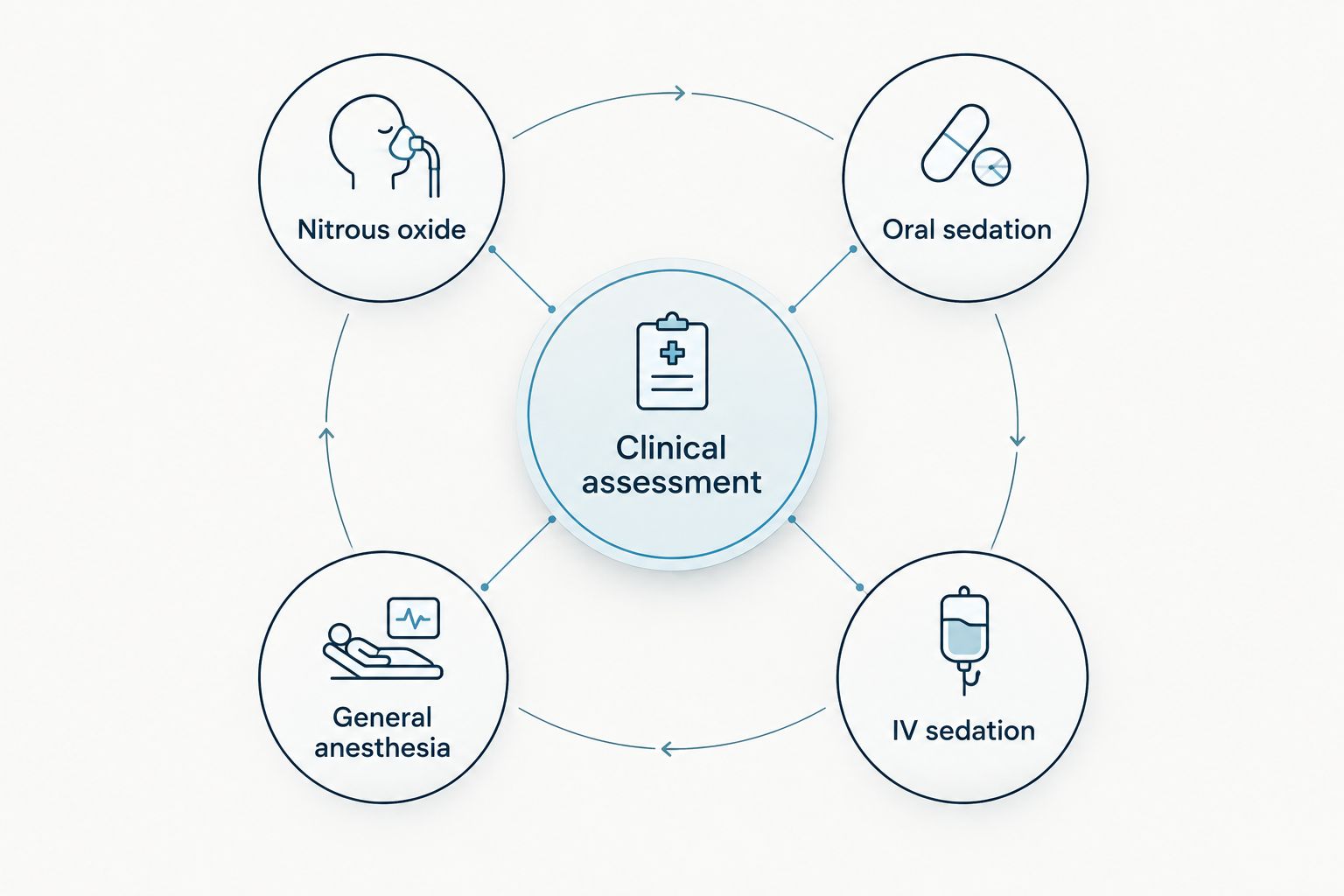
| Option | Best for | Standout feature | Key limitation |
|---|---|---|---|
| Nitrous oxide | Mild anxiety with a preference to stay responsive | Inhaled through a nasal mask and adjusted during treatment | Requires comfortable nasal breathing and mask tolerance |
| Oral sedation | Patients who want medication without an IV needle | Medication taken by mouth | Less adjustable after the dose is taken |
| IV sedation | Patients needing adjustable medication during demanding treatment | Medication delivered directly through an IV | Requires IV placement, monitoring, and recovery planning |
| General anesthesia | Selected patients unable to tolerate necessary treatment while conscious | Controlled unconsciousness | Requires anesthesia-level assessment, airway management, and recovery care |
Clinical assessment connects each option to your health and treatment needs. In 2026, a sedation recommendation should identify the intended depth, not simply name a drug or delivery method.
1. Nitrous oxide: best sedation option for mild dental anxiety
Nitrous oxide is a gas delivered with oxygen through a mask over your nose. It helps reduce anxiety while you generally remain awake and able to respond. Local anesthesia is still used when the procedure requires numbing.
The dental team adjusts the inhaled mixture during treatment. Its effects generally wear off quickly after administration stops, making it different from medication that continues circulating after an oral dose.
Nitrous oxide pros:
- No IV needle is needed to deliver the sedative.
- The team can adjust administration while treatment progresses.
- You generally remain able to communicate.
- Recovery is typically quicker than with oral or IV sedatives.
Nitrous oxide cons:
- Nasal congestion or difficulty breathing through your nose interferes with delivery.
- A nasal mask can feel uncomfortable if enclosed sensations trigger anxiety.
- It does not provide enough support for every level of fear or every procedure.
Best for: Patients with mild dental anxiety who want to stay responsive and can comfortably use a nasal mask.
Tell the dentist if masks make you nervous before the appointment starts. Ask about a stop signal and whether you can become familiar with the mask before treatment. A medication plan works better when communication remains part of the appointment.
Verdict: Hold until assessed; nitrous oxide is the first option to discuss for mild anxiety.
2. Oral sedation: best sedation option for avoiding an IV needle
Oral sedation uses medication taken by mouth to reduce anxiety and produce drowsiness. The effect depends on the medication, dose, your health, and how your body responds. Oral sedation does not automatically mean that you will sleep through treatment.
Once you take a dose, the dentist cannot remove it or adjust it as directly as an inhaled or IV medication. Follow the prescribing clinician's instructions exactly, including when to take it and what other substances to avoid.
Oral sedation pros:
- Delivering the sedative does not require IV placement.
- It offers medication-based support when reassurance alone is insufficient.
- It can help patients whose main barrier is anticipatory anxiety.
Oral sedation cons:
- The onset and effect vary between patients.
- Adjusting the sedation level is less direct after medication is taken.
- Drowsiness requires transportation and supervision arrangements as directed.
Best for: Patients seeking medication-based anxiety support without an IV needle, when their medical assessment supports oral sedation.
Avoid treating an oral sedative as a routine calming tablet. It can impair judgment and coordination, and combining it with alcohol, opioids, or other sedating medicines increases risk. Tell the clinician about prescriptions, over-the-counter sleep aids, supplements, and cannabis use.
Do not use leftover medication or take an extra dose because you still feel nervous. Contact the prescribing team instead. Also remember that avoiding an IV does not necessarily avoid the injection used for local anesthesia.
Verdict: Hold until prescribed; choose oral sedation only with a clear medication and recovery plan.
3. IV sedation: best sedation option for adjustable medication
IV sedation delivers medication through a small tube placed in a vein. This gives the clinician a direct way to administer and adjust medication during treatment. It does not automatically mean general anesthesia or complete unconsciousness.
Depending on the intended depth, you can remain responsive or need more intensive support. Sedation exists on a continuum, so the team must be prepared to manage a deeper level than planned.
IV sedation pros:
- Medication can be adjusted during treatment.
- It supports individualized dosing based on your response.
- It offers an option when lighter approaches do not meet assessed needs.
- It can reduce awareness or memory, depending on the medication and depth.
IV sedation cons:
- IV placement presents a challenge if needles are your main trigger.
- It requires appropriate monitoring and trained personnel.
- Recovery restrictions affect transportation and plans after treatment.
Best for: Patients needing adjustable sedation during demanding dental treatment, after evaluation by an appropriately trained provider.
Ask who will administer medication and who will monitor breathing, circulation, and responsiveness. These are practical safety questions, not signs that you are being difficult. You should also understand whether the proposed plan is moderate or deep sedation.
If IV placement frightens you, explain that concern before treatment day. The team needs to address both the anxiety about dentistry and the anxiety about the sedation process itself.
Verdict: Hold until evaluated; discuss IV sedation when adjustability is a priority.
4. General anesthesia: best for selected patients needing unconsciousness
General anesthesia produces unconsciousness. You are not expected to respond normally during treatment, and breathing can require assistance. It is different from feeling sleepy during oral or IV sedation.
This approach has a role for selected patients who cannot tolerate necessary treatment while conscious. The decision requires assessment of the procedure, health risks, alternatives, and the setting where anesthesia will be delivered.
General anesthesia pros:
- It permits treatment without conscious participation during the procedure.
- It provides an option when less intensive approaches are unsuitable.
- It supports necessary care for selected patients with substantial treatment-tolerance limitations.
General anesthesia cons:
- It requires anesthesia-level airway management and monitoring.
- Preparation and recovery involve more planning than minimal sedation.
- It is not the default approach for routine anxiety.
Best for: Selected patients whose treatment needs and inability to tolerate conscious care justify general anesthesia after specialist assessment.
Ask why unconsciousness is recommended instead of a lighter approach. You should understand who provides anesthesia, what the treatment setting includes, and how recovery will be supervised. A desire to remember nothing is not, by itself, a complete clinical reason to choose general anesthesia.
Verdict: Hold for specialist assessment; reserve general anesthesia for a defined clinical need.
How these options are ranked
This 2026 comparison prioritizes anxiety fit, adjustability, awareness, monitoring, and recovery. Nitrous oxide appears first because it is a useful discussion starting point for mild anxiety, not because it is appropriate for everyone.
The remaining options occupy different use cases rather than forming a simple ladder of quality. More sedation is not better sedation. A medically suitable plan that lets you receive care is the goal.
What to clarify before a sedation appointment
Give the dental team your complete health and medication history. Mention sleep apnea, breathing problems, pregnancy, previous anesthesia difficulties, and any recent illness. Do not stop prescribed medication unless the treating clinician instructs you to do so.
Ask for written preparation instructions. For healthy patients having elective anesthesia or procedural sedation, American Society of Anesthesiologists fasting guidance distinguishes 2 hours for clear liquids, 6 hours after a light meal, and 8 hours or more after fatty or fried foods or meat. These are category guidelines, not personal instructions; your anesthesia team determines the rules for your situation.
Before the appointment, confirm:
- Food and drink: Exactly what you can consume and when.
- Medication: What to take, what to avoid, and who to call with questions.
- Transportation: Whether a responsible adult must bring you home.
- Supervision: Whether someone needs to stay with you afterward.
- Consent: When treatment decisions and paperwork must be completed.
Do not assume feeling alert means you are ready to drive. Follow the discharge instructions, including restrictions on work, alcohol, and important decisions.
Which sedation dentistry option should you choose?
Start by describing your fear, not requesting the deepest sedation. For mild anxiety, ask about nitrous oxide alongside a stop signal and clear explanations. For stronger anxiety, discuss oral or IV sedation based on medical suitability, needle tolerance, and treatment needs.
Starboard Dental is a starting point for patients seeking general, restorative, and cosmetic dental care in Kennebunk, York, and Saco, Maine. Tell the team what makes dental visits difficult and ask which anxiety-support approaches are offered or whether referral is appropriate.
Discuss your dental anxiety
Explain your concerns and ask which support options fit your health and planned treatment.
FAQ
What's the best sedation dentistry option for anxious patients in 2026?
Nitrous oxide is a practical first option to discuss for mild anxiety, but the best choice depends on your health and treatment. Oral sedation, IV sedation, or general anesthesia serves different needs and requires clinical assessment.
Will I be asleep during sedation dentistry?
Not necessarily; many forms of dental sedation leave you awake or responsive. General anesthesia produces unconsciousness, while oral and IV sedation describe delivery methods rather than a guaranteed depth.
Does sedation dentistry stop dental pain?
Sedation does not replace local anesthesia when a procedure requires numbing. Ask the dentist how the plan addresses both anxiety and pain control.
Is oral sedation better than IV sedation if I'm afraid of needles?
Oral sedation avoids an IV needle, but it is less directly adjustable once you take the medication. You can still need an injection for local anesthesia, so discuss that concern separately.
Can I drive home after dental sedation?
Do not drive after oral sedation, IV sedation, or general anesthesia until your clinical team's restrictions have ended. After nitrous oxide alone, the team assesses recovery and gives specific transportation instructions.
Can children have dental sedation?
Children can receive dental sedation when a qualified team determines it is appropriate. Pediatric assessment, monitoring, and recovery requirements differ from adult care, so an adult comparison should not determine a child's plan.
Does Starboard Dental offer all these sedation methods?
Ask Starboard Dental directly which sedation methods it provides and when it recommends referral. Its stated services include general, restorative, and cosmetic dentistry; this comparison is not a list of confirmed sedation services.
One last thing
An appointment's hardest moment is not always the procedure. If your main trigger is waiting, lying back, or not knowing what happens next, describe that specific moment when arranging care in 2026. A stop signal, explanations before each step, and an agreed communication plan address problems medication alone does not solve.