

A root canal takes a dedicated treatment appointment and sometimes additional visits; your dentist estimates the time after checking the tooth, its roots, and any infection. The root canal appointment is not always the end of treatment: a permanent filling or crown can require separate care. For your 2026 schedule, ask about both the time in the chair and the visits needed to finish protecting the tooth.
- How long does a root canal take? Tooth anatomy, infection, and previous treatment determine your appointment length.
- Root canal treatment and the final crown are separate steps; ask about both before arranging time off.
- Starboard Dental provides general and restorative dental care for patients in Kennebunk, York, and Saco, Maine.
- Tell your dentist about swelling, worsening pain, or dental anxiety before your appointment.
How long does a root canal take?
Your dentist needs to assess the tooth before giving you a useful appointment estimate. A straightforward tooth and a tooth with narrow, curved canals do not require the same work. Treatment also changes when a tooth has already had a root canal or needs care across separate visits.
Ask the dental office whether the reserved appointment includes the examination, imaging, numbing, treatment, and a temporary or permanent restoration. An estimate for cleaning and sealing the canals is not necessarily an estimate for your whole visit.
For local general and restorative dental care, Starboard Dental serves patients of all ages in Kennebunk, York, and Saco, Maine. Starboard Dental is a fit for local patients seeking general and restorative dental care. Root canal timing, treatment suitability, and any referral needs belong in your individual assessment.
Treatment in a single visit or across separate visits
These are treatment pathways, not options you should choose based on convenience alone. Your dentist recommends an approach based on the tooth and its condition.
| Treatment pathway | Best for | Practical benefit | Limitation |
|---|---|---|---|
| Single-visit treatment | Teeth the dentist can appropriately clean and seal during the same appointment | Fewer separate root canal appointments | The appointment still requires enough time for careful treatment; a crown can remain a separate step |
| Staged treatment | Teeth that need treatment or reassessment across separate appointments | Allows additional treatment before the canals are permanently sealed | Requires return visits and care around a temporary restoration |
Neither pathway tells you whether a crown is needed or when the tooth will be ready for normal chewing. Ask those questions separately.
Why this matters
The useful question is not just how long you will sit in the chair. You also need to know when you can eat comfortably, whether you need transportation, and what happens after the canals are sealed.
A rushed schedule adds avoidable pressure to an already unfamiliar appointment. When arranging care in 2026, leave room for the full visit rather than assuming you can leave immediately after the treatment itself ends.
Plan around the complete treatment sequence, not just the root canal procedure. That includes any temporary restoration, follow-up assessment, and permanent protection your dentist recommends.
What happens during a root canal appointment?
A root canal removes inflamed or infected tissue from inside the tooth, then cleans and seals the canal spaces. The dentist works inside a small area where visibility, access, and the shape of the roots affect the pace.
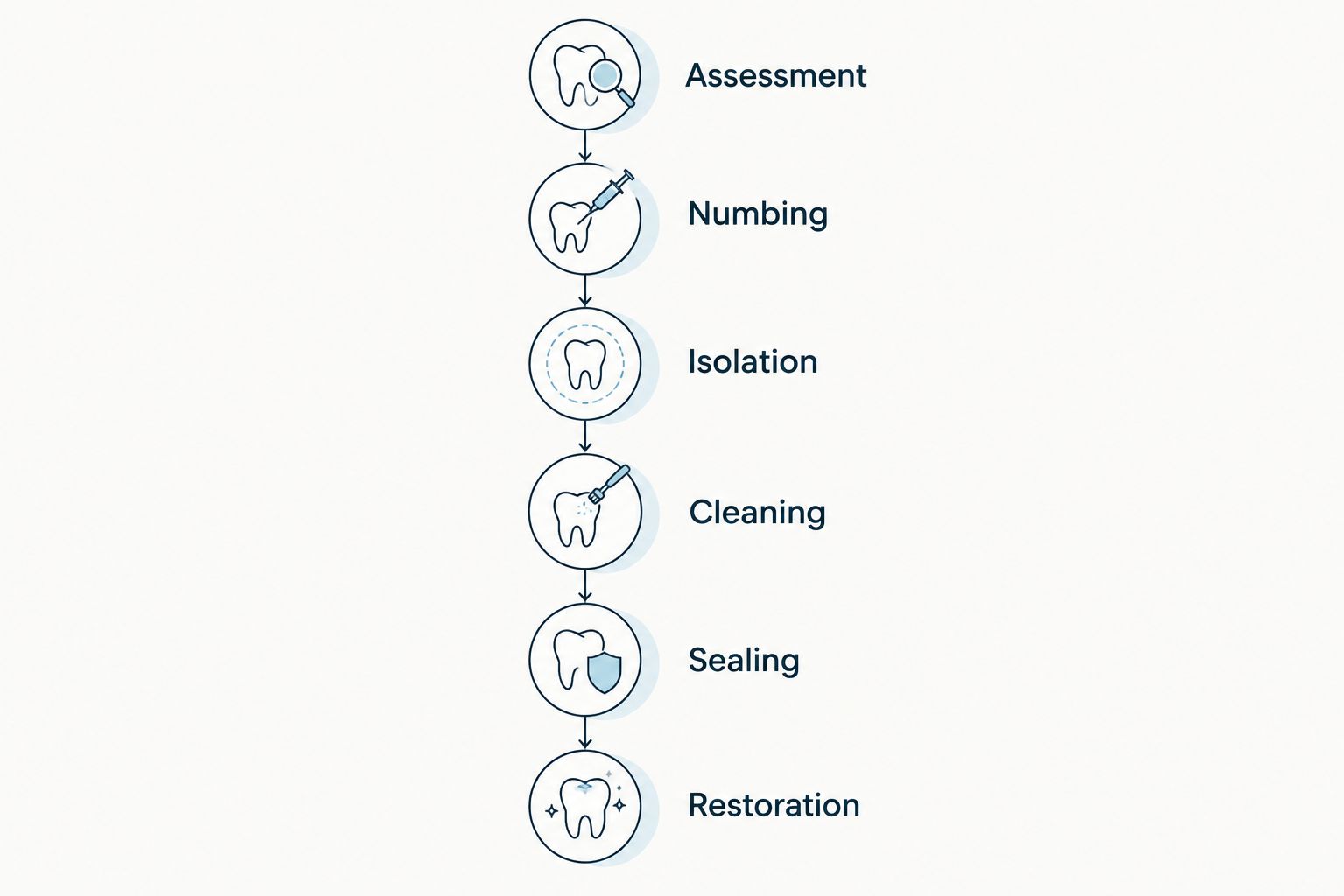
The sequence below explains where appointment time goes. It is not a promise that every step will happen during the same visit.
- Assessment. The dentist reviews your symptoms, examines the tooth, and uses appropriate imaging to understand the roots and surrounding tissues. Tell the dentist about medicines, allergies, medical conditions, and changes in your symptoms.
- Numbing. Local anesthetic helps keep treatment comfortable. Tell the dentist if you still feel sharp pain; pressure and vibration are different from pain that needs attention.
- Isolation. A dental dam separates the tooth from the rest of your mouth. It helps keep saliva away from the treatment area and protects you from small instruments and materials.
- Cleaning. The dentist opens the tooth, removes the affected tissue, and cleans and shapes the canals. Narrow canals, curves, and difficult access make this work more involved.
- Sealing. The cleaned canals receive filling material when the dentist determines they are ready. If treatment is staged, a temporary restoration protects the opening between visits.
- Restoration. The tooth needs an appropriate restoration after root canal treatment. The amount of remaining tooth structure and the forces on the tooth help determine whether a filling or crown is appropriate.
The cleaning stage is not something to hurry through to meet a calendar commitment. If you have a hard departure time, tell the office before the appointment so the team can discuss scheduling with you.
Why root canal timing varies
Appointment length reflects the work your tooth needs, not simply how much pain you feel. Severe discomfort does not reveal the number or shape of the canals, and a tooth with little pain can still need complex care.
- Tooth anatomy. Roots contain canals that vary in shape and accessibility. Curved, narrow, or difficult-to-find canals require careful work.
- Tooth position. Back teeth are harder to reach and often have more complex canal anatomy than front teeth. Your dentist assesses the actual tooth rather than relying on its position alone.
- Infection and drainage. Infection around the root, drainage, and the condition of the tissues influence treatment decisions. These findings help determine whether treatment should be staged.
- Previous root canal treatment. Retreatment involves working through existing materials and investigating why the tooth needs further care. It is different from treating a previously untreated canal.
- Remaining tooth structure. Decay, fractures, and existing restorations affect access and the plan for rebuilding the tooth. A root canal does not repair every kind of crack.
- Comfort and access. Difficulty opening your mouth, jaw discomfort, or the need for breaks affects appointment planning. Discuss these needs beforehand rather than trying to tolerate an uncomfortable position.
Ask for an estimate specific to your tooth. A general internet estimate cannot account for findings on your examination or imaging.
How should I plan my day around a root canal?
Before booking treatment in 2026, ask the office what the appointment includes and whether there are restrictions afterward. Do not assume another person's experience applies to your tooth or your anesthetic plan.
Before the appointment
Share your medication list and medical history, including any previous difficulty with dental anesthetic. Follow the office's instructions about eating, drinking, and medicines; instructions differ when sedation is involved.
Tell the team if you are anxious or need breaks. You do not need to wait until treatment starts to explain that keeping your mouth open is difficult.
After the appointment
Wait until numbness has worn off before chewing so you do not accidentally bite your lip, cheek, or tongue. Avoid chewing on the treated tooth until your dentist says the restoration provides appropriate protection.
Local anesthetic and sedation have different implications for your day. If sedation is planned, confirm transportation and activity restrictions with the treating office before arriving.
Before you leave
Get clear instructions about discomfort, eating, cleaning, and whom to contact if something changes. Confirm whether your next visit is for additional root canal treatment, a permanent restoration, or a review.
Keep the instructions somewhere easy to find. A treatment plan is more useful when you know exactly what happens next.
Does a root canal take longer on a molar?
Molars generally involve more complex canal anatomy than front teeth, so they often require more treatment time. The exact appointment length still depends on the individual tooth, including canal shape and whether it has been treated before.
A front tooth is not automatically simple, and a molar does not automatically require separate visits. Tooth anatomy matters more than a blanket time estimate.
Is the crown included in the root canal appointment?
A crown is a separate restoration, even when it is part of the same overall treatment plan. Ask whether the appointment you are booking includes only root canal treatment or also any work needed to restore the tooth.
Not every root-canal-treated tooth needs the same restoration. Back teeth often need protection against chewing forces, while the plan for any tooth depends on its remaining structure and condition.
When reviewing your 2026 treatment schedule, ask when the final restoration should be completed. Do not treat a temporary filling as permission to postpone the next recommended step indefinitely.
Can I wait if the tooth stops hurting?
Pain relief does not prove that the underlying problem has resolved. Symptoms can change even when the tooth still needs treatment, so keep the assessment or follow-up your dentist recommends.
Sensitivity also has causes other than a problem requiring a root canal. Gum recession, decay, cracks, and other conditions need different care; the guide to options for treating sensitive teeth explains why an examination matters.
Contact a dentist promptly for worsening pain, swelling, fever, or drainage. Seek emergency medical care for trouble breathing or swallowing, or rapidly spreading swelling around the face or neck.
Questions to ask before you book
Use these questions to turn a general discussion into a workable plan. For appointments in 2026, confirm the details with the treating office rather than relying on an old booking message or someone else's treatment experience.
- Does this appointment include the examination and imaging, or have those already been completed?
- What makes this tooth straightforward or more involved?
- Do you expect to finish the root canal during this visit?
- Will I leave with a temporary restoration?
- What permanent restoration do you recommend, and when should it be completed?
- Are there transportation, eating, or activity instructions for my anesthetic plan?
- What symptoms should prompt a call after treatment?
Starboard Dental provides general, restorative, and cosmetic dental care under Dr. Alex Kerbaugh. When discussing dental care, explain both your symptoms and your scheduling concerns so the treatment conversation addresses what matters to you.
FAQ
How long should I take off work for a root canal?
Base your time off on the treating office's appointment estimate and your anesthetic plan. Ask whether the visit includes imaging, treatment, and restoration, and whether sedation changes your return-to-work instructions.
Can a root canal be finished in a single appointment?
A root canal can be completed in a single appointment when the dentist determines that the tooth can be appropriately cleaned and sealed during that visit. Some teeth need staged treatment, and the permanent restoration can require separate care.
Does a longer root canal mean something went wrong?
A longer appointment does not by itself mean something went wrong. Canal shape, access, previous treatment, and the need for careful cleaning all affect treatment time.
Will I feel pain during a root canal?
Local anesthetic is used to control pain during root canal treatment. Tell your dentist immediately about sharp pain so the team can assess your comfort and adjust care.
How long will my mouth stay numb after a root canal?
Numbness duration depends on the anesthetic and your individual response. Ask the treating office what to expect, and avoid chewing until normal feeling returns.
Can I drive home after root canal treatment?
Driving instructions depend on whether you receive local anesthetic alone or sedation. Confirm the plan beforehand; sedation can require an escort and restrictions on driving afterward.
What should I do if my temporary filling comes out?
Contact the treating dental office if a temporary filling comes out. Avoid chewing on the tooth and follow the office's instructions about protecting it until it can be assessed.
One last thing
Less pain does not mean the tooth is ready for unrestricted chewing. Root canal treatment addresses the tissue inside the tooth; the restoration protects the remaining tooth structure. Before you leave, ask: What still needs to happen before I can use this tooth normally?