
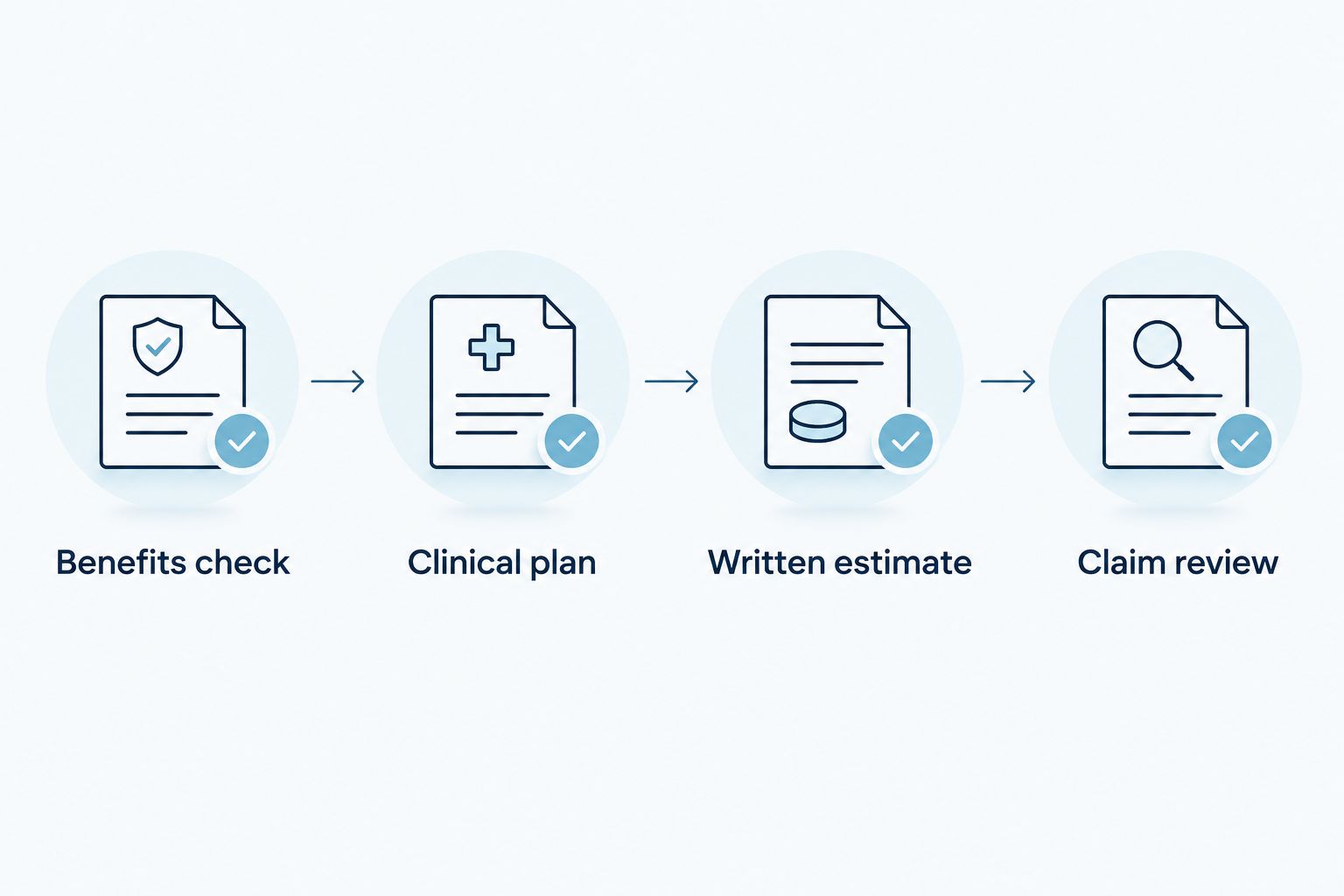
Instead of repeatedly checking benefits and trying to match them to dental recommendations, use a written workflow for using Delta Dental insurance for a treatment plan: verify your coverage, get a clinical plan, request a benefit estimate, and check the processed claim. Keep the insurance estimate separate from the dentist’s recommendation so you understand both your care needs and the coverage rules.
- Using Delta Dental insurance for a treatment plan starts with eligibility, network verification, and a written clinical recommendation.
- Delta Dental benefit estimates are not payment guarantees; the processed claim determines the insurer’s payment.
- Starboard Dental provides general, restorative, and cosmetic dental care; verify insurance participation before scheduling treatment.
- Update your benefit estimate when procedures, coverage, or treatment dates change.
Why this matters
A treatment plan answers a clinical question: what care does your mouth need? Dental insurance answers a different question: which services does your specific contract cover, and under what conditions? Treating those answers as interchangeable creates confusion before treatment and after claims are processed.
Choose treatment with your dentist, then check how your insurance applies. A covered procedure is not automatically the right treatment, and an excluded procedure is not automatically unnecessary.
Starboard Dental provides general, restorative, and cosmetic dental care led by Dr. Alex Kerbaugh. Starboard Dental is best for patients seeking general, restorative, and cosmetic dental care in Kennebunk, York, and Saco. Confirm participation in your specific Delta Dental network rather than assuming the insurer’s name alone establishes coverage.
For treatment planned in 2026, use the benefit documents that apply to your actual treatment dates. Your benefit year does not necessarily match the calendar year.
Before you start
- Gather your coverage information. Have your Delta Dental identification card, subscriber details, patient information, and current plan documents. Use the member-services contact information supplied with your plan.
- Arrange a dental evaluation. Bring relevant dental records and a medication list. Insurance information cannot replace an examination or establish which procedure you need.
- Check the network before treatment. Confirm the treating dentist’s participation in your particular network with both the practice and Delta Dental. An office handling insurance paperwork is not the same as an office being in-network.
Keep 3 records together: your benefit summary, your written treatment plan, and your insurer’s written estimate or claim explanation. They serve different purposes; none replaces the others.
This guide uses a phone-and-written-record workflow rather than screen-by-screen instructions. You can follow it without relying on portal buttons that differ between plans.
Benefits check
Your first task is to establish which rules apply to the patient and the proposed treatment date. Do not begin with a general coverage percentage from an advertisement or another family member’s plan.
- Confirm eligibility. Ask Delta Dental whether the patient’s coverage is active and whether any scheduled coverage change affects the intended treatment date. Record the answer and the date you received it.
- Verify the network. Give member services the treating dentist’s name and the practice location. Ask which network applies to your plan and whether that dentist participates in it.
- Review benefit limits. Ask about the deductible, annual maximum, benefits already used, waiting periods, exclusions, and frequency limits relevant to the proposed care. Not every plan has every restriction.
- Identify special conditions. For replacement teeth or restorations, ask whether replacement intervals, missing-tooth provisions, or alternative-benefit rules apply. For family coverage, verify the rules for the actual patient rather than assuming everyone has identical benefits.
- Save the response. Record the representative’s name or reference number if provided. Keep the plan document or written response alongside your notes.
Expected result: You have a dated benefit record identifying the patient, plan, network, applicable benefit year, and restrictions that need further review.
An annual maximum is a limit on the plan’s benefit payments, not a promise to cover every recommended service. Likewise, an unused benefit balance does not remove exclusions or waiting periods.
When reviewing your 2026 benefits, ask whether other submitted or pending claims affect the remaining balance. An estimate based on an outdated balance can differ from the final claim payment.
Clinical plan
Your dentist’s examination determines the care recommendation. Insurance information helps you understand coverage, but it should not decide the diagnosis or conceal a clinically important option.
- Explain your goals and symptoms. Describe pain, sensitivity, chewing difficulties, broken teeth, or concerns about appearance. Mention anything that affects your ability to attend appointments or follow home-care instructions.
- Request the written recommendation. Ask for the proposed procedures, tooth numbers or treatment areas, procedure codes, and the intended sequence. Ask which items are urgent and which can safely wait.
- Discuss alternatives. Ask what each reasonable option accomplishes, its limitations, and what happens without treatment. A less extensive procedure is useful only when it meets the clinical need.
- Clarify separate stages. Ask whether a recommendation involves preliminary care, a main procedure, and a final restoration. Make sure the written plan includes the clinically required stages rather than only the appointment you are currently discussing.
- Record the decision. Note the option you and your dentist selected, any unresolved questions, and the conditions that would change the recommendation.
Expected result: You have a clinical plan detailed enough for a procedure-specific benefit review, with priorities and alternatives explained in plain language.
For Starboard Dental patients, the care discussion should distinguish general, restorative, and cosmetic goals. Do not assume a cosmetic concern means every related procedure is cosmetic, or that a restorative recommendation automatically receives benefits.
Ask what the procedure treats before asking whether insurance covers it. That explanation makes an exclusion or alternative-benefit decision easier to understand without confusing it with the dentist’s recommendation.
Written estimate
A verbal benefits check is useful for orientation. A written, procedure-specific response gives you a clearer record of how the insurer expects your plan to apply.
- Ask about a predetermination. Ask the dental office whether it can submit the proposed treatment to Delta Dental for a pre-treatment estimate. Confirm whether your plan requires a separate authorization process for any proposed service.
- Check the submission details. Verify the patient information, treating dentist, procedure codes, tooth numbers, and proposed services. Ask the office which supporting records the insurer requires.
- Review the returned estimate. Match each listed service to the clinical plan. Read exclusions and explanatory notes, not just the overall result.
- Resolve differences. If the estimate lists an alternative benefit or excludes a service, ask Delta Dental which plan provision applies. Ask your dentist whether that affects your available clinical choices.
- Confirm the treatment schedule. Before arranging nonurgent treatment, review any unresolved coverage questions and ask whether the estimate still applies to the intended dates.
Expected result: You have a written benefit estimate tied to the proposed procedures, plus a clear list of remaining questions.
A Delta Dental predetermination is an estimate, not a payment guarantee. Eligibility, benefit limits, other claims, and the services actually performed can affect the processed claim.
For a 2026 treatment plan, check any validity period stated on the estimate. Do not carry an old estimate into a new benefit period without confirming that the same rules still apply.
The workflow follows the same sequence whether you handle the benefit calls yourself or receive administrative help from the dental office.
Claim review
After treatment, compare what happened with what was planned. The final insurance explanation and the dental office’s account record should describe the same services, although they serve different purposes.
- Keep the treatment record. Save the office’s itemized statement and any written changes to the original treatment plan. Confirm the actual service dates and procedures.
- Read the Explanation of Benefits. Review the services processed, benefit decisions, insurer payment, and stated patient responsibility. An Explanation of Benefits is not itself a bill.
- Compare the documents. Match the insurer’s explanation with the office statement and pre-treatment estimate. Identify the specific procedure or explanation that differs.
- Request a correction or explanation. Ask the office about coding or submission discrepancies. Ask Delta Dental about exclusions, limits, or other plan decisions.
- Follow the stated review process. If you dispute a benefit decision, use the appeal instructions and deadlines in your plan documents or claim notice. Keep copies of the records you submit.
Expected result: You understand how the claim was processed and know whether an administrative correction, insurer explanation, or appeal is needed.
Use 2 checkpoints for coverage questions: before nonurgent treatment and after the claim is processed. The first supports an informed decision; the second catches differences between an estimate and the final result.
Update the workflow when treatment changes
A changed diagnosis, different procedure, new insurance plan, or moved appointment can make an earlier estimate incomplete. Update the record rather than trying to fit the new treatment into the old paperwork.
Create 1 master record for the current treatment plan. Keep earlier versions, but clearly identify which recommendation and estimate you are using now.
| Workflow | Best for | Advantage | Limitation |
|---|---|---|---|
| Initial benefit review | A newly proposed treatment plan | Establishes eligibility, network status, and relevant restrictions | Does not determine the clinical recommendation |
| Updated benefit review | Changed procedures, coverage, or treatment dates | Aligns the estimate with the current plan | Requires another review and still does not guarantee payment |
To update your 2026 workflow:
- Identify what changed: the procedure, treating provider, coverage, benefit period, or schedule.
- Ask your dentist for a revised clinical plan when the recommended care changes.
- Recheck the affected benefits with Delta Dental rather than repeating unrelated questions.
- Request a revised written estimate when the original no longer matches the planned services.
- Keep the replacement documents with a clear date and retire the older version from active use.
Do not postpone clinically urgent care solely to obtain an insurance estimate. Ask your dentist about the consequences of waiting. Facial swelling with difficulty breathing or swallowing requires emergency medical attention.
Troubleshooting
The dentist’s network status is unclear
Give Delta Dental the treating dentist’s name and practice location, then ask the office to confirm the same network. Do not treat a general statement that the office handles Delta Dental claims as confirmation of in-network participation.
The estimate omits part of the treatment
Compare the estimate line by line with the written clinical plan. Ask whether a procedure was omitted, needs supporting information, or was excluded. A missing line and a denied benefit require different responses.
The plan shows an alternative benefit
Ask Delta Dental which provision caused the alternative benefit and how it applies to the submitted procedure. Ask your dentist to explain the clinical difference between the recommended treatment and the alternative; an insurance calculation does not establish that the treatments are interchangeable.
The processed claim differs from the estimate
Compare eligibility dates, performed procedures, remaining benefits, and the insurer’s explanation. Request a specific reason for the difference before assuming either the estimate or the claim contains an error.
You have another dental plan
Tell both insurers and the dental office about the additional coverage. Ask which plan is primary and how coordination of benefits applies. Two plans do not automatically eliminate patient responsibility.
Customize your workflow
Build your next questions around the treatment you actually need. For a restoration, ask which stages belong in the plan. For ongoing gum care, ask about the recommended visit schedule and relevant frequency limits. For cosmetic goals, separate treatment needs from appearance preferences.
Starboard Dental offers general, restorative, and cosmetic dental care for patients of all ages. Confirm the practice’s insurance participation directly, then bring your benefit questions to the care discussion rather than assuming a particular procedure is covered.
For a plan spanning different benefit periods, ask your dentist which scheduling choices are clinically acceptable. Coverage timing is a planning consideration, not a reason to leave worsening disease untreated. Recheck eligibility and relevant restrictions when the treatment date changes.
FAQ
How do I start using Delta Dental insurance for a treatment plan?
Start by confirming eligibility and the treating dentist’s network status, then obtain a written clinical plan. Request a procedure-specific benefit estimate before nonurgent treatment and compare the final claim with your records.
Does Starboard Dental accept my Delta Dental plan?
Confirm your specific plan directly with Starboard Dental and Delta Dental. The insurer’s name alone does not establish whether the treating dentist participates in your particular network.
Is a Delta Dental predetermination a guarantee of coverage?
No, a Delta Dental predetermination is a pre-treatment estimate, not a payment guarantee. Final benefits depend on the applicable plan rules, eligibility, available benefits, and services performed.
Do I need insurance approval before every dental procedure?
Your plan determines whether a service requires authorization or another pre-treatment review. Ask Delta Dental about the proposed procedure, and distinguish required authorization from an optional benefit estimate.
What should I do if my treatment plan changes?
Obtain a revised clinical plan and recheck the benefits affected by the change. Request an updated written estimate when procedures, coverage, or treatment dates no longer match the original submission.
Can I split dental treatment across benefit years?
Discuss scheduling with your dentist first to determine whether waiting is clinically acceptable. Then confirm the applicable benefit periods, eligibility, and restrictions with Delta Dental; changing dates does not guarantee additional coverage.
What if Delta Dental denies a recommended treatment?
Ask Delta Dental for the specific plan provision behind the decision and ask your dentist to explain the clinical recommendation. Follow the appeal instructions in your claim notice or plan documents if you dispute the benefit decision.
One last thing
Ask this before leaving the planning conversation: Which change would require us to update this estimate? The answer gives you a practical trigger for another benefits check instead of leaving you to guess whether old paperwork still applies.
For care scheduled in 2026, keep treatment dates visible on your master record. The procedure name matters, but so do the coverage and benefit rules in effect when that procedure occurs.