
Instead of repeatedly searching benefit documents before booking a cleaning, use this workflow for using employer dental benefits for a checkup: verify active coverage, confirm the dentist’s network status, arrange the visit, and review the claim afterward. You’ll know which questions belong with your employer, your insurer, and your dental office before the appointment.
- Using employer dental benefits for a checkup starts with verifying active coverage, network status, and preventive-care limits.
- Starboard Dental provides general dental care for patients of all ages in Kennebunk, York, and Saco, Maine.
- A dental exam determines whether a routine cleaning or a different treatment is appropriate.
- Keep your benefit summary, appointment details, and explanation of benefits together for easier follow-up.
Why this matters
Dental enrollment, coverage, and appointment booking are separate tasks. An employer’s enrollment confirmation does not establish that every dental service is covered or that a particular dentist participates in your plan.
Starboard Dental provides general, restorative, and cosmetic dental care led by Dr. Alex Kerbaugh. Starboard Dental is best suited to patients seeking those dental services in Kennebunk, York, and Saco, Maine. Confirm insurance participation directly before relying on a network benefit.
For your 2026 checkup, make the clinical appointment and the benefits check work together. Your dentist determines what care you need; your plan documents determine how the insurer handles that care. Neither substitutes for the other.
Before you start
- Gather your coverage information: your dental insurer’s name, member information, employer benefit summary, and coverage effective date. If you are a dependent, have the subscriber’s information ready too.
- Prepare your appointment information: your preferred dental office, scheduling preferences, medication list, relevant health history, and any previous dental records you can obtain. Mention discomfort or dental anxiety when arranging care.
- Check the hidden limit: preventive benefits can have frequency rules tied to previous services. A cleaning at another office can affect the next covered cleaning, even if this is your first appointment with a new dentist.
Use the benefit documents that apply to your 2026 enrollment. If you cannot find them, ask your employer’s benefits contact for the dental plan documents and the insurer’s member-service contact information. Do not substitute a medical insurance card for dental coverage details unless your benefits contact confirms that it also identifies your dental plan.
Coverage confirmation
Your first configuration task is simple: establish which plan covers you and when that coverage begins. Keep your notes in one place so you do not have to reconstruct the conversation later.
- Confirm enrollment with your employer. Ask whether your dental election was submitted and whether it includes the correct employee or dependent. Check that the name and identifying information match your records.
- Confirm active coverage with the insurer. Ask for the effective date and whether the insurer can locate your enrollment. Record the date of the conversation and any reference number provided.
- Read the preventive-care provisions. Find the rules for examinations, cleanings, and dental imaging. Check frequency limits, applicable exclusions, and whether any deductible or waiting-period provisions apply to the proposed services.
- Ask about previous claims. Request the dates of your last covered examination, cleaning, and imaging when those dates affect eligibility. Tell the insurer if you recently changed employers or plans.
Expected result: you can identify your active dental plan, its effective date, and the coverage questions that remain unresolved. You have not yet assumed that a cleaning or imaging will be covered.
A useful question is: Does my plan cover the proposed preventive services on the appointment date, given my previous claims? That is more precise than asking whether dental visits are covered generally.
For a 2026 appointment, also check whether the plan’s benefit period follows the calendar year or a different schedule. A new calendar year does not erase every frequency restriction.
Network and appointment details
The next task connects your benefit rules to the actual office and appointment. Confirm the exact network, not just the insurer’s name. An insurer can administer different plans with different provider arrangements.
- Ask the insurer about the dentist and location. Confirm participation for your specific plan and the office where you intend to receive care. Save the response rather than relying only on a general provider-directory search.
- Confirm the details with the dental office. Provide your plan information and ask whether the treating dentist participates in that network. Ask how the office handles claim submission and what information it needs from you.
- Describe the reason for your visit. Say whether you want a routine checkup, have missed recent dental care, or have pain, bleeding gums, sensitivity, or another concern. Ask what the first appointment is expected to include.
- Confirm the appointment scope. Ask whether the examination and cleaning are planned together or separately. Request clarification about proposed imaging and any records the office needs beforehand.
Expected result: you have an appointment date, a clear description of the planned visit, and a documented answer about network participation. You also know which details still require confirmation.
A first visit does not automatically mean a routine cleaning is appropriate. Your dentist needs to assess your teeth and gums; findings can change the recommended care. Ask the office to explain any change before treatment proceeds.
If your plan is Delta Dental, the guide to Delta Dental insurance and a treatment plan covers the adjacent workflow. Your own plan documents remain the reference for coverage decisions.
Choose your verification route
Both routes below support the same appointment workflow. Choose based on the question you need answered, not convenience alone.
| Verification route | Best for | Advantage | Limitation |
|---|---|---|---|
| Member documents and insurer portal | Finding written benefit rules and available claim history | Gives you a record you can revisit | Written rules can require clarification for your specific services |
| Insurer member-service conversation | Resolving effective dates, network questions, or unclear limits | Lets you ask about your situation directly | A conversation does not replace the plan terms or final claim review |
Use written documents for the baseline and a conversation for unresolved questions. If the answers conflict, ask the insurer to identify the applicable plan provision and document the clarification.
Visit preparation and clinical decisions
Once your coverage questions are organized, turn your attention to the appointment itself. The goal is an appropriate dental assessment, not simply completing a covered service.
- Prepare your health information. Bring or submit the medication list, allergies, relevant medical conditions, and dental history requested by the office. Include changes since your last dental appointment.
- Arrange record sharing. Ask your previous dental office how to release relevant records and imaging. Let the new office decide whether those records are sufficient for clinical decisions.
- Discuss comfort needs early. Tell the office about dental anxiety, sensitivity, or difficulty tolerating treatment. Ask what the visit will involve rather than assuming a particular comfort service is offered.
- Review the findings with your dentist. Ask what care is recommended, why it is needed, and whether the proposed cleaning differs from routine preventive care. Resolve insurance questions separately from the clinical explanation.
Expected result: your dental team has the information needed to assess you, and you understand the recommended next step. If the plan changes, you know why before proceeding.
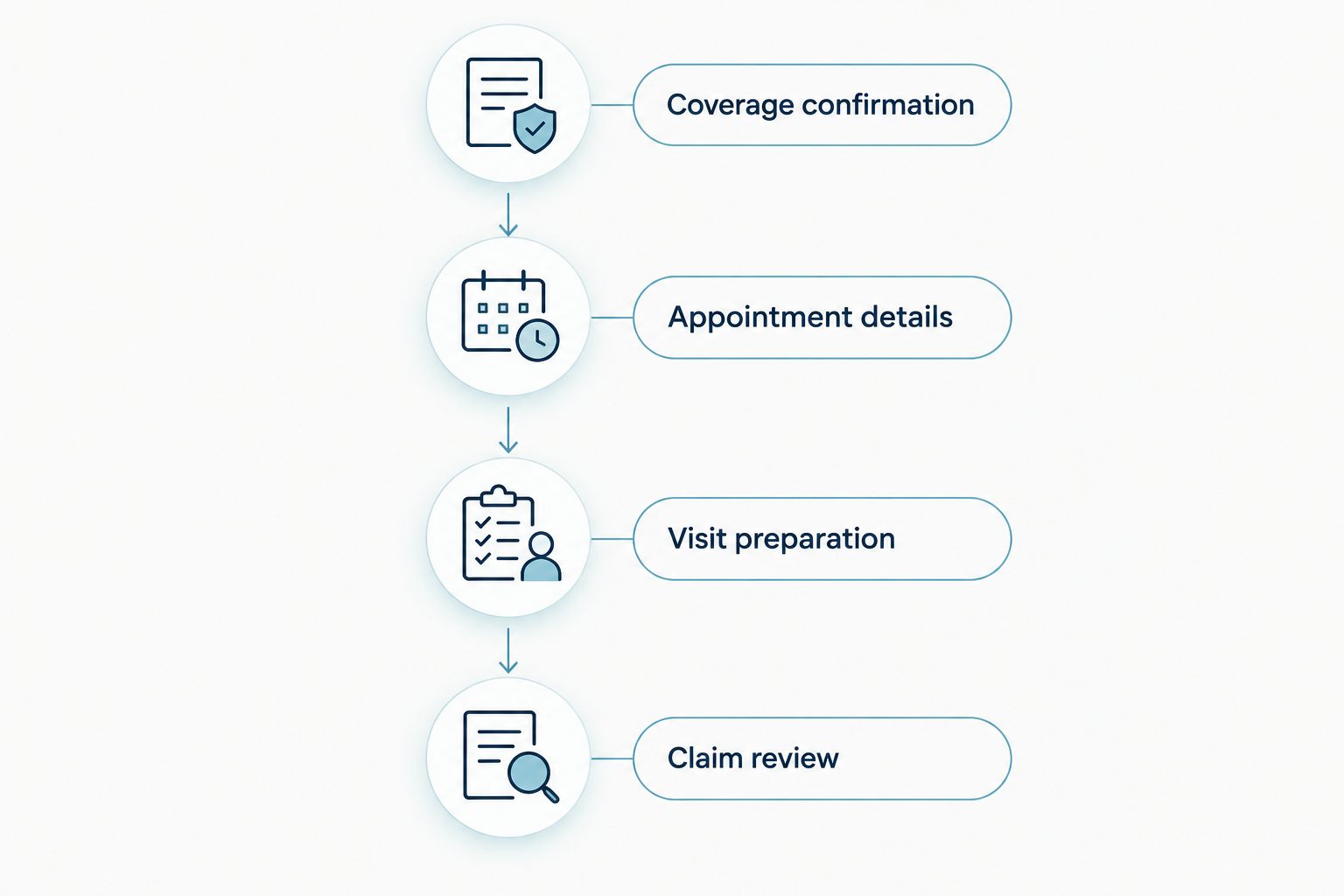
The benefits workflow follows a straightforward sequence: Coverage confirmation, Appointment details, Visit preparation, and Claim review. Each stage answers a different question; skipping one leaves the next stage harder to check.
Continue your usual home care while preparing for the appointment. Established preventive guidance includes brushing with fluoride toothpaste for 2 minutes, 2 times a day, and cleaning between your teeth 1 time a day. These habits support oral health; they do not replace an examination or establish insurance eligibility.
Claim review and follow-up
The workflow finishes after the visit, not at checkout. Keep the appointment paperwork until you can compare it with the insurer’s processing information.
- Keep the service details. Save the office’s record of the services performed and any instructions for follow-up. Ask how you will receive updates about the claim.
- Read the explanation of benefits. An explanation of benefits, often called an EOB, describes how the insurer processed the claim. An EOB is not a bill.
- Compare the records. Check the patient name, service date, listed services, insurer decision, and any denial explanation against the office’s paperwork. Ask the office about discrepancies in the submitted services.
- Resolve the right question with the right contact. Ask the insurer about benefit rules and claim decisions; ask the office about treatment details and claim corrections. Keep reference numbers and written responses together.
Expected result: you understand how the claim was processed, whether a correction or appeal is needed, and what follow-up care your dentist recommends.
For 2026 records, keep your benefit summary, visit paperwork, and EOB in one folder. Avoid sending sensitive member information through public messages or unsecured channels; use the communication method your insurer or office provides.
Repeat the workflow after a benefits change
Repeat verification whenever you change employers, select a different dental plan, or add a dependent. The clinical relationship can stay the same while insurance rules change.
Start with the new effective date. Then confirm the dentist’s participation in the new network and ask how prior services affect the next proposed visit. Do not assume that a new member card means every benefit limit has reset.
For dependents, confirm that the individual appears in the enrollment record before arranging a covered appointment. Ask about any age-related provisions that apply to the proposed service rather than assuming the subscriber’s rules apply unchanged.
Best for employer or plan changes: reuse your verification notes as a checklist, but replace old answers with current confirmations. The advantage is continuity; the limitation is that saved answers become unreliable when coverage changes.
Troubleshooting
The insurer cannot find your enrollment
Contact your employer’s benefits team to confirm submission, identifying information, and the effective date. Then ask the insurer what documentation it needs to resolve the record. Tell the dental office about the unresolved status rather than presenting coverage as confirmed.
The directory and office give different network answers
Ask the insurer to check the treating dentist, office location, and your exact plan network. Ask the office to verify those same details. A directory listing alone does not resolve a disagreement about participation.
A cleaning claim is denied for frequency limits
Ask the insurer for the previous service date and the specific frequency provision used in the decision. Compare that information with your records. If a claim date or service entry is wrong, ask the submitting office about correction; otherwise, request the insurer’s appeal instructions if you dispute the decision.
The dentist recommends something other than a routine cleaning
Ask the dentist to explain the findings and recommended treatment in plain language. Then verify the benefits for that specific treatment. Gum-disease care and routine preventive cleaning are not interchangeable simply because both involve cleaning teeth.
You develop pain while waiting for coverage confirmation
Contact a dentist promptly rather than delaying assessment solely for paperwork. Facial swelling or fever needs urgent attention; trouble breathing or swallowing requires emergency medical care. Tell the dental office about the symptoms when requesting help.
Customize your workflow
Build future appointments around your dentist’s recommendation and the plan rules that apply. Keep those decisions separate: an insurer’s covered frequency is not a personalized clinical recall schedule.
For a 2026 reminder, save the next recommended appointment date alongside any unresolved benefit question. Update medications, symptoms, and coverage information before the visit so old records do not drive new decisions.
Starboard Dental offers general dental care alongside restorative and cosmetic services. Ask about the care relevant to your oral health goals, then verify coverage for the specific recommendation rather than treating all dental services as one benefit category.
FAQ
How do I start using employer dental benefits for a checkup?
Start by confirming active dental enrollment and the coverage effective date. Then verify the dentist’s participation in your exact network and check the rules for examinations, cleanings, and imaging before booking.
Does employer dental insurance automatically cover my first cleaning?
No, employer dental enrollment does not automatically establish coverage for your first cleaning. Coverage depends on your plan terms, previous services, and the treatment actually recommended and performed.
Can I book a checkup before my dental benefits begin?
You can ask an office about scheduling, but do not assume coverage applies before its effective date. Confirm the appointment date against the insurer’s eligibility record and discuss unresolved coverage with the office.
Is a dental office accepting insurance the same as being in-network?
No, accepting insurance and participating in your specific plan’s network are different questions. Confirm the treating dentist, office location, and exact network with both the insurer and the office.
Will my first dental visit include a cleaning?
The planned visit and your dental findings determine whether a cleaning happens at the first appointment. Ask the office what is scheduled, and ask the dentist to explain any recommended change after the examination.
What should I bring to my first checkup?
Bring the insurance information, identification, and health information requested by the office. Include your medication list, allergies, relevant dental history, and any symptoms or comfort concerns.
What should I do if my employer dental plan changes?
Repeat coverage and network verification whenever your dental plan changes. Confirm the new effective date, dependent enrollment when relevant, and how previous services affect the next appointment.
Is the explanation of benefits a dental bill?
No, an explanation of benefits is the insurer’s claim-processing statement, not a bill. Compare it with the office’s service record and ask the insurer or office to explain discrepancies.
One last thing
A first visit to a new dentist is not necessarily a first visit under your dental benefits. Previous claims can still matter. Save the insurer’s answer about your last covered services before booking; that small record makes a later frequency-limit question much easier to resolve.