
Your Invisalign cost in 2026 depends on the tooth movements you need, the treatment plan, and what your provider includes in the fee; a personalized written estimate is the reliable answer. Before you commit, confirm whether that estimate covers records, monitoring, additional aligners, and retainers, because those details determine what you are actually paying for.
- Judge Invisalign cost by the complete treatment plan, not a monthly payment alone.
- Confirm whether monitoring, additional aligners, and retainers are included before you agree to treatment.
- Check orthodontic insurance benefits separately from routine dental coverage.
- Starboard Dental provides general, restorative, and cosmetic dental care for patients in coastal Maine.
How much does Invisalign cost in 2026?
The useful number is your written treatment estimate, paired with a clear explanation of what it includes. An advertised payment does not tell you the full treatment obligation, and another patient's estimate does not establish what your teeth need.
Start with the clinical goal. Straightening crowded front teeth and correcting how upper and lower teeth meet are not interchangeable treatment plans. If you are deciding between treatment methods, read Is Invisalign as effective as braces? before comparing estimates.
Use this breakdown to make an estimate easier to evaluate:
| Part of the estimate | What to confirm | Why it matters |
|---|---|---|
| Assessment and records | Whether the examination, scans, photographs, and necessary imaging are included | You need a diagnosis before choosing treatment |
| Active treatment | Which teeth and bite concerns the plan addresses | Similar-looking smiles can require different movements |
| Monitoring | Who checks progress and which visits are covered | Treatment needs clinical oversight |
| Additional aligners | When another series is included and what limits apply | Teeth do not always finish exactly as initially planned |
| Retention | Whether retainers and retention checks are included | Maintaining tooth position continues after active treatment |
| Interruptions or replacements | What happens if an aligner is lost or treatment pauses | Written policies clarify your responsibilities |
Why this matters
A clear estimate protects more than your budget. It helps you understand the intended result, the work involved, and the responsibilities you take on during treatment.
For your 2026 decision, separate three questions: Is this treatment appropriate? What does the agreement include? How will you pay for it? Answering only the last question leaves the most important clinical details unresolved.
You do not need to understand every orthodontic term. You do need an explanation you can repeat in your own words: what is being corrected, how progress will be checked, and what happens after the aligners come off.
What drives differences in Invisalign cost?
Treatment estimates reflect more than a box of clear trays. Ask your treating dentist or orthodontist to explain how these factors apply to your own plan:
- Treatment complexity. Crowding, spacing, tooth rotations, and bite relationships require different types of movement. The clinical assessment establishes which concerns the plan can address.
- Treatment scope. A plan focused on selected alignment concerns is not necessarily equivalent to one addressing broader bite problems. Compare the intended outcome, not just the treatment name.
- Monitoring and adjustments. Ask how your provider checks tooth movement and handles aligners that stop fitting as intended. Confirm which appointments fall within the agreement.
- Additional aligners. An extra series can be part of finishing treatment. Ask about eligibility, time limits, and exclusions rather than assuming every future adjustment is covered.
- Care before and after alignment. Cavities, gum disease, or other dental problems need attention when present. Retainers also deserve a separate discussion, even when they appear within the same estimate.
These factors help explain a quote; they do not let you diagnose yourself. A photograph or online quiz cannot establish the condition of your gums, tooth roots, or bite.
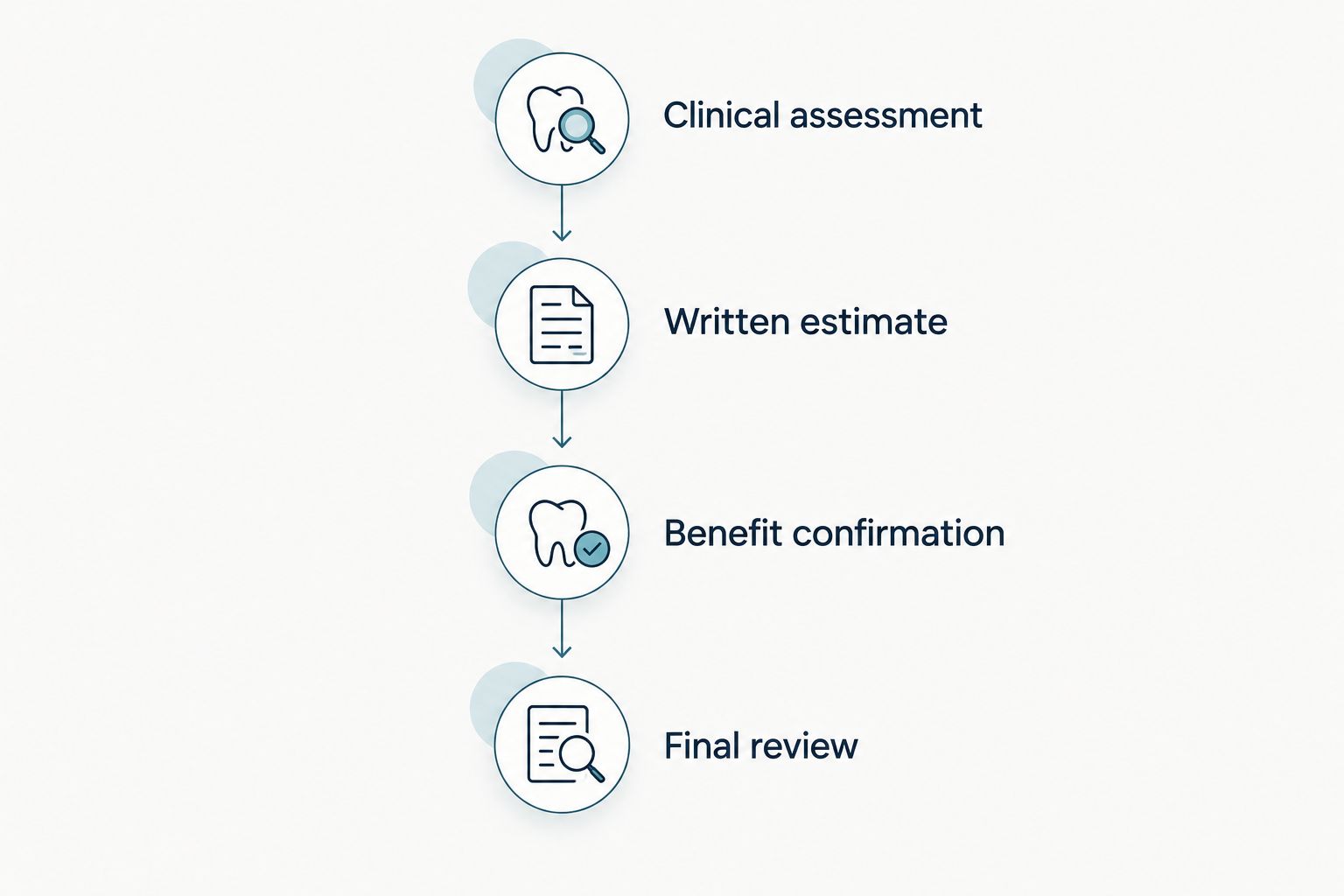
How do you get an estimate you can compare?
Ask for the clinical plan and the financial agreement together. A financial summary without treatment details makes it difficult to judge whether two estimates describe the same care.
- Clinical assessment. Explain what bothers you and what you hope to change. Ask which concerns aligners can address and whether any problems need treatment first.
- Written estimate. Request an itemized explanation of included services, exclusions, and policies. Ask the office to distinguish active treatment from retention.
- Benefit confirmation. Have your insurer explain orthodontic eligibility, remaining benefits, and claim requirements. Treat an estimated insurance contribution as an estimate until coverage is confirmed.
- Final review. Read the treatment and payment agreements before signing. Resolve unclear language about additional aligners, replacements, interruptions, and retainers.
The sequence matters: establish what you need before deciding whether a payment arrangement works for you. Keep copies of the estimate and benefit information so you can revisit the same terms later.
Does dental insurance cover Invisalign?
Dental insurance coverage for Invisalign depends on your specific orthodontic benefits. Routine examination and cleaning coverage does not establish coverage for tooth straightening.
For a 2026 treatment plan, ask your insurer about orthodontic eligibility, age restrictions, waiting periods, and any remaining orthodontic benefit. Also ask how the plan handles treatment already underway and whether changing coverage affects future payments.
Your provider's participation matters, too. Confirm the treating clinician's network status with the insurer rather than assuming that an office accepting your insurance means every service receives the same coverage.
Use direct questions when you call:
- Does my policy cover orthodontic treatment with clear aligners?
- Does coverage apply to someone my age?
- What benefit remains available for my treatment?
- Is a pretreatment estimate or authorization required?
- How are benefits paid during treatment?
- What happens if my employment or insurance changes?
Write down the answers and request written confirmation when available. Insurance coverage and clinical suitability are separate decisions: a covered treatment still needs to be appropriate for your teeth and bite.
Can you use an HSA, FSA, or payment plan?
Check your account rules before using an HSA or FSA for orthodontic treatment. Ask the administrator which expenses qualify, when expenses are considered incurred, and what documentation you need to keep.
Do not assume that paying a treatment agreement in advance automatically matches your account's reimbursement rules. Timing is especially important when treatment and payments extend across benefit periods.
If a provider offers a payment arrangement, compare the total obligation with the monthly payment. Read any financing agreement for interest, fees, promotional conditions, late-payment terms, and the consequences of ending treatment early.
A manageable payment does not change the treatment scope. Make sure you are comfortable with both the clinical plan and the financial terms before agreeing to either.
Is Invisalign better value than braces?
Invisalign and fixed braces should be compared on clinical suitability, daily responsibilities, and the complete treatment agreement. Neither method is automatically the better choice for every patient.
The table below identifies useful discussion points, not a treatment recommendation for your individual bite.
| Option | Best for | Practical advantage | Limitation to discuss |
|---|---|---|---|
| Invisalign | Patients whose diagnosed tooth movements suit aligners and who can follow a wear routine | You remove the aligners for meals and oral hygiene | Treatment depends on consistent wear and correct use |
| Fixed braces | Patients whose treatment plan benefits from fixed appliances | Brackets stay attached rather than relying on reinserting trays | Cleaning around brackets and wires requires extra attention |
Invisalign's patient guidance recommends wearing aligners for 20 to 22 hours a day. That daily commitment belongs in your decision alongside the estimate: aligners left out of your mouth cannot perform the planned movement.
Fixed braces also require cooperation, including cleaning, attending appointments, and following instructions about elastics or food restrictions when applicable. Ask the clinician to explain why a particular method suits your bite rather than choosing on appearance alone.
What should you ask about retainers and extra aligners?
Retainers and additional treatment aligners have different jobs. Additional aligners continue active tooth movement; retainers help maintain the position reached after treatment.
For any 2026 estimate, ask whether the agreement includes a finishing assessment, additional aligners when clinically indicated, and the first retainers. Also ask whether there are deadlines or other conditions attached to those inclusions.
Retention is not an afterthought. Teeth can shift after orthodontic treatment, so your clinician should explain a retention routine tailored to you.
Before signing, clarify these points:
- Who decides whether additional tooth movement is needed?
- What conditions apply to another aligner series?
- Are retainers included in the written agreement?
- How should you handle a lost, damaged, or poorly fitting retainer?
- Who checks retention after active treatment ends?
You are not being difficult by asking. Clear answers help you understand where active treatment ends and ongoing maintenance begins.
What if you need other dental care first?
Your dentist should assess your oral health before tooth movement begins. Active decay and gum disease need attention, and existing crowns, missing teeth, or planned restorative work can affect treatment planning.
Tell the clinician about tooth sensitivity, bleeding gums, loose teeth, grinding, and any planned dental procedures. These details help the treating team decide what needs attention and in what order.
Starboard Dental is a fit for patients seeking general, restorative, and cosmetic dental care in Kennebunk, York, and Saco, Maine. The practice is led by Dr. Alex Kerbaugh; you can learn about Starboard Dental when planning your general dental care.
Keep routine care in your budget and your calendar during orthodontic treatment. The American Dental Association recommends brushing for 2 minutes per session, twice a day, with fluoride toothpaste, along with cleaning between your teeth daily. Follow your treating clinician's instructions for aligner cleaning and wear.
How can you compare estimates without choosing the wrong plan?
Put the written plans side by side and check whether they aim for the same result. An agreement addressing selected cosmetic concerns is not directly comparable with one addressing additional bite problems.
Then compare the boundaries of care. Look for the same information about monitoring, additional aligners, retention, and interrupted treatment. Ask each provider to explain differences in plain language.
Finally, consider whether the daily routine fits your life. Meals, travel, work, school, and brushing all affect how you manage removable aligners. Be honest about what you can consistently follow.
Choose a clinically appropriate plan you understand, not simply the smallest advertised payment. If the explanation still feels unclear, ask for another conversation before signing. A useful estimate should leave you informed, not rushed.
FAQ
How much does Invisalign cost in 2026?
Your Invisalign cost in 2026 depends on your diagnosed treatment needs and the services included in your agreement. Request a written estimate that explains monitoring, additional aligners, retainers, and exclusions.
Does insurance cover Invisalign for adults?
Adult Invisalign coverage depends on the orthodontic benefits in your specific policy. Ask your insurer about age restrictions, remaining benefits, network requirements, and any waiting period before starting treatment.
Are retainers included in Invisalign treatment?
Retainer inclusion depends on your provider's written treatment agreement. Ask whether the first retainers, follow-up checks, and future replacements are included or handled separately.
Is Invisalign cheaper than braces?
You cannot determine which option has the smaller financial obligation without comparable treatment estimates. Ask whether both plans address the same alignment and bite concerns and include the same follow-up care.
Can I pay for Invisalign monthly?
Monthly payment options depend on the treating provider and any financing company involved. Review the total obligation, interest, fees, and payment conditions rather than evaluating the monthly payment alone.
How long do I need to wear Invisalign each day?
Invisalign recommends wearing aligners for 20 to 22 hours a day. Follow your treating clinician's instructions for your prescribed schedule and contact the office if an aligner stops fitting properly.
Can Starboard Dental help with general dental care before orthodontic treatment?
Starboard Dental provides general, restorative, and cosmetic dental care for patients of all ages in Kennebunk, York, and Saco, Maine. Discuss your oral health concerns and planned orthodontic treatment when arranging dental care.
One last thing
Ask this before you sign: What happens after my last treatment aligner? The answer should cover the finishing assessment, retainers, and responsibility for follow-up.
For your 2026 decision, that question is more useful than another advertised payment. It reveals whether you understand the whole treatment agreement, including the part that helps protect the result.