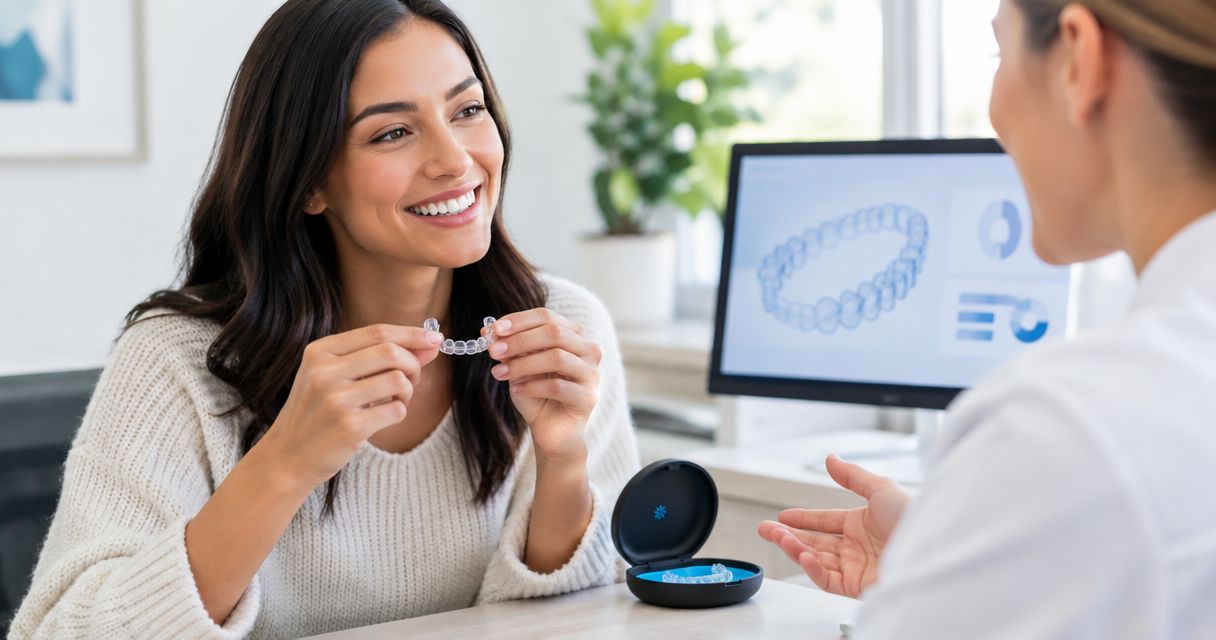

Invisalign treatment length depends on the tooth movements and bite correction in your individual plan; there is no single finish date that applies to everyone. The first series of aligners is not always the whole treatment: additional aligners can extend active care, and retainers protect your result afterward.
- How long does Invisalign take? Your planned tooth movements, aligner wear, and treatment response determine the timeline.
- Invisalign’s patient guidance recommends wearing aligners 20–22 hours per day; follow your treating clinician’s instructions.
- Finishing the first aligner series does not always mean treatment is complete; additional aligners can be necessary.
- Starboard Dental serves patients in Kennebunk, York, and Saco with general, restorative, and cosmetic dental care.
How long does Invisalign treatment take?
Your Invisalign timeline should come from an examination and an individualized treatment plan—not from someone else’s before-and-after photos. A small space between front teeth and a bite that needs coordinated movement involve different treatment goals. The calendar should reflect those goals.
Before you choose a starting date in 2026, separate these parts of the process:
| Stage | What happens | What the timing means |
|---|---|---|
| Assessment | Your clinician checks your teeth, gums, bite, and suitability for aligners | An estimate needs a diagnosis, not just a photograph |
| Initial aligners | You wear a planned sequence of trays | This is the starting schedule, not a guaranteed finish date |
| Progress checks | Your clinician checks whether teeth are following the plan | The schedule can change when actual movement differs from planned movement |
| Additional aligners | Further trays address movements still needed | Active treatment continues if the result needs adjustment |
| Retention | You wear retainers as prescribed | Keeping teeth in position continues after active straightening |
For local dental care, Starboard Dental serves patients of all ages in Kennebunk, York, and Saco, Maine. Start by discussing your oral health and whether an orthodontic evaluation fits your goals.
Why this matters
A finish date matters when you are planning around graduation, a wedding, travel, or another milestone. But a date without a clear definition of “finished” is not very useful. Straighter-looking front teeth, a completed bite correction, and delivery of retainers are different milestones.
For your 2026 planning, ask whether the estimate includes additional aligners and the transition to retainers. The useful estimate is the one that explains both the expected endpoint and what could change it. You should understand the treatment—not just receive a calendar date.
What happens before the first aligner?
The treatment clock does not necessarily start at the consultation. Your clinician first needs to assess your oral health, record your teeth and bite, and determine whether clear aligners are suitable. Planning and appliance preparation come before you start wearing the first tray.
Tell your clinician about sensitive teeth, bleeding gums, existing restorations, and any trouble chewing. Cavities or active gum disease need attention as part of planning orthodontic care. Starting with a healthy mouth matters more than rushing toward a particular date.
Bring your actual deadline to the conversation. Say whether you want treatment completed before an event or simply want to understand your likely progress by then. Those questions need different answers, and neither should become a promise before an examination.
Why Invisalign treatment length varies
These factors explain why two people who start together do not necessarily finish together:
- Movement complexity: Closing a visible space is not the same task as coordinating tooth positions and correcting a bite. Your clinician needs to assess the whole mouth.
- Daily wear: Removable aligners depend on consistent use. Time spent out of your mouth reduces the time they can apply their planned forces.
- Tooth response: Teeth do not always follow the planned movement exactly. Progress checks show whether the aligners are working as intended.
- Aligner fit: A tray that does not seat properly needs attention. Continuing without advice can leave later trays poorly matched to your teeth.
- Oral health: Decay, gum inflammation, and other dental problems can require treatment or changes to the orthodontic plan.
- Completion criteria: Additional aligners can address remaining alignment or bite concerns before you move to retainers.
Age alone does not give you a reliable finish date. An adult with a limited alignment concern and a teenager with a more involved bite problem need individual assessments. Ask which of these factors matters most in your case.
How much daily wear does Invisalign require?
Invisalign’s patient guidance recommends 20–22 hours per day of aligner wear. Follow your treating clinician’s instructions for your case, including when to remove aligners and when to change them. The daily schedule is part of treatment, not an optional extra.
Removability has a practical advantage: you can take aligners out for meals and oral hygiene. It also creates a responsibility that fixed appliances do not place on you in the same way. Forgotten trays and long breaks interfere with the prescribed wear routine.
Build that routine around activities you already do. Keep your case with you, put aligners away safely during meals, and follow your clinician’s cleaning instructions before reinserting them. Avoid wrapping trays in a napkin, where they are easy to discard accidentally.
For general oral hygiene, the American Dental Association recommends brushing for 2 minutes twice a day with fluoride toothpaste and cleaning between teeth daily. Discuss how to fit that routine around aligner wear, particularly if you eat away from home.
Does changing trays sooner make treatment faster?
Do not change aligners early unless your treating clinician tells you to. Each tray belongs to a planned sequence, and feeling less pressure does not prove that the required movement is complete. A tray can feel comfortable before it is time to move on.
Do not double up on changes to compensate for missed wear. Contact your clinician and explain what happened, including how long the aligners were out and whether the current tray fits. The right response depends on your treatment stage.
If a tray is lost, cracked, or no longer seats properly, ask for instructions rather than guessing which tray to wear. Keep previous aligners if your clinician asks you to retain them. They should decide whether an earlier tray, the current tray, or a replacement is appropriate.
What do progress checks and additional aligners mean?
An aligner plan describes intended tooth movement. Progress checks assess what is actually happening. Your clinician looks at fit, alignment, bite, and oral health before deciding whether to continue as planned or adjust treatment.
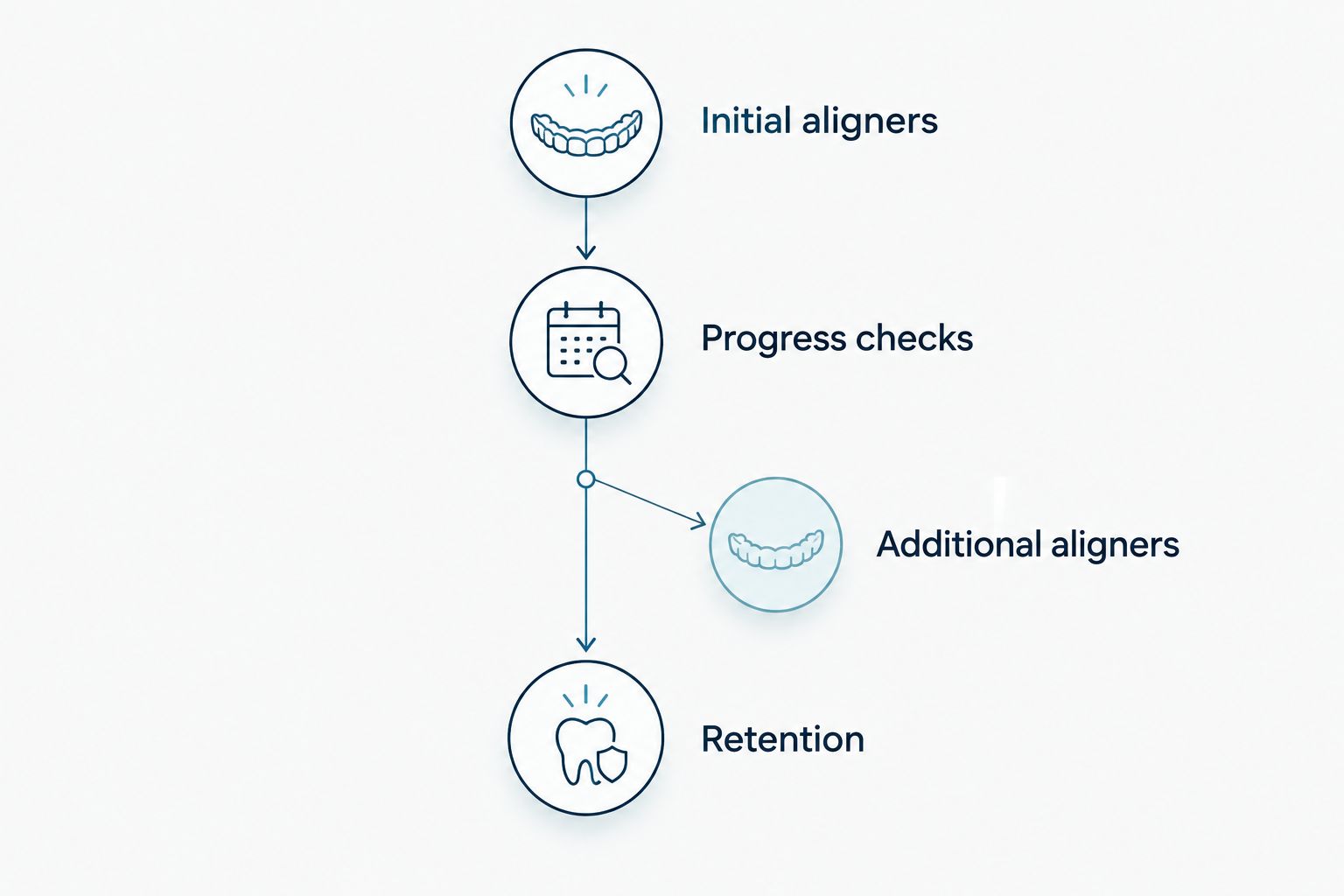
The sequence is straightforward:
- Initial aligners: Wear the prescribed trays and follow the change schedule.
- Progress checks: Report fit problems, missed wear, discomfort, or damaged trays.
- Additional aligners: Use a revised sequence if your clinician identifies movements still needed.
- Retention: Move to retainers when your clinician confirms active treatment is complete.
Additional aligners do not automatically mean that you did something wrong. Tooth movement can differ from the original plan even when you follow instructions. Ask what the extra trays are intended to improve and how they change the estimated endpoint.
At a 2026 consultation, ask whether the timeline being discussed covers only the initial sequence or the anticipated overall course. That distinction prevents a tray schedule from being mistaken for a guaranteed completion date.
Is Invisalign faster than braces?
Invisalign is not automatically faster than braces. Treatment speed depends on the movements needed, the appliance selected, and how treatment progresses. An appliance that suits one person’s teeth is not necessarily the right choice for another person’s bite.
| Option | Best for | Practical advantage | Limitation |
|---|---|---|---|
| Invisalign | Suitable cases where you can follow a removable-aligner routine | You remove aligners for eating and cleaning | Results depend on prescribed wear and appropriate case selection |
| Fixed braces | Cases where a clinician recommends fixed appliances for the required movements | The appliance stays attached between visits | Cleaning around brackets and wires requires extra care |
Choose the appliance that can address your diagnosis, not the one with the shortest advertised timeline. Both approaches require monitoring, and both need a retention plan after active treatment.
The guide to whether Invisalign is as effective as braces explains the comparison in more detail. Ask your clinician to explain why the recommended approach fits your particular alignment and bite concerns.
When will I notice a difference?
Visible changes and completed treatment are not the same thing. You might notice a gap changing or front teeth looking straighter while other movements remain unfinished. The appearance of your smile cannot confirm whether your bite correction is complete.
Use progress visits to ask what has changed and what still needs work. Your clinician can explain whether the current stage is focused on visible alignment, bite relationships, or finishing details. This gives you a better measure of progress than comparing daily mirror checks.
If you are planning photos or an event in 2026, discuss that goal before treatment starts. Ask what can reasonably be assessed along the way without turning an event date into a clinical deadline. Do not stop wearing aligners because your teeth already look straighter.
Do retainers count as Invisalign treatment time?
Retainers follow active tooth movement, but they are an ongoing part of maintaining your result. Teeth can shift after orthodontic treatment. Your clinician will prescribe a retention schedule and explain how to care for the appliance.
That means “How long will I wear aligners?” and “How long will I need to maintain my result?” are different questions. The first concerns moving teeth; the second concerns keeping them in their corrected positions. Neither should be left until the final appointment.
Ask how the transition will work, what to do if a retainer stops fitting, and whom to contact if it breaks or goes missing. A completed aligner series is not a reason to stop appliance wear without instructions.
What should I ask at my consultation?
Bring a short list of questions rather than trying to remember everything during the appointment. For a treatment plan starting in 2026, focus on these points:
- What alignment and bite problems are being treated?
- What does the estimated finish date include?
- What daily wear and tray-change schedule should I follow?
- How will you check whether my teeth are following the plan?
- What happens if I need additional aligners?
- What retention routine should I expect afterward?
Starboard Dental is best suited to patients in Kennebunk, York, and Saco seeking local general, restorative, and cosmetic dental care. For an Invisalign timeline, the next step is an orthodontic assessment and a plan specific to your teeth—not a generic deadline.
FAQ
How long does Invisalign take for adults?
Invisalign treatment length for adults depends on the required tooth movements, bite correction, daily wear, and treatment response. An examination and individual plan are needed to estimate your active treatment period.
Can I finish Invisalign before a wedding or graduation?
A wedding or graduation date does not establish a safe Invisalign finish date. Tell your clinician about the event before treatment so you can discuss expected progress without treating the deadline as a guarantee.
How many hours a day do I need to wear Invisalign?
20–22 hours per day is the wear recommendation in Invisalign’s patient guidance. Follow your treating clinician’s instructions for your particular case and tray sequence.
Will Invisalign take longer if I forget to wear my trays?
Missed wear can disrupt the planned movement and extend treatment. Tell your clinician what happened rather than changing trays early or trying to make up missed wear on your own.
Why do I need more aligners after finishing my first set?
Additional aligners address tooth movements or bite adjustments that remain after the initial sequence. Your clinician should explain what still needs correction and how the revised plan affects your timeline.
Is Invisalign always quicker than braces?
Invisalign is not always quicker than braces. The appropriate appliance and expected duration depend on your diagnosis, required movements, and ability to follow treatment instructions.
Can I stop Invisalign when my teeth look straight?
Do not stop Invisalign because your teeth look straight without your clinician’s approval. Bite correction or finishing movements can remain, and retainers are needed to maintain the result afterward.
One last thing
Before leaving your consultation, ask: What exactly needs to be true before active treatment is finished? The answer should describe your teeth and bite—not simply the last tray in a box.
Bring that question to your next dental conversation with Starboard Dental. Understanding the endpoint makes every later discussion about progress, additional aligners, and retainers more useful.