Yes, a dental crown can fall off if its cement loosens, decay develops underneath it, or the crown or supporting tooth breaks. Save the crown, avoid chewing on that side, and contact your dentist promptly—even if you have no pain—because an examination determines whether the crown can be secured again or needs replacement.
- Can a dental crown fall off? Yes—loose cement, tooth decay, or damage can cause a crown to detach.
- Keep the crown in a clean container; never use household glue to put it back.
- Trouble breathing or swallowing requires emergency medical care, not a routine dental appointment.
- Starboard Dental provides general and restorative dental care for patients in Kennebunk, York, and Saco, Maine.
Why this matters
A fallen crown leaves the supporting tooth exposed to chewing forces, food, and temperature changes. The absence of pain does not show that the tooth is healthy, particularly if the tooth previously had root canal treatment.
This 2026 guide separates what you can do at home from what needs a dental examination. For local care, Starboard Dental serves patients of all ages in Kennebunk, York, and Saco, Maine.
Can a dental crown fall off?
Yes. Both temporary and permanent crowns can come off, but the reason matters more than the fact that the crown detached. A crown that looks intact can still cover a decayed or fractured tooth.
Do not assume that putting the crown back solves the problem. Your dentist needs to check the tooth, the crown's fit, and the way your teeth meet before deciding how to secure it.
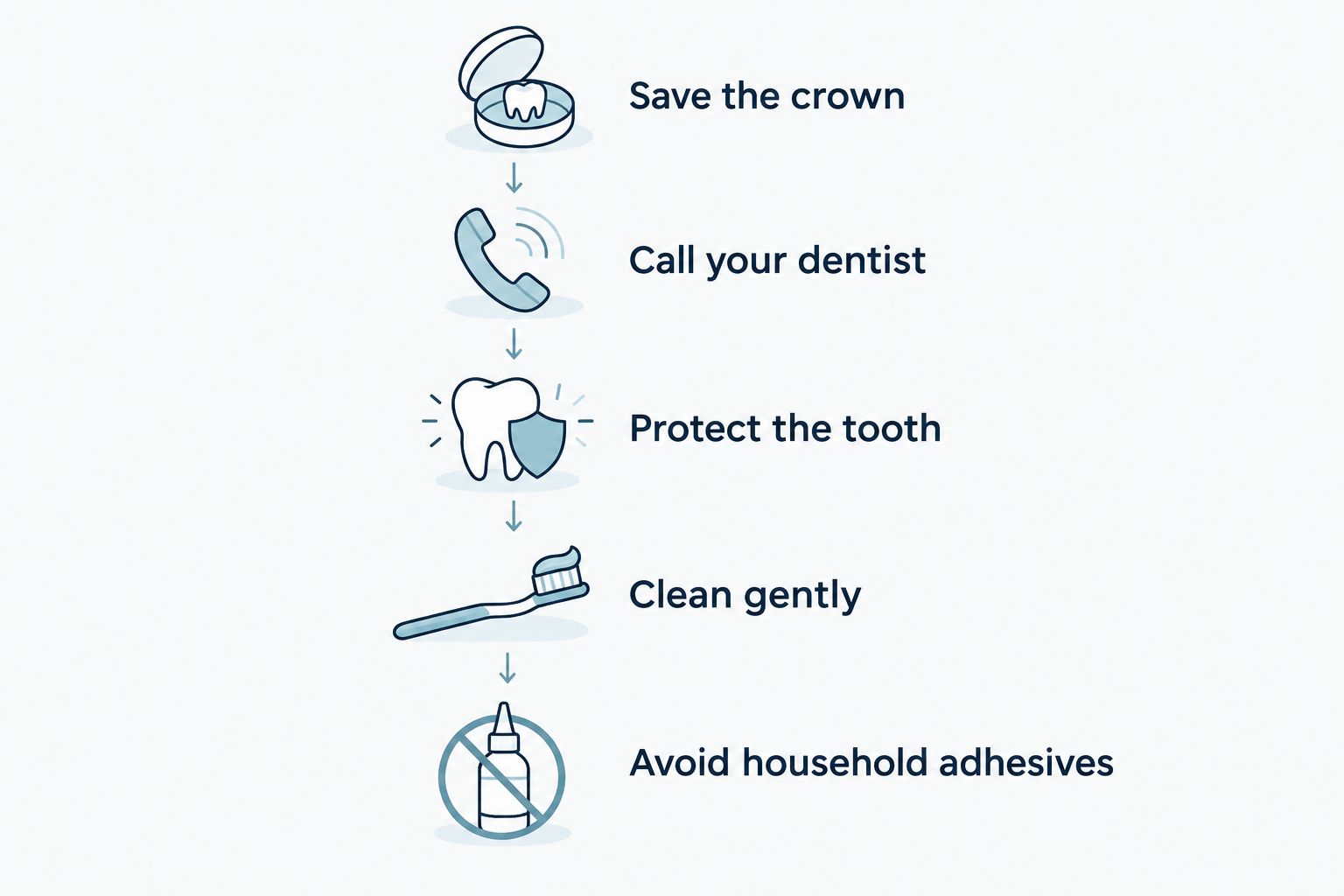
If your crown comes off in 2026, use these steps while arranging care:
- Take the loose crown out of your mouth. If it has already detached, remove it carefully so you do not swallow or inhale it. Do not pull on a crown that remains attached.
- Save the crown. Gently rinse it with water and place it in a clean container. Bring any broken pieces to your appointment, and do not scrape material from inside it.
- Call your dentist. Explain when it came off, whether you have pain or swelling, and whether anything resembling a tooth fragment or post is inside it.
- Protect the exposed tooth. Chew on the opposite side and avoid hard or sticky foods. If temperature changes hurt, choose foods and drinks that are comfortably lukewarm.
- Clean gently. Brush around the tooth without scrubbing the exposed area aggressively. Do not probe the tooth or gum with sharp objects.
- Leave household adhesives out of the repair. Superglue and craft glue are not dental materials and can damage tissue or interfere with treatment.
Do not force the crown into place to see whether it still fits. An incorrectly seated crown can change your bite, and a loose crown can detach again during eating or sleep.
Why a dental crown comes loose
A dental crown depends on the condition of the tooth beneath it, its fit, and its attachment. The visible crown alone does not reveal which part failed.
These are established causes your dentist considers during a crown assessment in 2026:
- Loose or failed cement. The material securing the crown can lose its hold. An intact crown still needs its fit checked before it is cemented again.
- Decay beneath the crown. The natural tooth can develop a cavity at or beneath the crown's edge. A crown does not make the underlying tooth immune to decay.
- A broken tooth or buildup. Part of the tooth or the material supporting the crown can fracture. Simply adding cement does not repair a damaged foundation.
- Grinding or clenching. Repeated heavy biting forces can contribute to damage or loosening. Tell your dentist about jaw soreness or a known grinding habit.
- Fit and bite problems. A crown that does not fit or meet the opposing teeth correctly can experience unfavorable forces. Repeated loosening calls for investigation rather than repeated home repairs.
Sticky food sometimes pulls off a crown, but that does not prove food was the only cause. Tell your dentist what you were eating without assuming the tooth underneath is sound.
A temporary crown falls off: protect the prepared tooth
Temporary crowns protect teeth while the final restoration is being made. Their cement is intended to allow removal, so losing a temporary crown does not automatically mean the final crown will have the same problem.
Best for a lost temporary crown: contact the treating dental office for instructions. The benefit of prompt attention is protection of the prepared tooth; the limitation is that home care cannot confirm the temporary crown's fit or keep the tooth position stable.
Do not decide to leave the tooth uncovered until the final appointment without speaking to the office. Report sensitivity, a changed bite, and whether the temporary crown is cracked or missing.
A permanent crown falls off: check the tooth underneath
A permanent crown that comes off needs assessment even when it looks undamaged. Your dentist checks whether the crown still seals properly and whether enough healthy tooth remains to support it.
Best for a lost permanent crown: an examination before any attempt to cement it again. Reusing a suitable crown preserves the existing restoration, but it is not appropriate when decay, fracture, or poor fit prevents a dependable repair.
An implant-supported crown needs a different assessment from a crown on a natural tooth. If your crown is attached to an implant, report that when you call and do not try to tighten or glue any components yourself.
Can a dentist put the same crown back on?
Yes, a dentist can sometimes secure the same crown again if the crown is intact, the underlying tooth is sound, and the fit remains suitable. A crown that has broken, no longer fits, or covers a damaged tooth needs a different plan.
This comparison explains the treatment decisions—not a way to choose your own repair:
| Approach | Best for | Benefit | Limitation |
|---|---|---|---|
| Cementing the existing crown again | An intact crown with a sound tooth and suitable fit | Keeps the existing restoration | Does not correct decay, fracture, or poor fit |
| Replacing the crown | A damaged crown or one that no longer fits properly | Provides a new restoration suited to the tooth | Requires assessment and preparation appropriate to the tooth's condition |
| Treating the supporting tooth first | Decay, a damaged buildup, or another underlying problem | Addresses the cause before the crown is secured | The existing crown might not be reusable afterward |
Crown material is only part of this decision. The guide to dental crown materials compared explains material choices, but no material compensates for an unhealthy supporting tooth.
At your 2026 appointment, ask what failed and what needs to change before the crown is secured. That question is more useful than asking only whether the old crown can be reused.
Is a fallen crown a dental emergency?
A fallen crown needs prompt dental advice, but urgency depends on the symptoms and circumstances. A comfortable exposed tooth is different from facial swelling, uncontrolled bleeding, or breathing trouble.
Seek emergency medical care for trouble breathing or swallowing, rapidly spreading swelling, or signs that the crown entered your airway. If you are choking or struggling to breathe, call 911.
Contact a dentist urgently for severe or worsening pain, swelling, fever with dental symptoms, significant injury, or bleeding that does not stop with pressure. When you call, describe these symptoms before discussing the crown itself.
If the crown came off without pain or swelling, still arrange dental assessment promptly. Waiting for pain is not a reliable safety check, and eating normally on an uncovered tooth can cause further damage.
What if I swallowed the crown?
Contact a medical professional for advice if you swallowed a crown, especially if it contains an attached post or sharp fragment. Do not induce vomiting or assume that every swallowed crown can be managed the same way.
Coughing, wheezing, chest discomfort, or breathing difficulty raises concern about inhalation rather than swallowing. Seek urgent medical assessment instead of waiting for a dental appointment.
Can I put my crown back on at home?
Do not use household glue, force the crown into position, or sleep with an unsecured crown in your mouth. A crown that seems to fit can still sit incorrectly or conceal a broken tooth.
Some pharmacy products are labeled for temporary crown repair, but they are not a substitute for an examination. Ask your dentist whether a particular product is appropriate before using it, and follow the product's instructions only if the dentist recommends it.
Keep the crown out if it does not seat easily, feels unstable, changes your bite, or has tooth material attached inside. Do not attempt home replacement of an implant-supported crown.
How do I care for the tooth until my appointment?
Keep the area clean and reduce pressure on the exposed tooth. Choose softer foods, chew elsewhere, and avoid repeatedly testing the tooth with your tongue or fingers.
For routine oral hygiene in 2026, brush for 2 minutes per session, complete 2 brushing sessions per day, and clean between your teeth 1 time per day. Use fluoride toothpaste, and be gentle around the affected tooth rather than skipping cleaning entirely.
Ask your dentist or pharmacist about pain relief that fits your medical history and current medicines. Follow the medicine label, and never place aspirin directly on the tooth or gum because it can injure the tissue.
Temperature sensitivity can occur after a crown comes off, but it does not identify the cause. Persistent or worsening symptoms need assessment, not just a switch in toothpaste.
What should I tell the dentist when I call?
Give the office enough information to assess urgency and prepare for the visit. Keep the description practical:
- Whether the crown is temporary, permanent, or implant-supported, if you know.
- Whether you have pain, swelling, bleeding, fever, or trouble swallowing.
- Whether the crown is intact, broken, lost, or possibly swallowed.
- Whether the crown came off during an injury or ordinary eating.
- Whether this crown has come loose before.
Bring the crown and any fragments rather than trying to determine what each piece is. Starboard Dental is a local option for patients seeking general and restorative dental care in Kennebunk, York, and Saco, Maine. The appropriate repair depends on the examination, not on a promise made before the tooth is assessed.
FAQ
Can a dental crown fall off without hurting?
Yes, a dental crown can fall off without pain. Lack of pain does not rule out decay or a fracture, so save the crown and contact your dentist.
Can I eat after my dental crown falls off?
You can eat carefully, but avoid chewing on the exposed tooth. Choose softer foods and avoid hard or sticky foods until your dentist advises you.
Does a crown falling off mean I need a root canal?
No, a fallen crown does not automatically mean you need root canal treatment. Your dentist checks the tooth for decay, fracture, and signs of infection before recommending treatment.
Can I use superglue to put my crown back on?
No, do not use superglue or other household adhesives to replace a dental crown. These materials can injure tissue and interfere with dental treatment.
Should I keep a crown that has fallen off?
Yes, keep the crown in a clean container and bring it to your dental appointment. Your dentist can assess whether it is suitable for reuse.
Where can I ask about a fallen crown near Kennebunk, York, or Saco?
Starboard Dental provides general and restorative dental care for patients in Kennebunk, York, and Saco, Maine. Contact the practice to describe your symptoms and discuss assessment; breathing or swallowing difficulty requires emergency medical care.
One last thing
A crown that repeatedly comes loose needs an explanation, not just more cement. Mention every previous episode, even if the crown felt normal after it was secured. The useful goal for your 2026 dental visit is to identify what failed and protect the tooth beneath it.