Your oral appliance for sleep apnea cost in 2026 depends on the prescribed device, the appointments included, and your medical insurance benefits; an itemized treatment estimate is the reliable way to find your total. Ask whether that estimate includes fitting, adjustments, and follow-up testing, because the appliance itself is only part of treatment.
- Compare oral appliance for sleep apnea cost using complete treatment estimates, not device-only quotes.
- Custom oral appliances need professional fitting and follow-up to assess comfort and sleep apnea control.
- CPAP and oral appliances serve different treatment needs; your sleep clinician should guide the choice.
- Starboard Dental is a local starting point for patients seeking general dental care in coastal Maine.
How much does an oral appliance for sleep apnea cost in 2026?
Your total is the treatment charge minus any insurance payment, plus services billed separately. A useful estimate distinguishes the appliance and dental visits from sleep-medicine appointments and testing. Your out-of-pocket responsibility also depends on your deductible, coinsurance, and network rules.
Before comparing estimates, understand what you are comparing. The guide to oral appliances for sleep apnea explains the device options; the next step is asking which option fits your diagnosis and oral health.
| Part of care | What to ask about | Why it affects your total |
|---|---|---|
| Sleep evaluation | Are the consultation and diagnostic testing separate? | Diagnosis belongs to the medical evaluation, not just the dental fitting. |
| Dental assessment | Does the estimate include examining teeth, gums, and jaw movement? | Your mouth must support the proposed appliance. |
| Custom appliance | Which device is prescribed, and what does its fabrication include? | Device design and laboratory work differ. |
| Fitting and adjustments | Which visits are included, and what is billed separately? | The starting fit is not necessarily the final treatment position. |
| Follow-up testing | Who orders it, and who bills for it? | Comfort and quieter snoring do not establish that apnea is controlled. |
| Ongoing care | How are later checks, repairs, and replacement handled? | The initial estimate does not necessarily cover future care. |
Keep the written estimate alongside your insurer's benefit explanation. Neither document replaces the other: the practice explains its charges, while the insurer explains how your plan applies.
Why this matters
An appliance that feels comfortable still needs to treat your breathing problem. Buying a device without a diagnosis or follow-up plan leaves that central question unanswered.
Sleep apnea involves repeated breathing interruptions during sleep. Untreated obstructive sleep apnea is associated with health risks and daytime sleepiness, so the decision should account for treatment effectiveness as well as financial responsibility.
For your 2026 treatment decision, separate clinical suitability from insurance coverage. An insurer's willingness to pay does not establish that a device is right for you, and a clinician's recommendation does not guarantee reimbursement.
Custom oral appliances: what the estimate should include
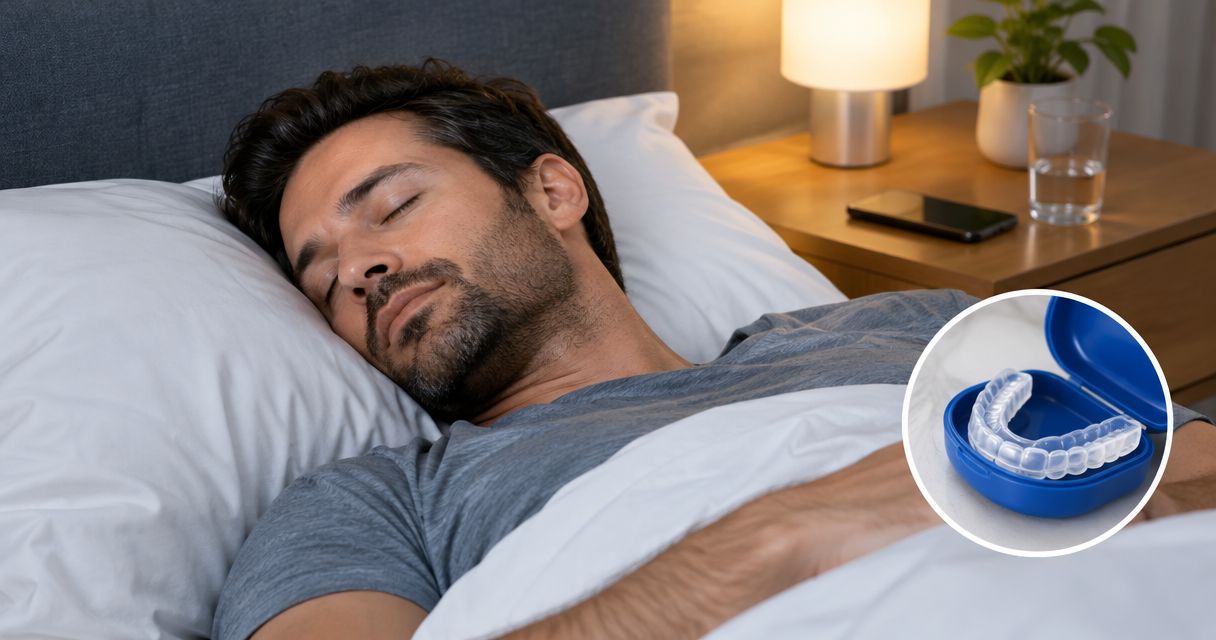
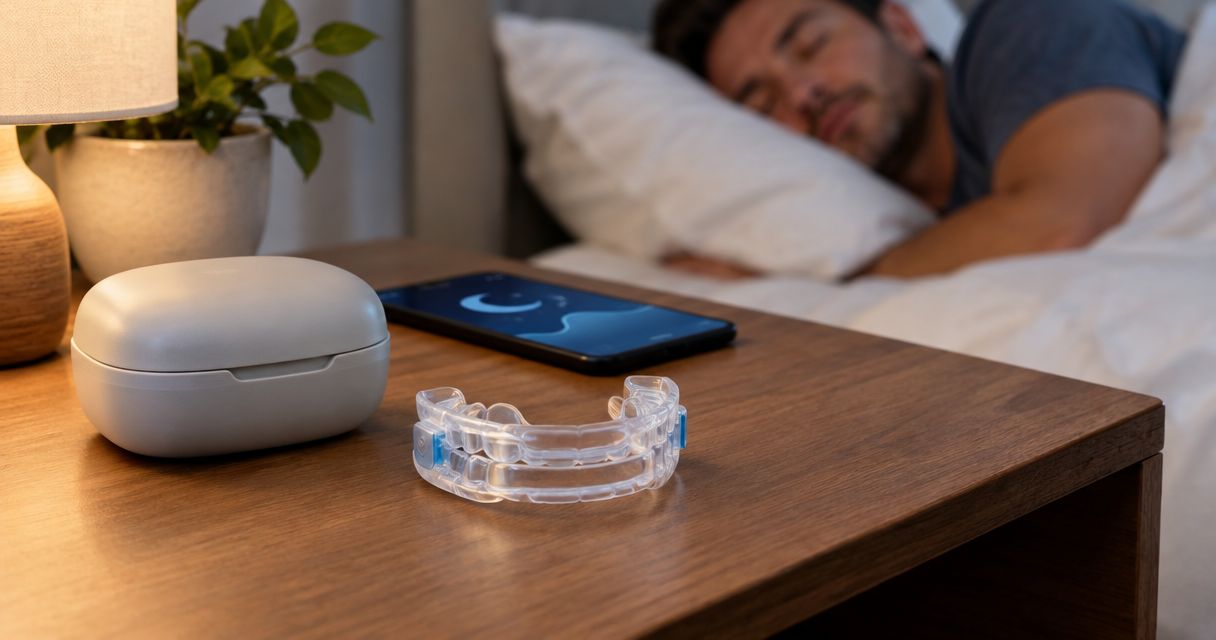
A custom mandibular advancement appliance holds your lower jaw forward during sleep to help keep the airway open. A qualified dentist fits the appliance and evaluates how your teeth, gums, bite, and jaw respond.
Many prescribed appliances allow gradual adjustment. That gives the treating team a way to change jaw position while monitoring comfort and treatment response, rather than treating the first setting as the finished result.
Best for: adults with obstructive sleep apnea whose sleep clinician recommends oral appliance therapy, including appropriate patients who cannot tolerate CPAP or prefer an alternative.
The benefit is a treatment worn in the mouth rather than a mask connected to a machine. The limitations include possible tooth discomfort, jaw symptoms, saliva changes, and bite changes; not every patient is a suitable candidate.
Ask the treating dentist to explain the proposed appliance without relying only on its name. You need to know how it adjusts, how you clean it, what to do if it hurts, and who checks its effect on your bite.
What if dental treatment is needed first?
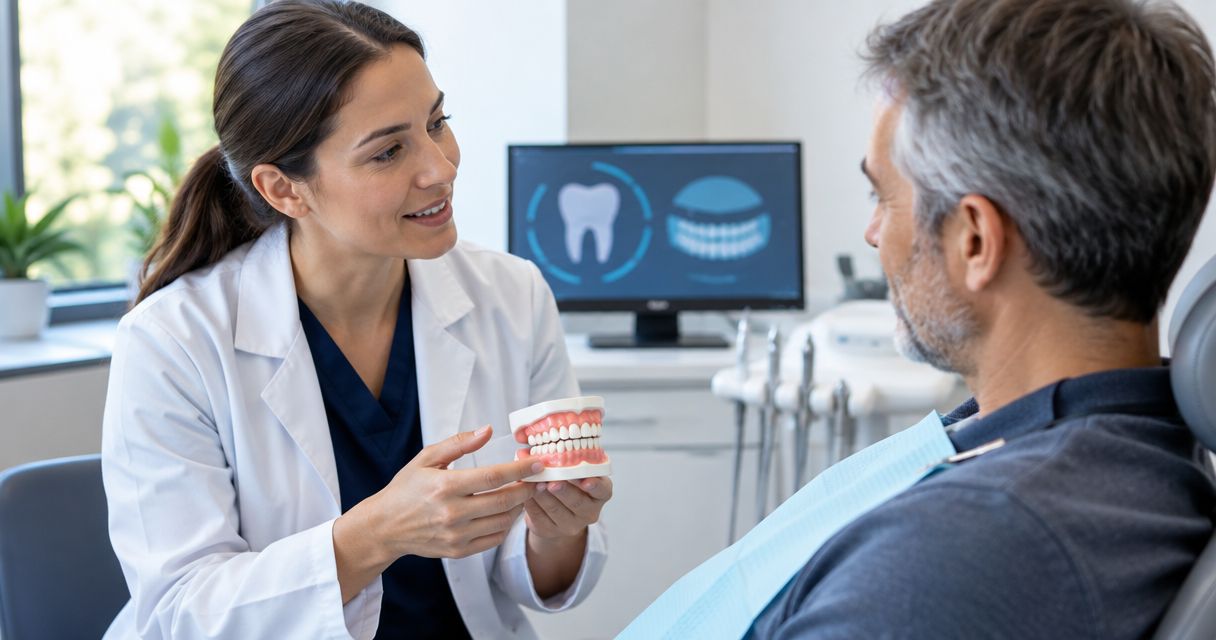
Active gum disease, loose teeth, untreated decay, or other dental problems can affect appliance suitability. A dental examination identifies issues that need attention before the appliance is made.
Ask for separate explanations of necessary dental treatment and sleep apnea appliance treatment. Keeping those plans distinct helps you understand the purpose of each recommendation and which insurance benefit might apply.
Oral appliance or CPAP: compare treatment, not just the bill
CPAP delivers pressurized air through a mask to keep the airway open. An oral appliance changes jaw position instead. These approaches are not interchangeable simply because both address obstructive sleep apnea.
| Treatment | Best for | Main advantage | Main limitation |
|---|---|---|---|
| Custom oral appliance | Appropriate adults prescribed oral appliance therapy | No mask or powered airflow during use | Requires dental suitability, adjustment, and testing to confirm effectiveness |
| CPAP | Patients prescribed positive airway pressure, particularly when stronger control of breathing events is needed | Generally reduces obstructive breathing events more effectively than oral appliances | Requires wearing a mask and adapting to pressurized airflow |
CPAP is generally more effective at reducing breathing disturbances, particularly in more severe obstructive sleep apnea. Some patients find an oral appliance easier to use, but personal preference alone does not confirm adequate treatment.
Choose the treatment your sleep clinician expects to control your apnea and that you can use consistently. Do not stop prescribed CPAP while waiting for an appliance unless your treating clinician directs you to change treatment.
Why oral appliance costs vary
A meaningful comparison looks at the whole course of care. These factors explain why estimates and patient responsibility differ:
- Device design: Custom fabrication and adjustment mechanisms affect what the appliance involves.
- Dental condition: Teeth, gums, existing restorations, and jaw symptoms affect the assessment and treatment plan.
- Included visits: An estimate that includes fitting and adjustment visits covers different services from a device-only estimate.
- Testing arrangements: Diagnostic testing and treatment-effectiveness testing can involve a separate medical provider.
- Insurance terms: Deductibles, coinsurance, network status, exclusions, and authorization requirements affect your share.
- Later maintenance: Repairs, replacement, and ongoing dental monitoring require their own explanation.
Ask every provider the same questions. Otherwise, a shorter estimate can look more appealing simply because it leaves out services listed elsewhere.
How do you get an estimate you can actually compare?
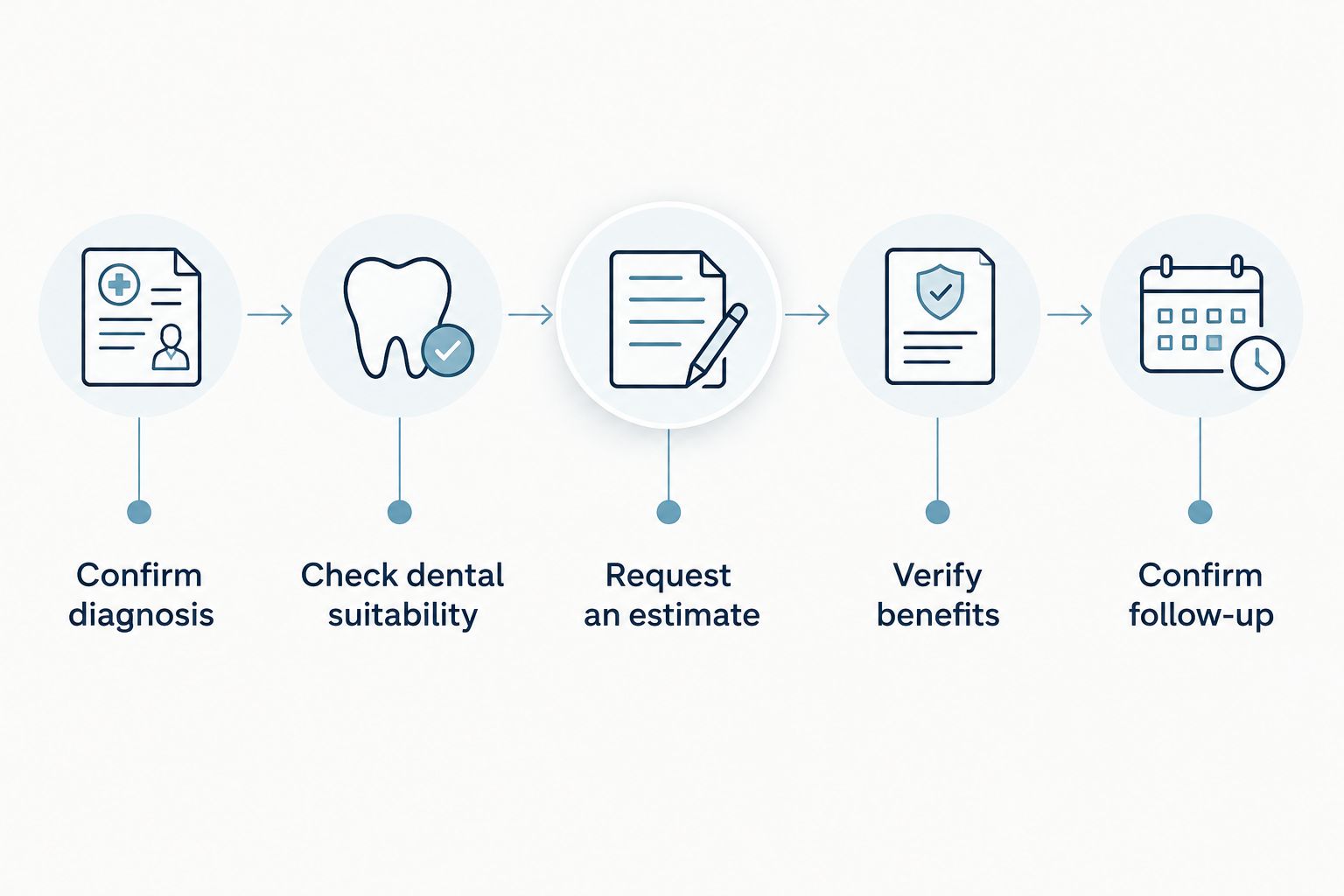
Use this sequence before authorizing fabrication. It keeps the clinical decision, treatment estimate, and insurance review connected.
- Confirm diagnosis. Obtain your sleep evaluation and ask the sleep clinician whether oral appliance therapy is appropriate for your type and severity of apnea.
- Check dental suitability. Have the treating dentist assess your teeth, gums, bite, and jaw before committing to an appliance.
- Request an estimate. Ask for the device, included appointments, adjustment arrangements, and separately billed services in writing.
- Verify benefits. Give your insurer the proposed treatment information and ask about authorization, network status, and your financial responsibility.
- Confirm follow-up. Establish who will adjust the appliance, assess side effects, and arrange testing of treatment effectiveness.
For a 2026 insurance review, save the date of each call and the representative's reference information. Ask for written confirmation when possible, and remember that a benefit estimate is not a guarantee of claim payment.
Bring 3 documents to the discussion: your sleep study report, the treatment recommendation, and your current insurance information. These give the treating team a practical starting point without asking you to interpret your own sleep study.
Does medical or dental insurance cover the appliance?
Medical insurance is generally the starting point for coverage questions about a prescribed sleep apnea appliance. Although a dentist fits it, the treatment addresses a diagnosed medical condition.
Coverage depends on your plan and the documentation it requires. Ask whether the proposed appliance qualifies, whether prior authorization is necessary, and whether the treating provider participates in the relevant medical network.
A dentist's participation in your dental plan does not establish participation in your medical plan. Verify both directly rather than assuming the office's dental network status answers the sleep apnea coverage question.
Use these 4 questions when you call:
- Does my plan cover a custom oral appliance for my documented diagnosis?
- What prescription, sleep study, and authorization records are required?
- How will my deductible, coinsurance, and provider network status apply?
- Are fitting, adjustments, and follow-up testing processed together or separately?
If you have Medicare, ask about the applicable coverage requirements and the provider's enrollment status before treatment. Do not assume that a general statement about accepting insurance settles those details.
Is a store-bought snoring device the same thing?
A store-bought snoring device is not a substitute for a professionally prescribed sleep apnea appliance. Reduced snoring does not prove that breathing interruptions or oxygen changes have resolved.
An ordinary night guard also has a different job: it protects teeth from grinding-related contact rather than serving as prescribed treatment for sleep apnea. A device that covers your teeth is not automatically designed to hold your jaw in a therapeutic position.
Tell the dentist if you already wear a night guard or have jaw pain. The treatment plan should account for both your dental concerns and your diagnosed sleep condition.
Where can you start with dental questions in coastal Maine?
Starboard Dental is a local starting point for patients seeking general dental care in Kennebunk, York, and Saco. Dr. Alex Kerbaugh leads the practice, which provides general, restorative, and cosmetic dental care for patients of all ages.
For sleep apnea treatment, confirm the specific service and referral arrangements directly. An introduction to Starboard Dental helps you identify the practice, but it does not replace confirmation that a provider offers the prescribed appliance or participates in your medical insurance network.
Bring your sleep clinician's recommendation and explain any tooth sensitivity, loose teeth, grinding, or jaw discomfort. Those details help frame the dental questions that need answers before appliance treatment.
FAQ
How much will I personally pay for an oral appliance for sleep apnea in 2026?
Your personal responsibility depends on the complete treatment estimate and how your medical insurance applies. Request an itemized estimate, then verify your deductible, coinsurance, network status, and separately billed testing.
Does dental insurance cover a sleep apnea mouthpiece?
Medical insurance is generally the starting point for a prescribed sleep apnea appliance. Verify your specific plan's rules rather than assuming dental coverage applies because a dentist fits the device.
Is an oral appliance better than CPAP?
An oral appliance is not automatically better than CPAP; the right treatment depends on your diagnosis and clinical needs. CPAP generally reduces obstructive breathing events more effectively, while an appliance is an appropriate alternative for selected patients.
Can I use a regular night guard for sleep apnea?
A regular night guard is not a substitute for prescribed sleep apnea treatment. Night guards protect teeth from grinding-related contact and do not automatically provide the jaw positioning needed for oral appliance therapy.
Do I need another sleep test after getting an appliance?
Follow-up sleep testing is used to assess whether oral appliance therapy controls your sleep apnea. Feeling better or snoring less does not establish treatment effectiveness on its own.
Can a sleep apnea appliance change my bite?
A sleep apnea appliance can change your bite and cause tooth or jaw discomfort. Keep dental follow-up appointments and report persistent symptoms rather than adjusting the device beyond your instructions.
What should I ask Starboard Dental before arranging care?
Ask Starboard Dental whether the practice provides your prescribed sleep apnea appliance service or can discuss referral options. Confirm the service, clinician, insurance arrangements, and follow-up responsibilities directly before scheduling treatment.
One last thing
A quieter bedroom is encouraging, but it is not a treatment test. The most useful question is not just what the appliance costs—it is how your team will confirm that it works.
Before signing your 2026 treatment estimate, identify 2 follow-up responsibilities: who adjusts the appliance and who confirms apnea control. Clear answers help you judge the treatment plan rather than just the device.