Porcelain veneers generally last 10–15 years with appropriate care, but they do not have a guaranteed replacement date. If you are considering veneers in 2026, plan for ongoing dental care and eventual replacement: the porcelain can remain intact while the tooth, gums, or bond underneath needs attention.
- How long do porcelain veneers last? Generally 10–15 years with appropriate care, not a guaranteed replacement schedule.
- Porcelain veneers resist staining, but the teeth underneath still need protection from decay and gum disease.
- Grinding, hard-object chewing, and changes around veneer edges deserve attention before a veneer breaks.
- Starboard Dental provides general, restorative, and cosmetic dental care for patients in coastal Maine.
Why this matters
Choosing veneers means thinking beyond how your teeth look on the day treatment ends. Your dentist needs to consider the health of each tooth, how your teeth meet, and whether a more conservative treatment would address your concern.
Starboard Dental provides general, restorative, and cosmetic dental care in Kennebunk, York, and Saco, Maine. A useful cosmetic dental conversation starts with what you want to change and what your teeth need to stay healthy—not a promise that a restoration will last forever.
How long do porcelain veneers last?
A practical planning range for porcelain veneers is 10–15 years, not a fixed expiration date. Cleveland Clinic's patient guidance on dental veneers gives this general lifespan with proper care. That range is useful for a 2026 treatment discussion, but it cannot predict the lifespan of an individual veneer.
Some veneers need attention earlier because they chip, loosen, or develop problems at the edges. Others remain serviceable beyond the usual planning range. An examination determines whether a veneer needs treatment; its birthday does not.
| What your dentist finds | What it means | Usual next step |
|---|---|---|
| Intact porcelain, healthy gums, secure bond | Age alone does not establish a problem | Continue care and monitoring |
| A rough or chipped edge | The damage needs assessment | Discuss smoothing, repair, or replacement |
| Movement or a detached veneer | The attachment has failed | Arrange prompt dental assessment |
| Decay or inflammation near an edge | The surrounding tooth or gum needs care | Treat the underlying problem and assess the veneer |
| A changed bite or new discomfort | Something needs investigation | Examine the tooth, veneer, and bite |
These are examination findings, not instructions for diagnosing yourself. A veneer that looks normal in the mirror can still have an issue at an edge that is difficult to see.
What does the lifespan estimate actually tell you?
A lifespan estimate helps you plan for maintenance and future treatment. It does not mean every veneer fails after the same number of years, or that careful brushing eliminates every risk.
Ask your dentist what would count as success for your teeth: an intact restoration, comfortable chewing, healthy surrounding tissue, and an appearance you still accept. Those goals are more useful than treating a calendar date as a replacement deadline.
Why porcelain veneer lifespan varies
The porcelain is only part of the picture. Your dentist also evaluates the tooth supporting it, the bond holding it in place, and the forces passing through it when you bite.
- Tooth health: Decay can develop in natural tooth structure around a veneer. Porcelain does not make the underlying tooth cavity-proof.
- Gum health: Inflammation and recession can affect the tissue around a veneer and expose an edge that was less noticeable before.
- Grinding and clenching: Repeated pressure places stress on teeth and restorations. Tell your dentist about morning jaw soreness or known grinding.
- Biting habits: Ice, pens, fingernails, and packaging put teeth under forces they are not meant to handle.
- Veneer fit and bonding: A secure attachment and well-fitting edges matter. Your dentist evaluates these during treatment and follow-up care.
- Daily cleaning and dental visits: Cleaning helps control plaque, while examinations provide opportunities to identify problems before they become more extensive.
For a 2026 treatment plan, discuss these factors before choosing a cosmetic procedure. A longer-lasting result starts with selecting an appropriate treatment, not simply selecting a material described as durable.
How can you help porcelain veneers last longer?
Protect the natural tooth as carefully as the porcelain covering it. A veneer changes the visible surface of a tooth; it does not replace the need for everyday oral hygiene.
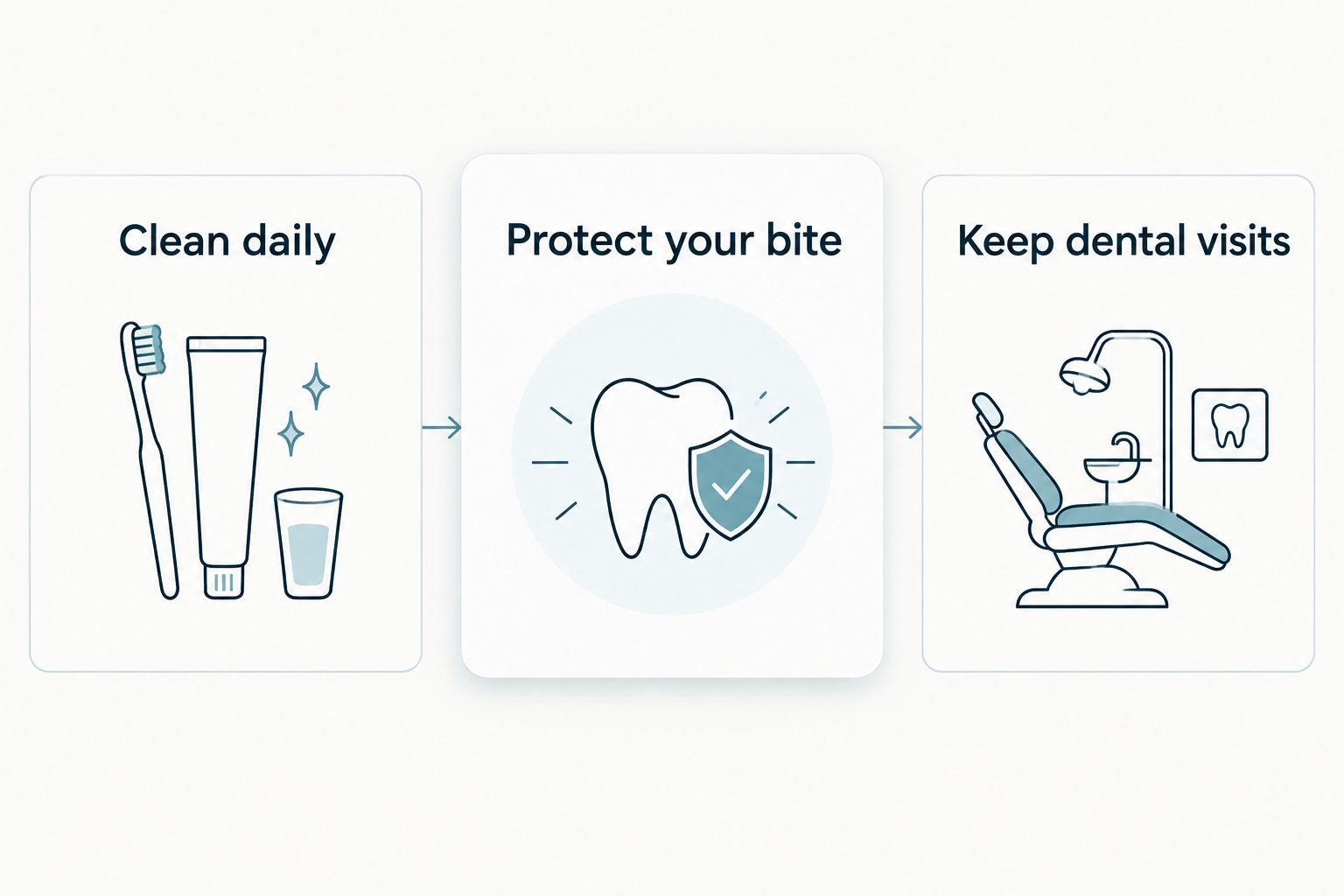
Clean daily
Brush for 2 minutes, twice a day, using fluoride toothpaste and a soft-bristled toothbrush. Clean between your teeth once a day with floss or another interdental cleaner suited to your needs. These are standard American Dental Association home-care recommendations, not a special maintenance program exclusive to veneers.
Pay attention to the gumline without scrubbing aggressively. If floss catches, shreds, or repeatedly gets stuck near a veneer, ask your dentist to check the area rather than forcing it.
Protect your bite
Do not use your teeth to open packages or hold hard objects. Avoid chewing ice, and discuss a protective appliance if your dentist identifies grinding or clenching.
A night guard and a sports mouthguard serve different purposes. Your dentist can explain which type of protection fits the activity or habit affecting your teeth.
Keep dental visits
Follow the examination and cleaning schedule your dentist recommends for your oral health. There is no single visit interval that suits every person with veneers.
Tell the dental team about new sensitivity, bleeding, a changed bite, or a rough edge. Small changes are worth mentioning even when you are not in pain.
Good care reduces avoidable risks, but it is not a guarantee against repair or replacement. Keep realistic expectations alongside good habits.
How do you know a veneer needs attention?
Watch for a new rough spot, visible chip, movement, or a change in how your teeth meet. Persistent sensitivity, gum swelling, bleeding, or food repeatedly collecting around an edge also deserves an examination.
Do not wait for a veneer to fall off before reporting a change. Pain is not required for a problem to need treatment, and discomfort does not automatically mean the veneer must be replaced.
If a veneer comes off, keep it safe and contact a dentist promptly. Do not use household glue to put it back. Whether the original veneer can be reattached depends on its condition and the condition of the tooth.
Sensitivity has several possible causes, including exposed tooth structure, decay, or a problem with the bite. The guide to options for treating sensitive teeth explains why identifying the cause comes before selecting treatment.
Seek urgent assessment for significant pain, swelling, or dental trauma. Trouble breathing or swallowing requires emergency medical care.
Are porcelain veneers the right long-term choice?
Choose the least invasive treatment that meets your dental needs and appearance goals. Porcelain veneers can change tooth color and shape, but they are not the right answer for every cosmetic concern.
Use this comparison to prepare questions, not to choose treatment without an examination. Your dentist must first check for decay, gum disease, and structural problems.
| Treatment | Best for | Main benefit | Main limitation |
|---|---|---|---|
| Porcelain veneers | Selected changes to visible tooth shape and color | Address several appearance concerns together | Often require irreversible enamel removal and eventual replacement |
| Composite bonding | Selected small chips or shape changes | Often preserves more natural tooth structure | Can stain, chip, or need maintenance |
| Teeth whitening | Suitable discoloration in natural teeth | Changes color without covering the tooth | Does not change tooth shape or whiten existing veneers |
Porcelain veneers have a clear benefit when the treatment goal involves both appearance and suitable tooth structure. The trade-off is commitment: after enamel removal, the tooth generally needs continued coverage with a restoration.
Bonding deserves discussion when the change is small. Whitening deserves discussion when color is the main concern and your natural teeth are suitable for it. Neither option automatically replaces veneers for every patient.
Starboard Dental is best suited to patients seeking general, restorative, and cosmetic dental care in Kennebunk, York, and Saco, Maine. The benefit of discussing appearance within general dental care is keeping tooth health part of the decision; no cosmetic procedure removes the need for maintenance.
What should you ask before choosing veneers?
For a 2026 consultation, bring a short list of goals and concerns rather than a request for a particular lifespan. Explain whether you want to change color, shape, spacing, or an existing restoration.
Ask your dentist:
- Is the tooth healthy enough for a veneer?
- How much enamel would treatment remove?
- Would whitening or bonding address the concern more conservatively?
- Does grinding or the way my teeth meet change the plan?
- What would make you recommend repair rather than replacement?
- What ongoing care will my teeth need?
If you already have veneers, bring any available treatment records and describe changes you have noticed. The placement date is helpful background, but present condition determines the next step.
Discuss your dental care goals
Learn about general, restorative, and cosmetic dental care in coastal Maine.
Can porcelain veneers last longer than 15 years?
15 years is not an automatic replacement deadline. A veneer that remains secure, comfortable, and compatible with healthy surrounding tissue does not need replacement solely because it has reached that age.
Equally, a newer veneer should not be ignored if it develops a problem. Judge its condition with your dentist rather than comparing it with someone else's experience.
Do porcelain veneers need replacing every 10 years?
10 years is not a mandatory replacement interval. Your dentist recommends treatment based on findings such as damage, decay, a failed bond, or changes around the veneer.
At a 2026 review, ask what the examination shows and why a particular treatment is recommended. Age provides context; a clear clinical reason should guide the decision.
FAQ
How long do porcelain veneers last with good care?
Porcelain veneers generally last 10–15 years with appropriate care. This is a planning range, not a guarantee; the tooth, gums, bite, and veneer condition all affect the result.
Are porcelain veneers permanent?
Porcelain veneers are not permanent restorations, although the enamel removal used for many veneers is irreversible. Plan for ongoing maintenance and possible replacement rather than a one-time treatment with no future care.
Can I get a cavity under a porcelain veneer?
Yes, the natural tooth supporting a porcelain veneer can develop decay. Brush with fluoride toothpaste, clean between your teeth, and keep the dental visits recommended for your oral health.
Can a chipped porcelain veneer be repaired?
Some chipped porcelain veneers can be repaired or smoothed, while others need replacement. The location and extent of the damage, your bite, and the underlying tooth determine the appropriate treatment.
Should I replace veneers just because they look old?
Age alone does not establish a need to replace porcelain veneers. Your dentist should assess their condition and discuss whether the concern is health-related, cosmetic, or both.
Can I whiten porcelain veneers?
Teeth-whitening treatments do not whiten porcelain veneers. Discuss whitening natural teeth and matching existing restorations with your dentist before starting treatment.
Is Starboard Dental an option for cosmetic dental care in coastal Maine?
Starboard Dental provides general, restorative, and cosmetic dental care for patients in Kennebunk, York, and Saco, Maine. The practice is led by Dr. Alex Kerbaugh.
One last thing
A veneer can look unchanged while the natural tooth around it needs care. That is why appearance alone is not a reliable health check.
If you make one change to your 2026 dental routine, mention small changes early: a catching piece of floss, a rough edge, or discomfort when biting. Give your dentist the chance to investigate before deciding that the veneer simply needs replacing.