Dental care for diabetics is preventive and restorative oral care with the aim of protecting teeth and gums while accounting for blood sugar, medications, and healing. This 2026 guide explains your daily routine, appointment planning, and treatment choices; Starboard Dental provides general, restorative, and cosmetic dental care for patients in Kennebunk, York, and Saco, Maine.
- Dental care for diabetics combines daily plaque removal, gum disease checks, and coordination with your diabetes care team.
- Starboard Dental serves Maine patients seeking general and restorative dental care; share your diabetes history before treatment.
- Brush twice daily with fluoride toothpaste, clean between teeth daily, and report bleeding gums or persistent dry mouth.
- Do not skip meals or change diabetes medication for a dental appointment without instructions from your care team.
Why dental care matters for people with diabetes
Diabetes and gum disease affect each other. High blood sugar increases the risk of oral health problems, and periodontal disease can make blood sugar harder to manage. Dry mouth, infections, and slower healing also deserve attention when you plan dental treatment.
Bleeding gums are a reason to arrange a dental assessment, not a reason to stop cleaning your teeth. Gum disease can develop without tooth pain. Waiting until something hurts leaves an unreliable signal in charge of your oral health.
For your 2026 care plan, the priorities are straightforward: remove plaque consistently, identify inflammation early, and tell your dentist when your diabetes treatment changes. The American Dental Association's MouthHealthy guidance on diabetes, the CDC's diabetes and oral health guidance, and the National Institute of Dental and Craniofacial Research's diabetes information support these priorities. These sources address diabetes-related oral risks; they do not replace your individual treatment instructions.
Build your 2026 dental care routine
Share your diabetes history before treatment
Start with a written medication list and a brief account of how you manage diabetes. Include insulin, other prescriptions, supplements, allergies, and any history of low blood sugar. Bring recent glucose information and your latest A1C result if available, rather than trying to recall everything during the appointment.
Your dentist needs this information to plan care, not to judge you. Explain recent medication changes, previous healing problems, and whether an appointment will interrupt meals. An A1C result describes longer-term blood sugar patterns; it does not replace checking your current glucose when your care plan calls for it.
Starboard Dental is best suited to patients in Kennebunk, York, and Saco seeking local general and restorative dental care. Its stated services do not establish a diabetes specialty, so ask how your dentist will coordinate with your diabetes clinician when treatment needs additional planning.
- Bring your current medication and allergy list.
- Share recent A1C and glucose information when available.
- Describe previous low blood sugar episodes or healing difficulties.
- Provide your diabetes clinician's contact information.
Brush gently and clean between your teeth
Use a soft-bristled toothbrush and fluoride toothpaste for 2 minutes per brushing session, twice daily. Clean along the gumline without scrubbing hard. Aggressive brushing does not compensate for missed areas and can irritate your gums.
Clean between your teeth once daily with floss or another suitable interdental cleaner. Choose a tool you can use consistently, especially if hand stiffness, limited dexterity, bridges, or wider spaces make standard floss difficult. Ask your dental team to demonstrate the technique in your own mouth.
A manual toothbrush is a valid starting point; an electric brush is an alternative if its motion or timer helps you maintain the routine. Neither brush replaces cleaning between teeth. For dental care for diabetics, the important distinction is thorough, gentle cleaning rather than a particular brand or device.
- Brush the outer, inner, and chewing surfaces.
- Angle the bristles toward the gumline and use gentle strokes.
- Clean between teeth daily with a tool suited to your spaces.
- Ask for a demonstration if floss catches or hurts.
Check your gums and arrange the right follow-up
Look for bleeding, swelling, redness, persistent bad breath, gum recession, or teeth that feel loose. These signs need an assessment even when your teeth do not hurt. Do not assume that every symptom comes from diabetes; cavities, damaged teeth, and other conditions also need diagnosis.
Your dentist can examine your gums and measure the spaces around your teeth. Those findings help distinguish gingivitis from periodontitis and guide treatment. A routine cleaning and treatment for established periodontal disease serve different purposes.
Set your visit interval from your gum health and individual risk, not a calendar rule alone. Ask when you should return and what would justify an earlier visit. Our guide to treatments for gum disease explains the differences between treatment approaches without making every option a requirement.
- Report bleeding, swelling, recession, or loose teeth.
- Ask whether you have gingivitis or periodontitis.
- Request an explanation of any gum measurements.
- Confirm your next visit and the symptoms that need earlier care.
Manage dry mouth without adding sugar exposure
Start with regular sips of water and tell your dentist about persistent dryness. Saliva helps protect teeth, so a dry mouth deserves more than simply tolerating discomfort. Diabetes and some medications can contribute, but your clinician should assess the cause rather than assume one explanation.
Sugar-free gum can stimulate saliva if chewing is comfortable and appropriate for you. A saliva substitute is another option for symptom relief, although it does not treat the underlying cause. Ask whether additional fluoride protection belongs in your care plan.
Avoid using frequent sugary drinks or sweets to manage ordinary dryness. Treating low blood sugar is a separate medical need: follow your diabetes instructions when that happens. Do not stop a prescribed medication because you suspect it causes dry mouth; ask your prescriber about alternatives or adjustments.
- Keep water accessible throughout the day.
- Choose sugar-free gum if your dentist considers it suitable.
- Discuss saliva substitutes and fluoride protection.
- Report soreness, white patches, or difficulty swallowing.
Plan appointments around meals and diabetes medication
Tell the dental office if the appointment will interfere with your normal eating schedule. For a visit without fasting instructions, maintain your usual meals and medication routine unless your treating clinician directs otherwise. Do not skip breakfast simply because you are having dental work.
Sedation, fasting, and procedures that affect eating require separate instructions. Obtain a clear plan from the dental team and the clinician managing your diabetes before the appointment. It should explain meals, medication, glucose checks, and what to do if your readings are outside your usual range.
The American Diabetes Association defines low blood sugar as below 70 mg/dL for most people with diabetes. If you develop symptoms or your reading meets your low-glucose action threshold, tell the dental team immediately and follow your established treatment plan. Scheduling preferences alone do not prevent hypoglycemia.
- Ask whether the procedure requires fasting.
- Confirm medication instructions with your treating clinician.
- Bring your glucose monitoring supplies and usual low-glucose treatment.
- Tell staff promptly if you feel shaky, sweaty, confused, or unwell.
Prepare for recovery before extractions or surgery
Discuss healing, infection risk, and your current diabetes management before a procedure. Diabetes does not automatically rule out an extraction, implant, or other dental surgery. The decision depends on your health, oral findings, and the treatment being considered.
Plan how you will eat and manage diabetes if chewing becomes uncomfortable. Ask for food guidance that respects both the procedure and your diabetes meal plan. A recovery diet made entirely of sweet drinks is not an appropriate default.
Your dentist should explain wound care, pain management, and when to seek help. Do not change diabetes medication, start leftover antibiotics, or stop prescribed medicine on your own. Antibiotics are not automatically required just because you have diabetes. Before leaving, make sure you understand who to contact if recovery does not follow the expected course.
- Confirm whether coordination with your diabetes clinician is needed.
- Plan suitable foods and glucose monitoring during recovery.
- Follow the procedure-specific cleaning instructions.
- Ask which symptoms need an urgent call or emergency care.
Review what changes between visits
Keep a brief record of recurring bleeding, dry mouth, discomfort, and any difficulty eating after treatment. You do not need a complicated tracker. A few notes help you explain whether a symptom is new, persistent, or connected with a change in medication or routine.
Review your dental plan when your diabetes care changes. New prescriptions, frequent low glucose episodes, or changes in your ability to clean your teeth are useful information for your dental team. Bring those updates rather than waiting for someone to ask the exact question.
For the rest of 2026, focus on a routine you can repeat. If flossing is difficult, ask for another technique; if brushing hurts, seek an assessment rather than abandoning it. Your next move should solve the obstacle that prevents consistent care, not simply add more products.
- Note symptoms and when they occur.
- Update your medication list after prescription changes.
- Tell your dentist about repeated glucose difficulties.
- Reassess tools when dexterity or dental work changes.
Compare prevention and treatment options
The best option depends on the problem being addressed. Home care prevents plaque buildup; professional treatment evaluates or treats disease that home care cannot resolve. These approaches complement each other rather than compete.
| Option | Best for | Main benefit | Key limitation |
|---|---|---|---|
| Home care | Daily plaque control between visits | Supports tooth and gum health through consistent cleaning | Cannot remove hardened tartar or diagnose disease |
| Routine cleaning | Preventive care based on your examination | Removes deposits and supports ongoing assessment | Does not replace periodontal treatment when that is needed |
| Periodontal treatment | Diagnosed gum disease | Addresses infection and deposits around affected teeth | Requires follow-up and continued home care |
| Dry mouth support | Persistent dryness after assessment | Helps manage symptoms and tooth-protection needs | Does not necessarily correct the underlying cause |
| Starboard Dental | Local patients seeking general or restorative dental care | Provides the stated categories of dental care | Diabetes-specific treatment arrangements require an individual discussion |
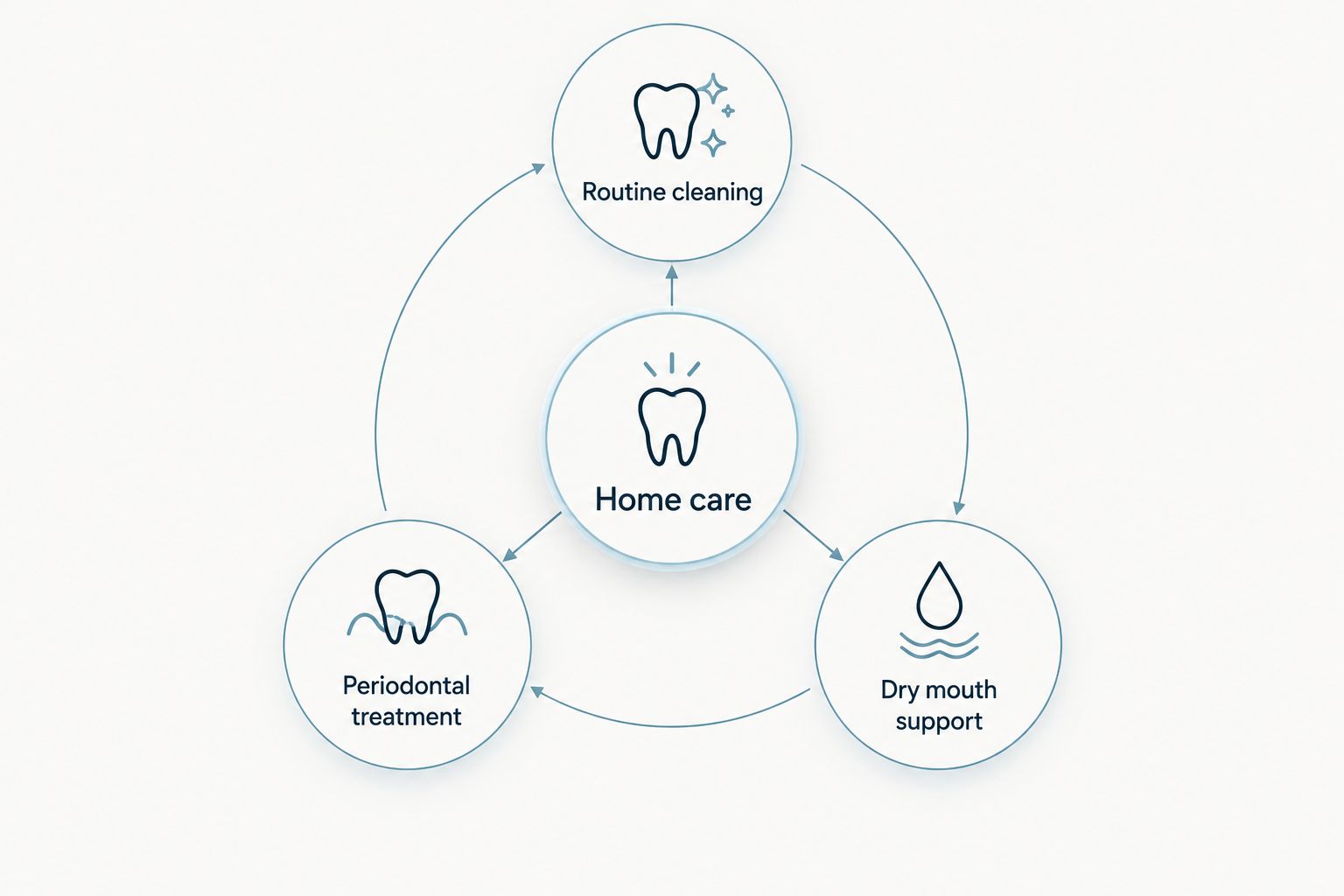
Choose care based on a diagnosis, not on diabetes alone. At your 2026 appointment, ask what each recommended treatment addresses, what its limitations are, and how your dental and diabetes care plans fit together.
Discuss your dental care needs
Share your diabetes history and ask about a dental care plan suited to your oral health.
Common mistakes people with diabetes make
Waiting for pain before checking bleeding gums
Gum disease does not always hurt. Repeated bleeding, recession, or persistent bad breath deserves an assessment even when chewing feels normal. Keep cleaning gently while you arrange care; stopping plaque removal does not treat inflammation.
Changing medication to fit the appointment
Skipping insulin or another diabetes medicine without instructions can create avoidable problems. Fasting and sedation require coordinated planning, not guesswork. Ask for instructions before appointment day and clarify anything that conflicts with your usual diabetes routine.
Treating dry mouth with frequent sugary sips
Repeated sugar exposure adds a tooth-decay concern to an already dry mouth. Use water for routine dryness and discuss persistent symptoms with your dentist. Keep medically necessary low-glucose treatment separate from everyday drink choices.
Assuming every procedure is unsafe
Diabetes is a reason to plan treatment carefully, not a reason to automatically avoid it. Untreated infection also needs attention. Ask about your specific risks, the purpose of treatment, and any coordination needed instead of postponing care indefinitely.
Relying on mouthwash instead of cleaning
Mouthwash does not replace brushing and interdental cleaning. A rinse can have a specific role when your dentist recommends it, but it cannot mechanically remove plaque from every surface. Start with cleaning technique before adding another bottle to the bathroom shelf.
FAQ
What's the best dental care routine for someone with diabetes?
Brush with fluoride toothpaste for 2 minutes twice daily, clean between your teeth daily, and attend dental visits at the interval your dentist recommends. Share your diabetes history and report bleeding gums, dry mouth, or healing problems.
How often should I see a dentist if I have diabetes?
Your dentist should set your visit interval according to your gum health, dental findings, and individual risk. Diabetes alone does not establish one schedule for everyone; active gum disease can require closer follow-up.
Is it safe to get a tooth pulled if I have diabetes?
Diabetes does not automatically prevent a tooth extraction. Your dentist should review your current health, medications, infection, and recovery needs, with input from your diabetes clinician when needed.
Should I skip insulin before a dental appointment?
Do not skip or change insulin unless the clinician responsible for your diabetes treatment gives you instructions. If fasting or sedation is planned, obtain a coordinated meal and medication plan before the visit.
Can treating gum disease cure diabetes?
Treating gum disease does not cure diabetes. Periodontal disease and blood sugar management are connected, but dental treatment does not replace diabetes medication, monitoring, or medical care.
Does diabetes mean I need antibiotics before dental work?
Diabetes alone does not automatically mean you need preventive antibiotics. Your dentist assesses the procedure, infection, and relevant medical history; do not take leftover antibiotics on your own.
When is a dental problem an emergency for someone with diabetes?
Trouble breathing or swallowing, rapidly spreading swelling, or severe illness requires immediate medical attention. Contact your dentist promptly for new swelling, pus, worsening pain, or a wound that is not healing as expected.
One last thing
Your medication list belongs in your dental care kit alongside your toothbrush. Before your next 2026 visit, update that list and write down your main question. Starboard Dental provides general, restorative, and cosmetic care; sharing your medical history helps your dental team plan around your needs rather than discover them during treatment.