Best overall for suitable implant candidates: an implant-retained removable overdenture. Best without surgery: a conventional complete denture. Best when healthy teeth remain: a cast-metal partial denture. This 2026 guide compares the best denture types by support, daily care, healing needs, and the teeth you still have.
- The best denture types depend on remaining teeth, gum health, implant suitability, and how you want to clean them.
- Implant-retained removable overdentures suit eligible patients who want added retention while keeping a removable appliance.
- Conventional complete dentures replace all teeth in an arch without requiring implant surgery.
- Cast-metal partial dentures replace missing teeth while using suitable remaining teeth for support.
- Starboard Dental provides general, restorative, and cosmetic dental care for patients in Kennebunk, York, and Saco, Maine.
Why this matters
A denture replaces missing teeth, but different designs solve different problems. A removable appliance resting on your gums is not the same as one attached to implants, and neither works like a fixed full-arch restoration.
Choose the support system before choosing the appearance. Your remaining teeth, gum health, jawbone, and ability to clean the restoration determine which options deserve consideration.
Starboard Dental is a general and restorative dental practice serving patients of all ages in Kennebunk, York, and Saco, Maine. A dental assessment is the starting point for comparing denture types against your own oral health needs.
What makes the best denture types?
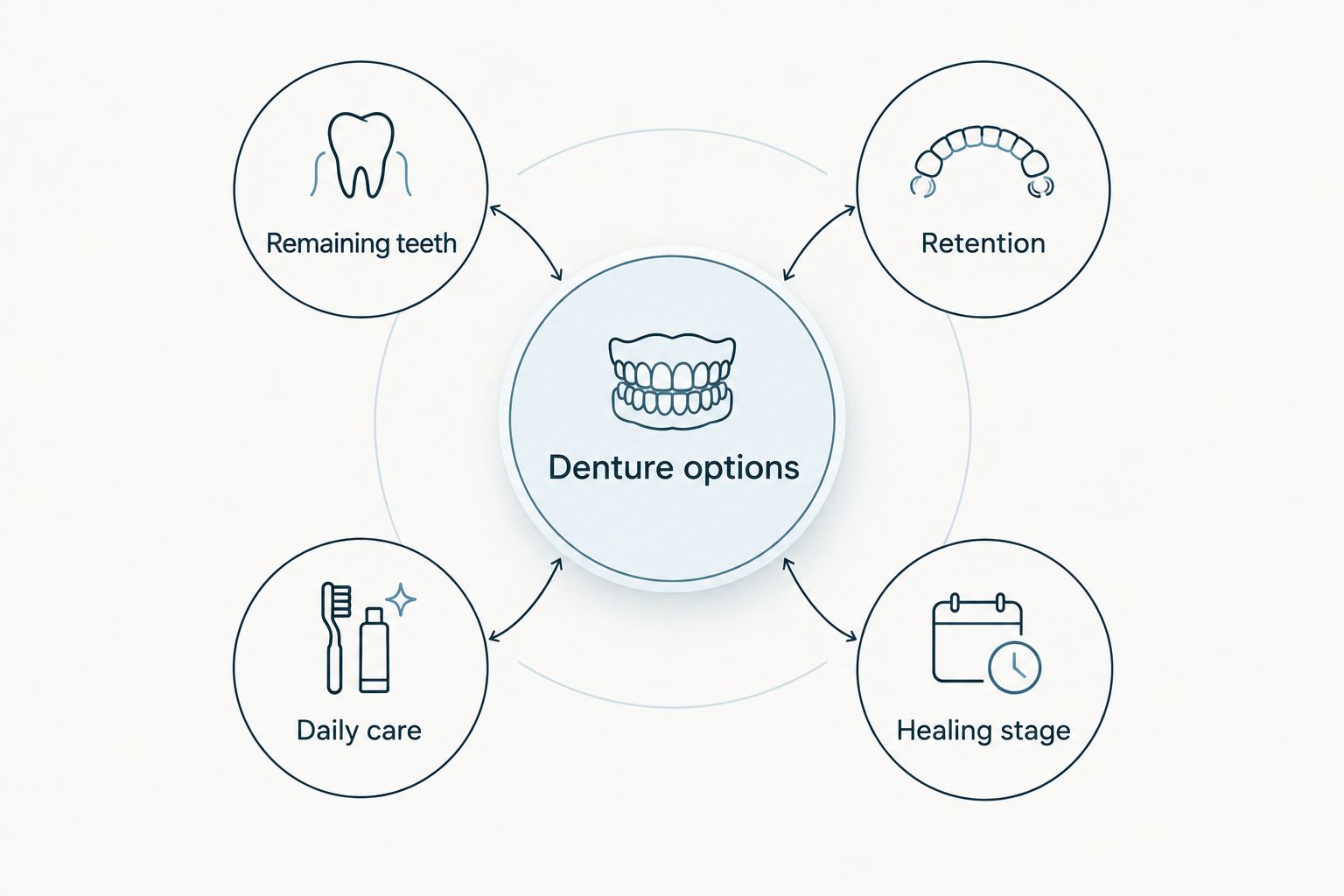
Use these criteria to compare denture options in 2026. A design that suits someone else's mouth does not automatically suit yours.
- Remaining teeth: A partial denture needs suitable teeth to support or retain it; a complete denture replaces an entire arch.
- Retention: Compare how the appliance stays in place—through its fit, clasps, implant attachments, or fixed implant connections.
- Daily care: Decide whether you can remove and clean an appliance or clean carefully beneath a fixed restoration.
- Implant suitability: Implant-supported options require assessment of your health, jawbone, and surgical needs.
- Healing stage: Immediate and transitional dentures serve a different purpose from a restoration fitted after tissues heal.
- Repair and adjustment: Ask how changes in your gums, teeth, or attachments affect future maintenance.
A useful comparison explains both the benefit and the trade-off. More retention does not eliminate cleaning, and avoiding surgery does not eliminate the need for adjustments.
Best denture types at a glance
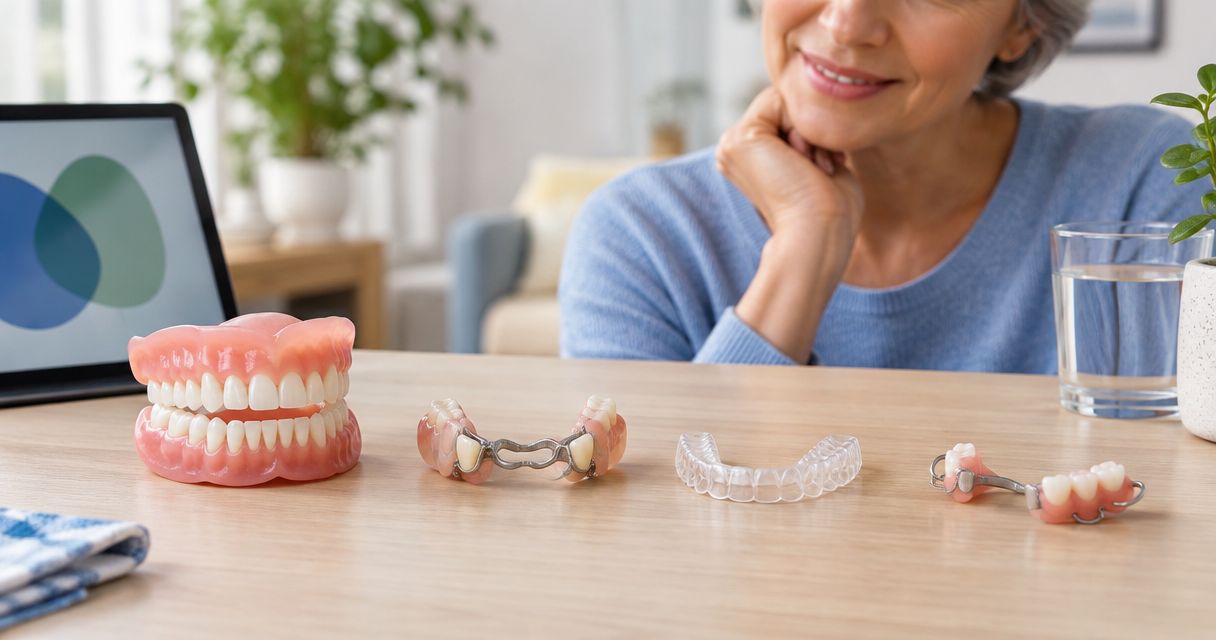
| Rank and type | Best for | Standout feature | Key limitation |
|---|---|---|---|
| 1. Implant-retained removable overdenture | Eligible patients wanting added retention with removable care | Connects to implant attachments and comes out for cleaning | Requires implant treatment and attachment maintenance |
| 2. Conventional complete denture | Patients missing all teeth in an arch who want a nonsurgical option | Replaces a full arch without implants | Fit depends on oral anatomy and changes in supporting tissues |
| 3. Cast-metal partial denture | Patients with suitable natural teeth who need ongoing removable replacement | A metal framework supports replacement teeth | Clasps can show, and supporting teeth need careful cleaning |
| 4. Fixed full-arch implant restoration | Eligible patients who want teeth that stay attached | A full-arch restoration secured to implants | Requires surgery and thorough cleaning underneath |
| 5. Acrylic partial denture | Patients needing a transitional replacement | Can accommodate changes during a treatment plan | Often bulkier than a cast-metal framework |
| 6. Immediate complete denture | Patients who want replacement teeth at the extraction appointment | Fitted immediately after planned extractions | Healing changes the fit and requires follow-up |
These categories overlap. “Immediate” describes when a denture is fitted; “partial” describes how many teeth it replaces; “implant-retained” describes how it stays in place.
1. Implant-retained removable overdenture: best for added retention
An implant-retained removable overdenture connects to attachments on dental implants. You remove it for cleaning, while the attachments help hold it in place during use.
This is the default option to discuss when a conventional denture moves and implant treatment is appropriate. Depending on its design, an overdenture can still receive some support from the gums; implant retention does not mean every appliance works identically.
Implant-retained removable overdenture pros:
- Implant attachments provide added retention.
- Removal allows direct access for cleaning the appliance.
- Offers a removable alternative to fixed implant teeth.
Implant-retained removable overdenture cons:
- Requires implant placement and a healing plan.
- Attachments need maintenance and sometimes replacement.
- Suitability depends on your health and oral anatomy.
Best for: Patients who want a removable denture with more retention and are suitable implant candidates.
Ask which parts support the denture, how the attachments release, and what you will clean every day. The dental implant types comparison explains a related decision, but choosing an implant does not by itself choose the denture design.
Verdict: Hold until implant suitability is confirmed; prioritize this option if removable care and added retention are your goals.
2. Conventional complete denture: best for avoiding implant surgery
A conventional complete denture replaces all teeth in an upper or lower arch after the supporting tissues have healed sufficiently. It rests on the oral tissues rather than attaching to implants.
A complete denture can replace teeth in either of your 2 dental arches. Upper and lower dentures face different retention challenges, so a successful upper denture does not predict an identical lower-denture experience.
Conventional complete denture pros:
- Does not require implant surgery.
- Replaces a full arch of missing teeth.
- Comes out for cleaning and inspection.
Conventional complete denture cons:
- Movement and sore spots can occur.
- Changes in the supporting tissues affect fit.
- Some foods are harder to manage than with natural teeth.
Best for: Patients missing all teeth in an arch who prefer or need a non-implant approach.
For a conventional denture assessment in 2026, ask about fit, bite, adjustment visits, and when a reline becomes appropriate. Adhesive can assist a suitable denture, but it should not hide persistent looseness or pain.
Verdict: Hold until your tissues and bite are assessed; choose this route when avoiding implant surgery is the priority.
3. Cast-metal partial denture: best for keeping healthy natural teeth
A cast-metal partial denture uses a metal framework to support replacement teeth. Clasps and other components connect the appliance to suitable remaining teeth.
The important question is not simply whether teeth remain. Those teeth need assessment for decay, gum health, strength, and their ability to support the planned appliance.
Cast-metal partial denture pros:
- Replaces several missing teeth while retaining suitable natural teeth.
- Uses a rigid framework for support.
- Can be removed to clean the appliance and remaining teeth.
Cast-metal partial denture cons:
- Clasps can be visible when you smile.
- Supporting teeth and clasp areas require careful cleaning.
- Future tooth loss can change the replacement plan.
Best for: Patients with suitable remaining teeth who want an ongoing removable replacement rather than a transitional appliance.
Ask where the clasps will sit and which teeth carry the support. A partial denture does not protect those teeth from decay or gum disease; keeping them healthy remains central to the treatment.
Verdict: Hold until the supporting teeth are assessed; prioritize a cast-metal partial when preserving healthy teeth is practical.
4. Fixed full-arch implant restoration: best for nonremovable teeth
A fixed full-arch implant restoration replaces a complete arch and stays attached to dental implants. You do not remove it at home, although a dental professional can remove certain designs for maintenance.
People sometimes call this a fixed denture or implant bridge. In a 2026 denture comparison, the defining difference is daily use: you clean around and beneath a restoration that remains attached.
Fixed full-arch implant restoration pros:
- Stays attached during everyday use.
- Does not require removal at home.
- Uses implants rather than denture adhesive for retention.
Fixed full-arch implant restoration cons:
- Requires implant treatment and surgical assessment.
- Cleaning beneath the restoration takes attention and suitable tools.
- Repairs and professional maintenance remain necessary.
Best for: Suitable implant candidates who specifically want a nonremovable full-arch replacement and can maintain it.
Ask the clinician to explain the cleaning access before treatment. A restoration that stays attached still needs a daily routine you can carry out comfortably.
Verdict: Hold until surgical suitability and cleaning access are confirmed; consider this option when nonremovable teeth are your priority.
5. Acrylic partial denture: best for transitional replacement
An acrylic partial denture replaces missing teeth with an acrylic base, sometimes with clasps for retention. It is often used while a longer-term treatment plan develops or tissues heal.
Its role matters more than its label. Ask whether the proposed appliance is transitional or intended for ongoing use, and what happens if the condition of your remaining teeth changes.
Acrylic partial denture pros:
- Provides a removable replacement during treatment.
- Can sometimes be modified as the plan changes.
- Leaves access to remaining teeth when removed.
Acrylic partial denture cons:
- The base can feel bulky.
- Retention and support depend on the design and remaining teeth.
- A transitional appliance does not settle the long-term treatment decision.
Best for: Patients needing replacement teeth during healing or staged dental treatment.
Ask what the appliance is meant to accomplish now and what the next decision will be. A temporary role is useful when it is clearly explained.
Verdict: Hold unless its purpose is clear; use a transitional acrylic partial as part of a defined treatment plan.
6. Immediate complete denture: best for the extraction-to-healing stage
An immediate complete denture is prepared before planned extractions and fitted after the teeth are removed. It provides replacement teeth during the initial healing period.
The gums and supporting tissues change after extractions. That makes adjustment and reassessment part of the process, not evidence that the appliance was meant to fit permanently without changes.
Immediate complete denture pros:
- Provides replacement teeth at the extraction appointment.
- Supports appearance during the healing stage.
- Lets you begin adapting to a removable appliance.
Immediate complete denture cons:
- Healing changes its fit.
- Follow-up adjustments and relining can be needed.
- Later treatment can include a replacement denture.
Best for: Patients having planned extractions who want a denture during healing.
Follow the treating dentist's instructions about wear and removal after surgery. Early postoperative instructions differ from the routine for a healed mouth.
Verdict: Hold until the extraction and follow-up plan is explained; choose an immediate denture for the healing stage, not guaranteed lasting fit.
How the denture types are ranked
This 2026 ranking uses retention, remaining teeth, daily cleaning, implant suitability, and healing stage—not appearance alone. Implant-retained removable overdentures lead for eligible patients seeking added retention, while each other option has a distinct role.
There is no universal winner across all mouths. The best choice must match both your clinical needs and the care routine you can maintain.
Which denture type should you choose?
Start with a dental assessment rather than selecting an appliance from a list. Bring your current denture if you have one, and describe what troubles you: movement, sore spots, chewing, speech, or cleaning.
- No teeth remain: Compare a conventional complete denture with implant options if clinically appropriate.
- Healthy teeth remain: Ask whether a partial denture can use them safely for support.
- Extractions are planned: Discuss immediate replacement and the later healing-stage plan separately.
- Removal is difficult: Discuss hand mobility and cleaning needs before choosing any design.
Starboard Dental provides general and restorative dental care for patients comparing replacement options. Tell your dentist what you want to improve, rather than assuming a particular denture type is the answer.
Discuss your tooth replacement goals
Start with your remaining teeth, oral health, and daily care needs.
Daily care matters as much as the design
Remove food and plaque from removable dentures daily using a suitable denture-cleaning method. Avoid hot water, which can distort a denture, and follow instructions for its material and attachments.
If natural teeth remain, brush with fluoride toothpaste for 2 minutes per session, 2 times per day, and clean between the teeth daily. These routines protect the teeth a partial denture depends on.
Generally, remove dentures overnight unless your treating dentist gives different instructions, particularly after extractions. Persistent soreness, looseness, or a mouth sore that does not heal needs dental assessment; do not adjust the denture yourself.
FAQ
What are the best denture types in 2026?
The best denture types depend on remaining teeth, oral health, and cleaning needs. Implant-retained removable overdentures suit eligible patients seeking added retention; conventional complete dentures provide a non-implant option, and cast-metal partials use suitable remaining teeth.
Are implant dentures better than regular dentures?
Implant-retained dentures provide added retention, but they are not appropriate for every patient. They require implant treatment and attachment maintenance, while conventional dentures avoid implant surgery.
What is the difference between full and partial dentures?
A full denture replaces all teeth in an arch, while a partial denture replaces some missing teeth. A partial denture relies on suitable remaining teeth and its design for support and retention.
Can I get dentures without having all my teeth removed?
Yes, a partial denture can replace missing teeth while suitable natural teeth remain. A dentist must assess those teeth and gums before deciding whether they can support the appliance.
Are immediate dentures permanent?
Immediate dentures are fitted at the extraction appointment, but healing changes their fit. They can need adjustments, relining, or replacement as the tissues settle.
Can I sleep with my dentures in?
Generally, removable dentures should come out overnight unless your treating dentist instructs otherwise. Follow specific wear instructions after extractions rather than applying the routine for a healed mouth.
What should I do if my denture keeps moving?
Arrange a dental assessment if your denture repeatedly moves or causes soreness. The dentist can check fit, bite, and tissue health and discuss adjustment, relining, replacement, or implant retention where appropriate.
Can Starboard Dental help me compare tooth replacement options?
Starboard Dental provides general, restorative, and cosmetic dental care for patients in Kennebunk, York, and Saco, Maine. Discuss your missing teeth, current appliance, and goals during a dental assessment.
One last thing
“Full,” “immediate,” and “implant-retained” are not competing descriptions. They describe tooth coverage, fitting time, and retention, so one denture can fit more than one category.
For your 2026 consultation, ask a better question than “Which denture is best?” Ask: “What supports this appliance, how will I clean it, and what changes should I expect as my mouth heals?”