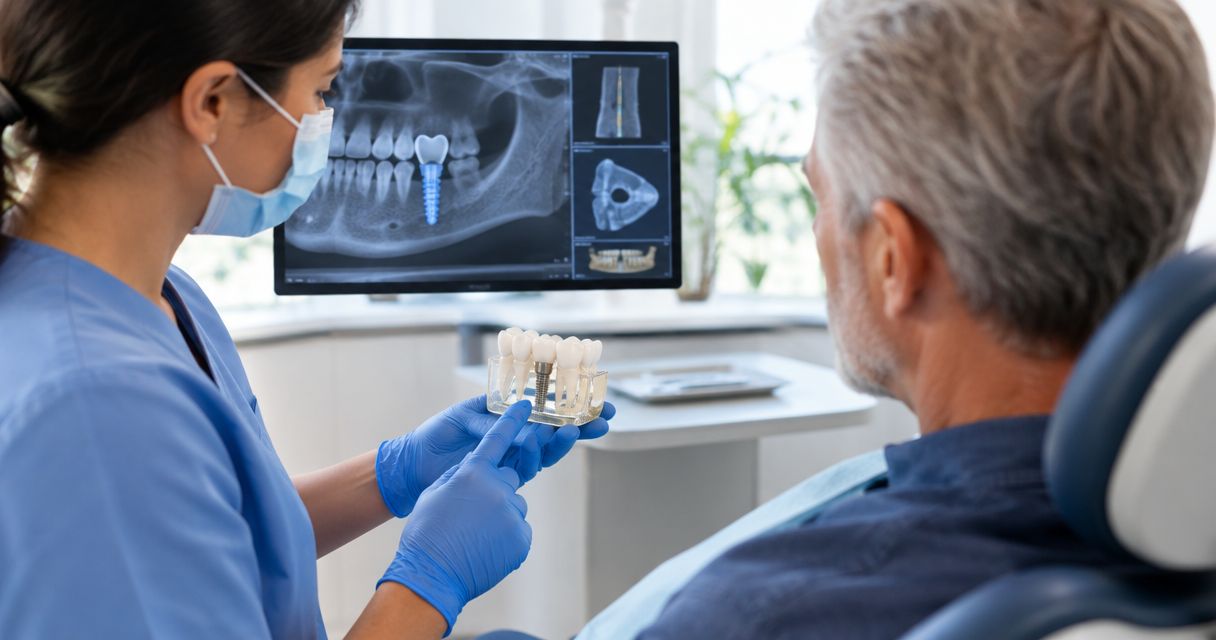
Yes, you can get dental implants with bone loss if the remaining bone can support an implant or a suitable procedure can rebuild that support. Bone grafting, treatment for gum disease, or a different implant plan can make treatment possible, but some patients are better served by a bridge or denture. In 2026, an examination and appropriate imaging—not the words bone loss alone—determine your options.
- Dental implants with bone loss are possible when existing or rebuilt jawbone provides adequate support.
- Bone grafting adds a treatment stage; it does not guarantee implant eligibility.
- Active gum disease needs assessment and treatment before implant placement.
- Starboard Dental provides general and restorative dental care for patients in Kennebunk, York, and Saco.
Can you get dental implants if you have bone loss?
Bone loss does not automatically rule out dental implants. What matters is the amount, shape, location, and health of the bone where the implant would sit. Losing bone around one tooth does not necessarily mean every possible implant site lacks support.
An implant needs bone around it for stability and healing. Your dentist also needs room to position the replacement tooth correctly while protecting nearby nerves, tooth roots, and sinus spaces. Our guide to dental implant types compared explains why implant design and treatment planning are separate decisions.
The main treatment paths have different advantages and limitations:
| Treatment path | Best for | Main advantage | Main limitation |
|---|---|---|---|
| Implant without grafting | Patients with adequate bone at the planned site | Avoids a separate bone-building procedure | Not appropriate when support or positioning is inadequate |
| Bone grafting followed by an implant | Patients with a treatable bone deficiency | Can rebuild support for a planned implant | Adds surgery and healing; successful grafting is not guaranteed |
| Tooth-supported bridge | Patients with suitable neighboring teeth who want a fixed replacement | Does not require an implant in the missing-tooth site | A conventional bridge requires preparation of supporting teeth |
| Removable denture | Patients seeking a nonsurgical replacement for missing teeth | Can replace teeth without implant placement | Requires removal, cleaning, and adjustment as the mouth changes |
These are treatment categories, not a ranking. The right replacement is the one your mouth can support and you can maintain.
Why this matters
Being told you have bone loss can sound like the end of the conversation. It should start a more specific discussion: where is the loss, what caused it, and what would make tooth replacement safe?
For your 2026 treatment plan, separate two questions: can an implant be placed, and can it be positioned for a useful, cleanable replacement tooth? A technically possible implant is not automatically the right treatment.
Starboard Dental is a fit for patients seeking general, restorative, and cosmetic dental care in Kennebunk, York, and Saco. Start by discussing your oral health goals rather than choosing a procedure before your mouth has been evaluated.
How your dentist checks whether implants are possible
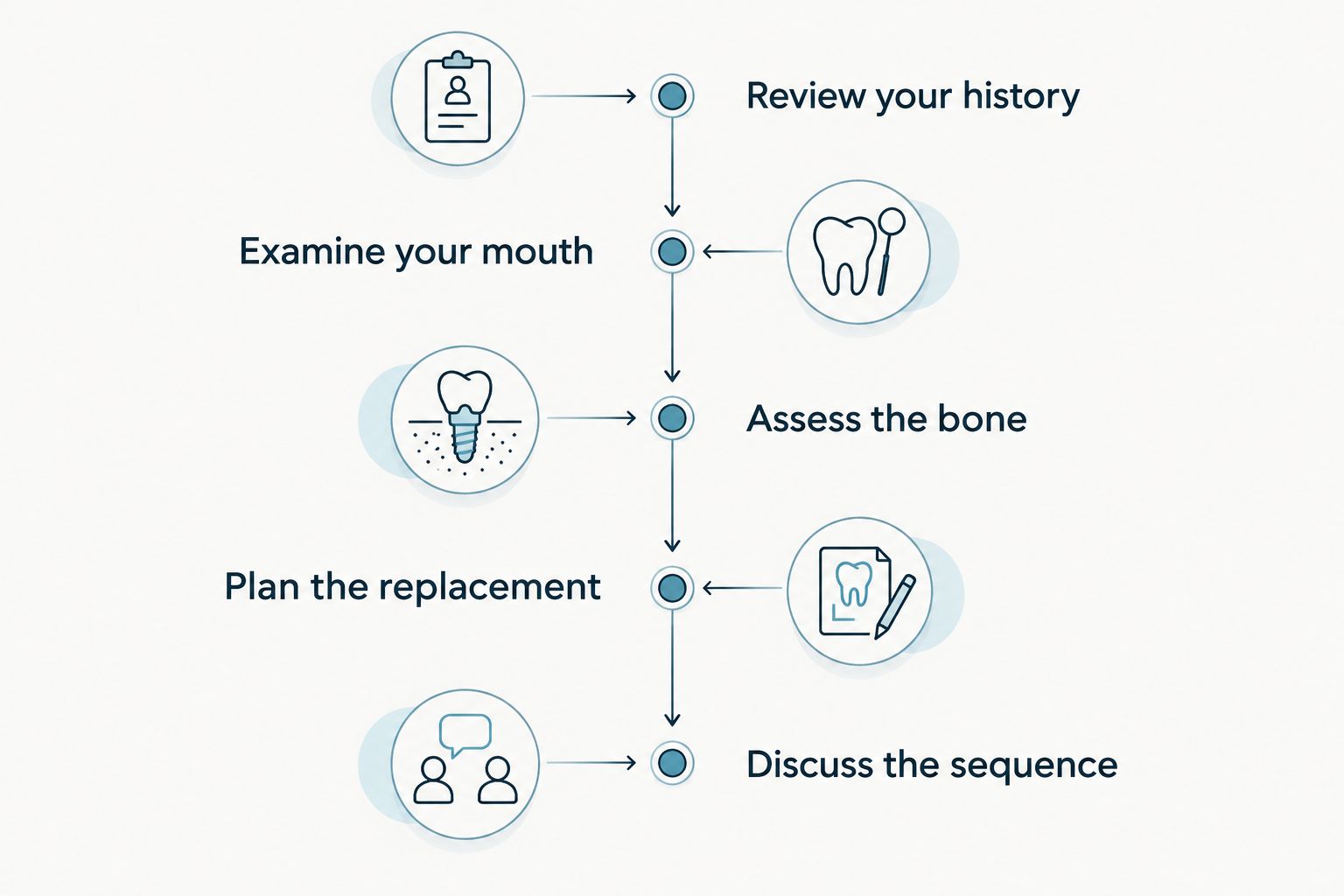
An implant assessment looks beyond the gap in your smile. Expect a discussion of your gums, remaining teeth, health history, and the replacement you want.
- Review your history. Explain when the tooth was lost, whether you have had gum treatment, and which medicines you take. Mention tobacco use, diabetes, and treatment involving the jaw.
- Examine your mouth. Your dentist checks the gums, neighboring teeth, bite, and tissues around the missing-tooth site. Untreated disease changes the treatment sequence.
- Assess the bone. Dental imaging helps evaluate the proposed site. A cone-beam CT scan provides three-dimensional information when needed for planning.
- Plan the replacement. The final tooth position helps guide the implant position—not the other way around. Your dentist evaluates support, space, bite forces, and access for cleaning.
- Discuss the sequence. Ask which problems need treatment first, whether grafting is needed, and whether specialist assessment is appropriate.
The American Dental Association's patient guidance identifies adequate bone, healthy oral tissues, and general health as important considerations for implant treatment. Your own examination determines how those considerations apply to you.
Implant placement without bone grafting
Best for: patients whose planned implant site already has adequate support. A history of bone loss does not establish whether grafting is necessary. The remaining ridge can be sufficient in one area even when another area has substantial loss.
The advantage is avoiding a bone-building procedure that is not needed. The limitation is that the implant still needs an appropriate position, surrounding support, and room for the replacement tooth.
Ask your dentist to explain the proposed site on your images. “There is bone” is less useful than understanding whether that bone supports the intended tooth position and allows daily cleaning.
Bone grafting before or during implant placement
Best for: patients with a bone deficiency that can be treated predictably enough to support the planned restoration. A graft provides a framework for bone formation and can help rebuild part of the ridge. It does not simply turn into an implant-ready site immediately.
Some grafts are placed before an implant; others are performed at the same appointment as implant placement. The choice depends on the defect and whether the implant can achieve adequate initial stability.
The benefit is creating support where it is insufficient. The trade-off is another surgical component, healing, and the possibility that the result will not support the original plan. For a 2026 treatment decision, ask what the next step would be if the graft does not heal as expected.
Graft material can come from different sources. Ask what material is proposed, why it fits your situation, and whether its source matters to your personal preferences.
Sinus augmentation for an upper back-tooth site
Best for: selected patients whose upper back jaw lacks enough bone height beneath the sinus. A sinus augmentation, sometimes called a sinus lift, creates space for bone-building treatment in that region.
Its benefit is addressing a specific anatomical barrier to implant placement. Its limitation is that it adds a procedure involving the sinus area and is not necessary or suitable for every upper-jaw implant.
Tell your dentist about sinus symptoms and previous sinus procedures. Ask whether your anatomy requires this approach, whether another implant plan is appropriate, or whether a non-implant replacement better matches your needs.
Why treatment for dental implants with bone loss varies
There is no single bone-loss threshold that answers every implant question. These factors shape the plan:
- Location of the loss: An upper back-tooth site presents different anatomical concerns from a front-tooth site or lower-jaw site.
- Shape of the ridge: Bone height alone does not describe the space needed around an implant; width and contour matter too.
- Cause of the loss: Tooth loss, gum disease, trauma, and other conditions require different assessments.
- Gum health: Active infection and inflammation need attention before an implant plan proceeds.
- Healing factors: Tobacco use, diabetes control, medicines, and certain medical treatments affect risk and planning.
- Replacement design: A single tooth, bridge, and full-arch replacement place different demands on implant position and cleaning access.
These factors also explain why someone else's treatment timeline is not a useful promise for your mouth. Ask for a sequence tied to healing milestones rather than a guaranteed completion date.
Can you get implants if gum disease caused the bone loss?
Yes, implants remain an option for some people with a history of gum disease, but active disease needs treatment and reassessment first. Replacing a missing tooth does not remove infection around the teeth you still have.
A history of periodontitis also matters after implant placement because it is associated with a higher risk of disease around implants. Your plan should address home cleaning and professional maintenance, not just surgery.
If your gums bleed, your teeth feel loose, or you have persistent bad breath, mention those symptoms before making implant decisions. Avoid treating the empty space as a separate problem from the rest of your mouth.
Can severe bone loss make implants impossible?
Yes, severe bone loss can make a standard implant plan unsuitable. Some complex situations require specialist assessment, and some are better managed without implants.
An alternative implant design or placement strategy is not automatically safer simply because it avoids grafting. The proposed treatment still needs a sound anatomical basis, a maintainable replacement, and risks you understand.
A second opinion is useful when you do not understand why a treatment is recommended or ruled out. Bring your existing images and records so the discussion addresses your situation rather than starting with a preferred procedure.
What if you do not want bone grafting?
You can ask about a tooth-supported bridge or removable denture when you do not want grafting. Suitability depends on the remaining teeth, gum health, bite, and extent of tooth loss.
A bridge provides a fixed replacement, but conventional designs involve supporting teeth. A removable denture avoids implant placement, but it needs daily care and periodic assessment of its fit.
Neither choice is a failure. The goal is a replacement that helps you eat, speak, and clean your mouth without accepting treatment you do not want.
Questions to bring to your consultation
You do not need to arrive knowing which procedure to choose. Bring your questions, medication list, and any available dental records.
For a consultation in 2026, focus on these practical points:
- Where is the bone loss, and what caused it?
- What does the imaging show about the proposed implant site?
- Does gum disease need treatment before tooth replacement?
- Is grafting necessary, and what does it add to the treatment sequence?
- What are the main risks in my case?
- How will I clean the finished replacement?
- What is the alternative if healing does not support the original plan?
If you are seeking general or restorative dental care locally, Starboard Dental serves patients in Kennebunk, York, and Saco. Discuss your goals and ask what evaluation or referral is appropriate before committing to an implant approach.
FAQ
Can I get dental implants if I have already lost a lot of jawbone?
Substantial jawbone loss does not automatically rule out implants, but it requires an individual assessment. Imaging and an examination help determine whether grafting, a different treatment plan, or a non-implant replacement is appropriate.
Do I always need a bone graft if I have bone loss?
No, bone loss does not always mean you need a graft. The decision depends on whether adequate bone remains at the intended implant site and whether the implant can be positioned appropriately.
Will dental implants grow my lost jawbone back?
Dental implants do not rebuild an existing bone defect by themselves. If the site needs additional bone, your dentist must assess whether a bone-building procedure is appropriate.
Can I get an implant while I still have gum disease?
Active gum disease needs treatment and reassessment before implant placement. A history of gum disease also matters when planning long-term implant maintenance.
Does osteoporosis mean I cannot have dental implants?
Osteoporosis alone does not automatically exclude dental implants. Your dentist needs to review your health, jawbone, and medicines, especially antiresorptive medicines that can affect jaw-related treatment risks; do not stop prescribed treatment without medical advice.
How long will implants take if I need bone grafting?
The treatment timeline depends on the graft, the implant site, and healing. Ask whether the graft and implant are planned together or in separate stages, and what must heal before the next step.
Can Starboard Dental help me discuss replacing missing teeth?
Starboard Dental provides general, restorative, and cosmetic dental care for patients in Kennebunk, York, and Saco. Discuss your missing teeth and oral health goals, including what assessment or specialist referral is appropriate.
One last thing
Ask how you will clean the replacement before asking when it will be finished. An implant plan needs to account for your toothbrush, cleaning aids, and access around the finished teeth—not just the placement procedure.
For your 2026 decision, request an explanation of the final tooth position and the maintenance it will require. That conversation connects the surgery you are considering with the everyday care you will actually provide.