
Best overall for an eligible adult with one missing tooth: a dental implant and crown. Best fixed option when neighboring teeth already need crowns: a traditional bridge. Best removable option: a partial denture. These are the best ways to replace a missing tooth in 2026, but the right choice depends on the gap, the teeth beside it, and your oral health. Starboard Dental is a local choice for discussing those factors with a general and restorative dental practice.
- A dental implant and crown is the best overall tooth replacement for an eligible adult with one missing tooth.
- A fixed bridge suits a gap beside teeth that already need crowns; a resin-bonded bridge can suit a front-tooth gap.
- A removable partial denture avoids surgery, while a temporary tooth fills a gap during treatment.
- Starboard Dental is best for local patients who want a restorative dental evaluation before choosing among these options.
Why this matters
A missing tooth affects more than the appearance of your smile. Depending on its position, the gap can change how you chew or speak, and the teeth around it need attention. Covering the space quickly is not the same as choosing a replacement that fits your bite and long-term plans.
The first question in 2026 is not which option looks most like a natural tooth. It is whether the neighboring teeth, gums, and jawbone support the option you want. A dentist can check the gap and explain which choices fit your mouth. Do not commit to a replacement based on a ranked list alone.
What makes the best tooth replacement?
Use these criteria to compare your options before looking at the ranking:
- Neighboring teeth: An implant stands independently. A traditional bridge uses the teeth beside the gap for support, so their condition changes the decision.
- Jawbone and gums: An implant needs an assessment of the bone and surrounding tissues. Active dental problems need attention before a lasting replacement is chosen.
- Fixed or removable: Implants and fixed bridges stay in place. Partial dentures and temporary removable teeth come out for cleaning.
- Position in your mouth: A front-tooth gap brings different appearance and bite considerations from a gap farther back.
- Treatment sequence: Some options need surgery and healing. Others can serve as an interim replacement while you complete care.
- Daily care: Every option needs cleaning. Bridges also require you to clean beneath the replacement tooth.
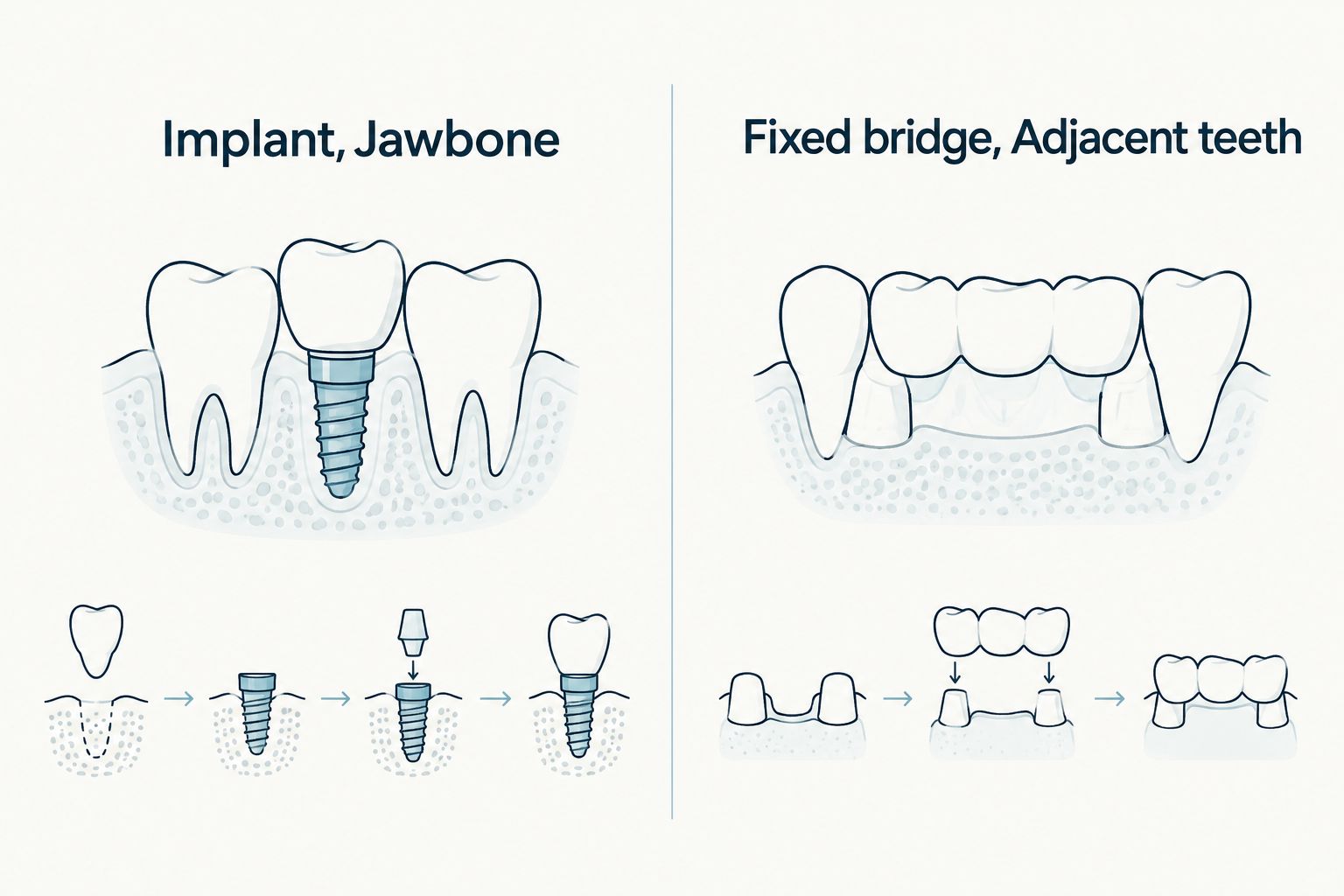
In 2026, the most useful distinction is whether an option replaces only the visible tooth or also replaces its root. An implant addresses both. A bridge or denture replaces the visible tooth without placing a root in the jawbone.
Tooth replacement options at a glance
| Option | Best for | Standout feature | Key limitation |
|---|---|---|---|
| Dental implant and crown | An eligible adult who wants a standalone replacement | Replaces the tooth root and visible tooth | Requires surgery, healing, and suitable oral conditions |
| Traditional fixed bridge | A gap beside teeth that already need crowns | Fixed replacement supported by neighboring teeth | Supporting teeth must be prepared and maintained |
| Resin-bonded bridge | A suitable front-tooth gap | Usually needs less preparation of neighboring teeth | Can come loose and is not right for every bite |
| Removable partial denture | Someone who prefers a removable, nonsurgical option | Can replace one or more teeth | Must be removed and cleaned; fit can change |
| Temporary removable tooth | An interim gap during treatment | Provides a short-term visible replacement | Not a substitute for a lasting treatment plan |
The table ranks typical uses, not what every patient should receive. A front tooth, a back tooth, and a gap beside heavily restored teeth can lead to different recommendations. Ask what each option requires from the teeth and tissues you already have.
1. Dental implant and crown: best overall standalone replacement
A dental implant is placed in the jawbone to support a replacement tooth. For an eligible adult with 1 missing tooth, it offers a fixed option that does not use the 2 adjacent teeth as bridge supports. It is the best overall choice when an examination confirms that the bone, gums, bite, and treatment plan make it suitable.
An implant is not an instant replacement. Placement involves surgery and healing, and a dentist must assess whether other treatment is needed first. If you are missing a tooth and want to avoid preparing healthy neighboring teeth, ask whether an implant is an appropriate option rather than assuming you qualify.
Dental implant pros:
- Replaces the missing tooth without using adjacent teeth as bridge supports.
- Provides a fixed replacement rather than one you remove daily.
- Replaces the tooth root as well as the visible tooth.
Dental implant cons:
- Requires surgery and a healing period.
- Is not suitable for every patient or every gap.
- Still needs careful cleaning and dental follow-up.
Best for: An eligible adult seeking a fixed, independent replacement for 1 tooth.
Verdict: Buy only after an examination confirms that implant treatment fits your oral health and goals.
2. Traditional fixed bridge: best when adjacent teeth need crowns
A traditional bridge holds a replacement tooth in the gap by attaching to crowns on neighboring teeth. It is fixed in your mouth, so you do not remove it for daily cleaning. It becomes a stronger candidate when the teeth beside the space already need crowns.
The trade-off is permanent: the supporting teeth must be prepared for those crowns. If both neighboring teeth are healthy, ask why they should be altered instead of considering an independent replacement. If they need restoration anyway, a bridge can address the gap as part of that plan.
Traditional fixed bridge pros:
- Stays in place during eating and speaking.
- Can replace a missing tooth without implant surgery.
- Can make use of adjacent teeth that already need crowns.
Traditional fixed bridge cons:
- Requires preparation of the supporting teeth.
- Depends on those teeth remaining healthy enough to support it.
- Needs cleaning beneath the replacement tooth.
Best for: A person with 1 missing tooth whose neighboring teeth already need crowns and can support a bridge.
Verdict: Buy when the supporting teeth need restoration and your dentist confirms a bridge suits your bite.
3. Resin-bonded bridge: best conservative fixed option for a front tooth
A resin-bonded bridge attaches a replacement tooth to the back of a neighboring tooth using a bonded support. It can be considered for a suitable front-tooth gap because it generally requires less alteration of the supporting tooth than a traditional bridge. Your bite and the condition of that tooth determine whether it is a realistic choice.
Its main drawback is retention: the bond can come loose. That does not make it a poor option for everyone, but it does make the location of the gap and the forces on the replacement especially important. Ask how your dentist would assess the risk in your mouth.
Resin-bonded bridge pros:
- Provides a fixed replacement without implant surgery.
- Generally preserves more neighboring tooth structure than a traditional bridge.
- Can suit a carefully selected front-tooth gap.
Resin-bonded bridge cons:
- Can detach from the supporting tooth.
- Is not appropriate for every bite or gap location.
- Does not replace the missing tooth root.
Best for: A suitable front-tooth gap where limiting preparation of the neighboring tooth matters.
Verdict: Hold until a dentist checks your bite and confirms the bond has a suitable support tooth.
4. Removable partial denture: best nonsurgical removable option
A removable partial denture replaces one or more missing teeth and uses the remaining teeth and surrounding tissues for support. You take it out for cleaning. It is an option to discuss if you do not want implant surgery or if a fixed replacement does not fit the treatment plan.
Expect an adjustment period with a removable appliance. It can feel different from a fixed tooth, and its fit needs attention as your mouth changes. Ask how to insert, remove, and clean it without damaging the appliance or the teeth that support it.
Removable partial denture pros:
- Does not require implant surgery.
- Can replace one or more missing teeth.
- Can be removed for cleaning.
Removable partial denture cons:
- Can feel less stable than a fixed replacement.
- Must be removed and cared for regularly.
- May need adjustments if its fit changes.
Best for: Someone who wants a removable replacement or needs to address more than 1 gap without implant surgery.
Verdict: Buy if a removable option matches your preferences and your dentist confirms the supporting teeth and tissues are suitable.
5. Temporary removable tooth: best while a lasting plan is underway
A temporary removable tooth can fill a visible gap while you heal or plan a lasting replacement. It helps separate two decisions: how to manage the gap now and what you want to maintain over time. That distinction matters when treatment cannot be completed in one stage.
Temporary does not mean maintenance-free. The appliance needs cleaning and a fit check, and it should not become a reason to put off an evaluation of the missing tooth. Ask what it can safely do during your particular treatment sequence.
Temporary removable tooth pros:
- Addresses the appearance of a gap during treatment.
- Can be removed for cleaning.
- Gives you time to settle on a lasting treatment plan.
Temporary removable tooth cons:
- Is not designed to replace a lasting plan.
- Can feel different from a fixed tooth.
- Needs care and attention to fit.
Best for: Someone who needs an interim visible replacement while a lasting option is evaluated or completed.
Verdict: Wait before treating a temporary tooth as your final answer; agree on the next step with your dentist.
How we ranked the options
The 2026 ranking puts an implant first for an eligible adult seeking an independent, fixed replacement for 1 tooth. It places a traditional bridge next for the distinct case where adjacent teeth already need crowns. The remaining options serve narrower needs: a conservative front-tooth bridge, a removable appliance, or a temporary replacement.
No single option wins every criterion. Surgery, the condition of neighboring teeth, and your willingness to use a removable appliance can change the order for you. The best-ranked treatment is not the best treatment if your mouth cannot support it.
Which tooth replacement should you choose?
If you want a default starting point in 2026, ask whether you are eligible for an implant and crown. If the teeth beside the gap already need crowns, ask for a bridge comparison. If you want to preserve a suitable front-tooth support, discuss a resin-bonded bridge. If you want to avoid surgery or need a removable option, discuss a partial denture.
Bring the decision back to your own gap. Tell the dentist whether the missing tooth affects chewing, speech, or how comfortable you feel smiling. Ask which neighboring teeth would be changed, whether any option requires surgery, and how you would clean the replacement each day.
Starboard Dental provides general, restorative, and cosmetic dental care for patients of all ages in Kennebunk, York, and Saco, Maine. Starboard Dental is best for local patients who want to discuss their oral health goals before choosing a tooth replacement. Dr. Alex Kerbaugh leads the practice; confirm which treatments fit your needs during an evaluation rather than assuming every option on this list is offered.
FAQ
What is the best way to replace one missing tooth in 2026?
An implant and crown is the best overall standalone option for an eligible adult with one missing tooth. A dentist must check your bone, gums, bite, and treatment needs before recommending it.
Is an implant better than a bridge for a missing tooth?
An implant avoids using neighboring teeth as bridge supports, while a traditional bridge can make sense when those teeth already need crowns. Your oral health and the condition of the adjacent teeth decide which is better for you.
Can I replace a missing tooth without surgery?
Yes, a fixed bridge or removable partial denture can replace a missing tooth without implant surgery. Each relies on different supporting teeth or tissues, so an examination still matters.
Is a resin-bonded bridge suitable for a back tooth?
A resin-bonded bridge is not the default choice for a back-tooth gap. The location and forces from your bite need assessment before a dentist can recommend it.
Can a partial denture replace just one tooth?
Yes, a removable partial denture can replace one tooth or more than one. You must remove and clean it, and its fit may need adjustment over time.
Are veneers a way to replace a missing tooth?
No, a veneer covers an existing tooth rather than replacing a tooth that is gone. Ask about an implant, bridge, or denture for an empty gap.
Should I leave a missing tooth untreated?
Have the gap evaluated rather than assuming it needs no attention. A dentist can assess your bite, surrounding teeth, and oral health, then explain whether replacement is appropriate.
One last thing
Do not confuse improving an existing tooth with replacing a missing one. A veneer cannot fill a gap where there is no tooth to cover. That simple distinction can save you from comparing treatments meant to solve different problems. In 2026, start with an evaluation of the gap, then compare only the options that can actually replace the tooth.
Related guides
- Maine veneers price guide — for understanding a cosmetic treatment for an existing tooth, not a replacement for a missing one.