Best overall for a single missing tooth: an endosteal implant with a crown. Best for several neighboring missing teeth: an implant-supported bridge; best for a removable full-arch replacement: an implant-retained overdenture. This 2026 guide compares the best dental implant types and explains what to discuss during a restorative care visit with Starboard Dental.
- The best dental implant types depend on missing teeth, jawbone support, gum health, and cleaning needs.
- An endosteal implant with a crown is the default option to discuss for one missing tooth.
- Implant-supported bridges replace neighboring missing teeth without giving every replacement tooth its own implant.
- Removable overdentures and fixed full-arch restorations serve different cleaning preferences.
- Starboard Dental provides general, restorative, and cosmetic care for patients in Kennebunk, York, and Saco, Maine.
Why this matters
An implant is the part that anchors a replacement tooth to bone. The crown, bridge, or denture is the part you see and use to chew. Choosing an implant without considering its restoration leaves half the decision unfinished.
The best choice is the least extensive treatment that meets your oral health and functional needs—not the option with the most implants. A single missing tooth and an entire missing arch require different plans. Your examination determines whether an implant belongs in that plan at all.
This 2026 comparison separates routine implant-supported restorations from a specialist option for severe upper-jaw bone loss. It does not rank dental practices or assume every practice provides every procedure.
What makes the best dental implant types?
Use these criteria before comparing names or materials:
- Replacement scope: Does the plan replace 1 missing tooth, several neighboring teeth, or a full arch?
- Bone and anatomy: Is there suitable bone, and where are nearby nerves and sinuses?
- Gum health: Are infection and inflammation controlled before treatment?
- Daily cleaning: Can you reach underneath the restoration or remove it for cleaning?
- Treatment complexity: Does the plan involve grafting, specialist surgery, or additional healing stages?
- Repair needs: Can worn attachments or damaged replacement teeth be maintained without replacing the whole restoration?
Tell your dentist what matters most to you: keeping a replacement fixed in place, simplifying cleaning, or avoiding treatment you do not need. Those priorities help shape a useful recommendation.
Dental implant options at a glance
The first four entries describe replacement designs commonly supported by endosteal implants, which sit in the jawbone. Zygomatic implants describe a different anchoring approach. These categories overlap; they are not five competing implant materials.
| Option | Best for | Standout feature | Key limitation |
|---|---|---|---|
| Endosteal implant with a crown | Single missing tooth | Replaces one tooth without using neighboring teeth as bridge supports | Requires suitable bone or additional treatment |
| Implant-supported bridge | Neighboring missing teeth | Multiple replacement teeth share implant support | Cleaning underneath the bridge requires attention |
| Implant-retained overdenture | Removable full-arch replacement | You remove the denture for cleaning | Retaining attachments need maintenance |
| Fixed full-arch restoration | Fixed full-arch replacement | Replacement teeth stay attached during everyday use | Cleaning access must be planned carefully |
| Zygomatic implants | Severe upper-jaw bone loss | Anchors in the cheekbone rather than relying on the usual upper-jaw site | Requires specialist assessment and complex surgery |
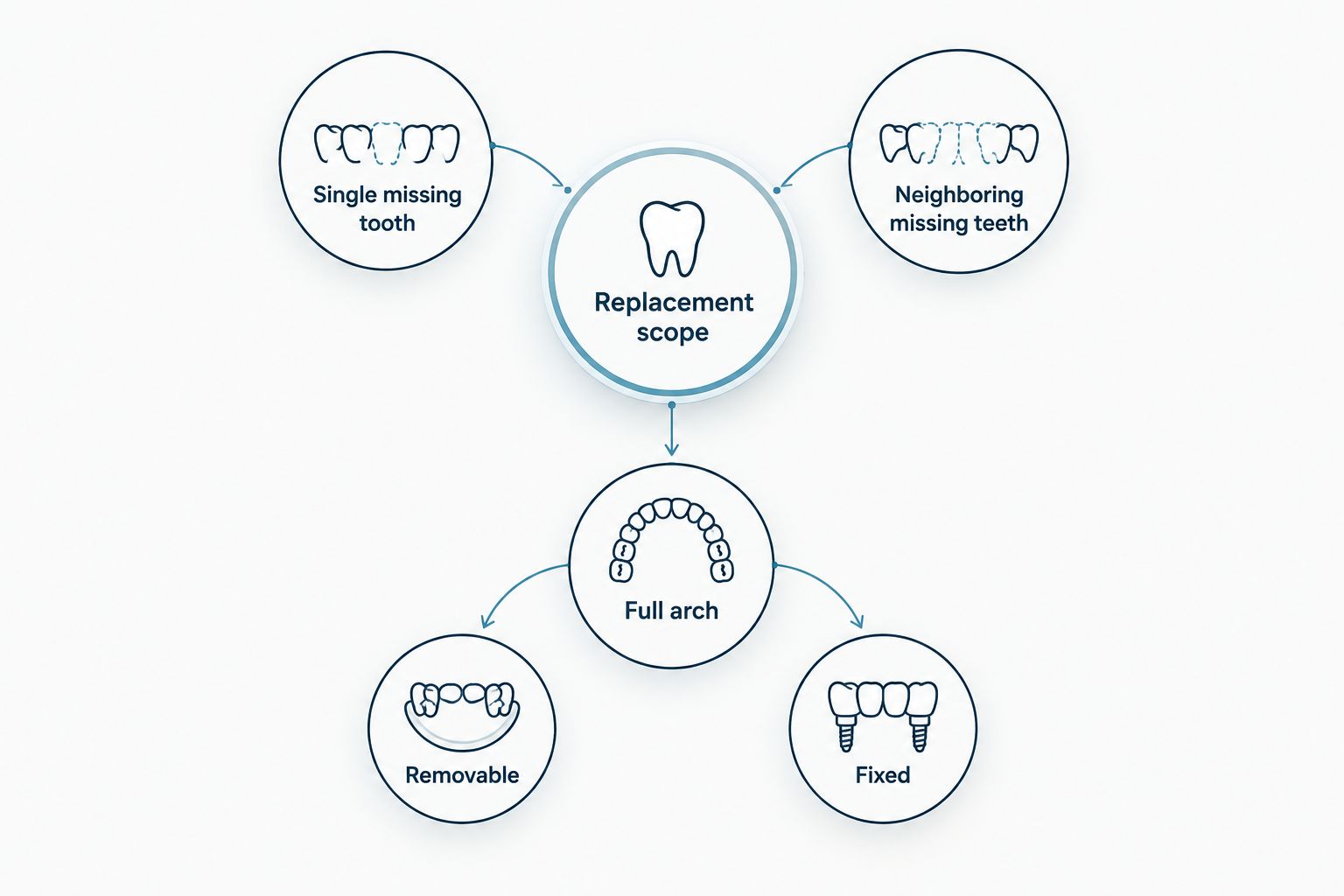
The most useful first distinction is single tooth versus neighboring teeth versus a full arch. Within a full-arch plan, the next question is whether you want a removable or fixed restoration.
1. Endosteal implant with a crown: best for one missing tooth
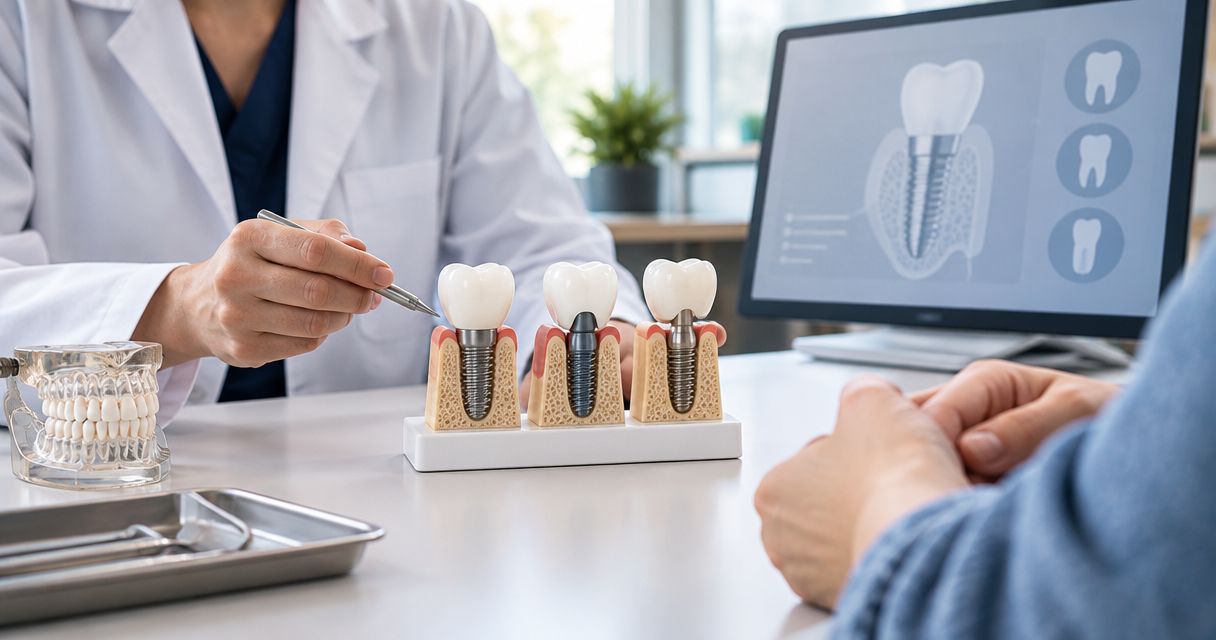
An endosteal implant sits within the jawbone. A connecting component supports a crown above the gumline, creating an individual replacement tooth rather than a removable appliance.
For 1 missing tooth, this is the default implant option to discuss when your bone, gums, and general health support treatment. It avoids preparing neighboring teeth specifically to hold a conventional bridge. That advantage does not eliminate the need for surgery or maintenance.
Endosteal implant with a crown pros:
- Replaces an individual tooth independently.
- Does not use neighboring teeth as bridge supports.
- Stays fixed during everyday eating and cleaning.
Endosteal implant with a crown cons:
- Requires surgery and an individualized healing plan.
- Bone loss can make additional treatment necessary.
- The crown and surrounding tissues still need ongoing care.
Best for: An individual missing tooth with a suitable implant site.
Ask how the dentist will assess the bone, position the crown, and manage your bite. For a front tooth, ask about the gumline as well as the replacement tooth's appearance.
Verdict: Buy—choose this approach for an isolated gap when clinical assessment supports it.
2. Implant-supported bridge: best for neighboring missing teeth
An implant-supported bridge connects replacement teeth to implants rather than relying on natural teeth at the ends of the gap. Not every replacement tooth necessarily needs its own implant.
If you have 2 adjacent missing teeth or a longer gap, ask whether a bridge fits your anatomy and bite. The number and position of supporting implants require an individualized plan; the length of the gap alone does not determine them.
Implant-supported bridge pros:
- Replaces neighboring missing teeth with a connected restoration.
- Avoids using natural teeth as bridge supports.
- Can support multiple replacement teeth without an implant beneath each one.
Implant-supported bridge cons:
- You must clean underneath the connected teeth.
- A problem with one component can affect the larger restoration.
- Implant placement must account for the forces on the whole bridge.
Best for: Several neighboring missing teeth where a fixed bridge is clinically appropriate.
Before accepting the plan, ask your dentist to demonstrate how you will clean underneath it. A replacement that looks straightforward from above can require a different cleaning technique below.
Verdict: Buy—choose this approach for a neighboring gap when shared implant support fits your treatment plan.
3. Implant-retained overdenture: best for removable full-arch care
An implant-retained overdenture attaches to implants but comes out for cleaning. Depending on its design, the denture also receives support from the tissues beneath it.
This option suits someone who wants implant retention while keeping a removable appliance. Removing the denture gives you access to its underside and the implant attachments, but you still need the hand control to insert, remove, and clean it.
Implant-retained overdenture pros:
- Offers implant retention for a removable denture.
- Allows direct access to the denture's underside during cleaning.
- Provides an alternative to a fixed full-arch restoration.
Implant-retained overdenture cons:
- Must be removed as directed for cleaning and care.
- Retaining attachments can wear and require replacement.
- Fit and tissue support need review over time.
Best for: A full-arch replacement when removable cleaning access is a priority.
Ask whether the proposed denture relies mainly on implants, gum support, or both. Those details affect how it feels and how you maintain it. Also ask what happens when an attachment becomes loose.
Verdict: Buy—choose this approach if you prefer removable care and the design meets your functional needs.
4. Fixed full-arch restoration: best for a nonremovable full arch
A fixed full-arch restoration attaches a complete arch of replacement teeth to implants. You do not remove it during your daily routine; a clinician handles removal when the design and treatment needs require it.
The defining benefit is fixed replacement teeth—not a particular implant count. In 2026, choose the design around your bone, bite, and cleaning access rather than treating a named implant configuration as a guarantee of suitability.
Fixed full-arch restoration pros:
- Stays attached during everyday use.
- Replaces a full arch rather than separate gaps.
- Avoids daily removal and reinsertion of the teeth.
Fixed full-arch restoration cons:
- Requires careful cleaning underneath the restoration.
- Repairs can involve the connected arch.
- Treatment planning must account for bone support and bite forces.
Best for: A full-arch replacement when fixed teeth are your priority and you can maintain the design.
Ask to see the cleaning method before treatment begins. If limited dexterity makes that routine difficult, discuss assistance or a removable alternative. Fixed teeth do not mean maintenance-free teeth.
Verdict: Buy—choose this approach only when both surgical suitability and daily cleaning needs are satisfied.
5. Zygomatic implants: best for specialist upper-jaw assessment
Zygomatic implants anchor into the cheekbone and support an upper-jaw restoration. They are a specialist option for selected patients with severe upper-jaw bone loss, not a routine alternative for an isolated missing tooth.
Their role is to address anatomy that makes a conventional upper-jaw implant plan difficult. A specialist must assess the proposed surgery, sinus health, and restoration together.
Zygomatic implant pros:
- Provides an alternative anchoring site in selected upper-jaw cases.
- Can support a fixed upper-arch restoration.
- Offers a treatment pathway when conventional sites are unsuitable.
Zygomatic implant cons:
- Requires specialist expertise and detailed imaging.
- Involves more complex anatomy and surgical planning.
- Carries procedure-specific risks, including sinus complications.
Best for: Specialist evaluation of severe upper-jaw bone loss.
Do not choose this approach because it sounds more advanced. Ask why conventional implants, grafting, or a removable restoration do not meet your needs before considering specialist surgery.
Verdict: Hold—seek specialist assessment rather than treating zygomatic implants as a default choice.
Titanium or zirconia: a separate material decision
Titanium and zirconia describe implant materials, not whether you receive a crown, bridge, or denture. A zirconia crown on a titanium implant is not a zirconia implant.
Titanium has a longer clinical track record and broad use in implant dentistry. Zirconia offers a metal-free implant material, but suitability depends on the available implant system and your restorative plan.
| Material | Best for discussion | Advantage | Limitation |
|---|---|---|---|
| Titanium | Routine implant planning | Long clinical track record | Does not meet a preference for a metal-free implant |
| Zirconia | A specific metal-free preference | Ceramic implant material | Fewer system choices and less long-term evidence than titanium |
Do not change an otherwise suitable plan based on material alone. Ask what the proposed system allows your dentist to do, how it connects to the restoration, and why that material fits your case.
How the options are ranked
This 2026 ranking prioritizes the replacement task: an individual gap first, neighboring gaps next, then removable and fixed full-arch care. The specialist option comes last because it addresses a narrower anatomical problem, not because it is inherently worse.
The criteria are replacement scope, bone support, gum health, cleaning access, treatment complexity, and maintenance. This is a suitability guide, not a product test or a ranking of implant manufacturers.
Which dental implant type should you choose?
For one missing tooth, start by discussing an endosteal implant with a crown. For neighboring gaps, compare an implant-supported bridge with individual replacements. For an entire arch, decide whether removable cleaning access or fixed teeth better fits your daily life.
Starboard Dental is a starting point for patients in Kennebunk, York, and Saco seeking restorative dental care and a discussion of missing-tooth options. Bring your questions about dental implant types, medications, previous dental treatment, and cleaning difficulties to that conversation.
Before committing to a 2026 treatment plan, ask for an explanation of the surgery, restoration, healing stages, alternatives, and ongoing care. You should understand the complete replacement—not just the implant beneath it.
FAQ
What's the best dental implant type for one missing tooth?
An endosteal implant with a crown is the default option to discuss for one missing tooth when bone and health conditions support treatment. An examination determines whether you need additional treatment or a different replacement approach.
Is a dental implant better than a bridge?
Neither is best for every patient. An implant-supported crown avoids using neighboring teeth as bridge supports, while a conventional bridge avoids implant surgery; the condition of your teeth and bone affects the choice.
Are removable implant dentures better than fixed teeth?
Removable implant dentures are better suited to patients who prioritize taking the appliance out for cleaning. Fixed full-arch teeth suit a preference for nonremovable replacement, but require cleaning underneath the restoration.
Are zirconia implants better than titanium implants?
Zirconia implants are not automatically better than titanium implants. Titanium has a longer clinical track record, while zirconia provides a metal-free option for selected treatment plans.
Can I get implants if I have lost jawbone?
Jawbone loss does not automatically rule out implant treatment. Your dentist evaluates the site and discusses whether grafting, a different restoration, or specialist assessment fits your needs.
How do I clean around dental implants?
Clean implant-supported teeth daily using the technique and tools recommended for your restoration. Brush for 2 minutes twice daily and clean between teeth; bridges and full-arch restorations also need access underneath them.
Does Starboard Dental treat patients from York and Saco?
Starboard Dental serves patients of all ages in Kennebunk, York, and Saco, Maine. The practice provides general, restorative, and cosmetic dental care led by Dr. Alex Kerbaugh.
One last thing
An implant cannot develop a cavity, but the gum and bone around it can develop disease. That distinction matters more than choosing a fashionable material.
For your 2026 consultation, ask one practical question: Show me how I will clean this replacement every day. A treatment plan should work in your bathroom as well as in the dental chair.