Best starting option for limited wear: composite bonding. Best for damaged chewing surfaces: onlays. Best for extensively weakened teeth: crowns. The best restorative options for worn or eroded teeth in 2026 depend on how much healthy tooth remains, where the damage sits, and what is causing it—not simply how the teeth look.
- The best restorative options for worn or eroded teeth depend on remaining tooth structure, bite forces, and ongoing erosion.
- Composite bonding suits limited wear; onlays rebuild chewing surfaces; crowns protect more extensively weakened teeth.
- Veneers address selected front-tooth concerns, but they do not solve uncontrolled grinding or acid exposure.
- Starboard Dental provides general, restorative, and cosmetic dental care for patients in Kennebunk, York, and Saco, Maine.
Why this matters
Tooth erosion is the loss of tooth structure through acid exposure. Grinding, clenching, and friction cause other forms of wear, and these problems can occur together. A restoration replaces missing structure; it does not remove the cause.
The right repair preserves useful tooth structure and addresses the reason it was lost. At Starboard Dental, the practice’s general, restorative, and cosmetic care serves patients of all ages in Kennebunk, York, and Saco, Maine.
For your 2026 treatment decision, separate appearance from protection. A slightly shortened front tooth and a heavily weakened back tooth need different answers, even if both look worn.
What makes the best restoration for worn teeth?
Use these criteria to compare recommendations before choosing a treatment:
- Remaining tooth structure: A restoration needs a suitable foundation. Ask how much healthy enamel and dentin remain.
- Location of the damage: Front edges, biting surfaces, and weakened tooth walls face different demands.
- Bite and grinding forces: A repair must fit how your teeth meet, including any clenching or grinding.
- Cause of the wear: Acid exposure and mechanical wear require different preventive steps.
- Amount of tooth preparation: Compare how much additional tooth structure each option removes.
- Repair and maintenance: Ask what happens if the restoration chips, wears, or needs replacement.
Sensitivity also matters, but it does not reveal the depth of damage by itself. An examination helps distinguish exposed dentin from decay, a crack, or a problem inside the tooth.
Restorative options at a glance
| Option | Best for | Standout feature | Key limitation |
|---|---|---|---|
| Composite bonding | Limited worn edges or small defects | Adds tooth-colored material directly to the tooth | Can chip or wear under heavy forces |
| Onlays or overlays | Worn chewing surfaces with usable remaining walls | Rebuilds selected biting surfaces and cusps | Needs a suitable bonding or retention foundation |
| Crowns | Extensively weakened individual teeth | Covers and protects the remaining tooth | Usually requires more tooth preparation |
| Veneers | Selected front-tooth appearance concerns | Changes the visible front surface | Does not address widespread chewing-surface wear |
| Staged full-mouth rehabilitation | Wear affecting multiple teeth and the bite | Coordinates repairs across the mouth | Requires careful planning and ongoing maintenance |
These are treatment categories, not interchangeable upgrades. The ranking starts with localized repairs and moves toward broader treatment as the damage demands it.
1. Composite bonding: best for limited worn edges
Composite bonding adds tooth-colored resin to replace small areas of missing tooth structure. A dentist shapes the material to rebuild an edge, fill a localized defect, or improve the contour of a worn tooth. It can provide an additive approach when the remaining tooth offers a suitable foundation.
Composite bonding pros:
- Can preserve healthy tooth structure through an additive repair.
- Addresses small defects without covering the entire tooth.
- Often allows localized repair if the material chips.
- Can improve both contour and appearance.
Composite bonding cons:
- Can chip or wear when exposed to heavy grinding forces.
- Can stain and need polishing or repair over time.
- Is not a substitute for protecting an extensively weakened tooth.
Best for: Small worn front edges, localized defects, and selected conservative repairs.
Ask whether the repair will sit in a heavy biting contact. A small restoration can face substantial force if it receives the first contact every time you close your mouth.
Verdict: Hold if grinding or acid exposure remains unaddressed; choose bonding for suitable limited damage after assessment.
2. Onlays and overlays: best for worn chewing surfaces
An onlay restores part of a tooth’s chewing surface and covers one or more weakened cusps—the raised points used to chew. An overlay covers the broader biting surface. Both can rebuild a back tooth without automatically covering every outer surface as a crown does.
Onlay and overlay pros:
- Restore damaged chewing surfaces and weakened cusps.
- Can preserve tooth walls that remain healthy.
- Offer a partial-coverage alternative when a full crown is unnecessary.
- Can help restore tooth shape and biting contacts.
Onlay and overlay cons:
- Need enough suitable tooth structure for reliable attachment.
- Still require preparation of the damaged tooth.
- Can fracture or develop problems at the margins.
Best for: Back teeth with worn biting surfaces but enough sound structure to support partial coverage.
For a 2026 treatment plan, ask the dentist to explain why partial coverage is sufficient—or why it is not. The important distinction is structural support, not whether one restoration sounds more advanced.
Verdict: Hold if the remaining tooth cannot support partial coverage; choose an onlay when usable walls can be preserved.
3. Crowns: best for extensively weakened individual teeth
A crown covers the prepared tooth and replaces its outer shape. It is a stronger fit for the treatment discussion when substantial structure is missing, several surfaces need rebuilding, or the remaining walls need protection. A crown is not automatically necessary for every worn tooth.
Crown pros:
- Provides coverage around extensively damaged tooth structure.
- Rebuilds shape and chewing contacts.
- Can combine protection and appearance in one restoration.
- Offers an option when a smaller repair lacks adequate support.
Crown cons:
- Usually removes more tooth structure than an additive repair.
- Does not stop decay or wear-related problems by itself.
- Can need repair or replacement, and the underlying tooth can still develop problems.
Best for: An individual tooth whose remaining structure needs broader coverage and protection.
Ask what supports the crown underneath. If too little usable tooth remains, placing a crown does not solve that foundation problem. Tooth nerve health, cracks, and gum support also affect the decision.
Verdict: Skip crowns for minor wear that a conservative repair can address; choose them when broader protection is justified.
4. Veneers: best for selected front-tooth appearance concerns
A veneer covers the visible front surface of a tooth. It can change the appearance of selected worn front teeth when the underlying structure, enamel, and bite support that approach. Veneers are not a general solution for damaged back-tooth chewing surfaces.
Veneer pros:
- Can improve the visible shape of selected front teeth.
- Can address appearance across neighboring teeth.
- Provides a front-surface restoration without automatically using a full crown.
Veneer cons:
- Often involves irreversible tooth preparation.
- Can chip or detach under unsuitable bite forces.
- Does not correct the cause of erosion or grinding.
Best for: Front-tooth shape and appearance concerns after tooth health and bite suitability have been assessed.
If your main complaint is shortened teeth, ask whether bonding can meet your goals first. A discussion about veneers should include how much enamel remains and whether the proposed shape fits your bite.
Verdict: Skip veneers as a shortcut for uncontrolled wear; consider them for suitable front-tooth appearance goals.
5. Staged full-mouth rehabilitation: best for widespread wear
Full-mouth rehabilitation is a coordinated treatment plan, not one particular restoration. It can combine bonding, onlays, crowns, and other appropriate care when wear affects multiple teeth and their biting relationships. Planning matters because changing one tooth can change how others meet.
Staged full-mouth rehabilitation pros:
- Addresses the mouth as a connected system rather than isolated teeth.
- Allows different teeth to receive different levels of repair.
- Coordinates chewing function, appearance, and protection.
- Can separate planning, trial stages, and definitive treatment.
Staged full-mouth rehabilitation cons:
- Involves more decisions and appointments than a localized repair.
- Requires careful assessment of the bite and tooth health.
- Still depends on controlling ongoing wear and maintaining restorations.
Best for: Widespread wear that affects several teeth, chewing function, or biting relationships.
For extensive wear in 2026, ask which teeth need treatment now and which can be monitored. A coordinated plan should explain the sequence and the reason for each restoration rather than treating every tooth identically.
Verdict: Hold until the diagnosis and sequence are clear; choose coordinated rehabilitation when isolated repairs cannot address the wider problem.
How we ranked these options
This guide prioritizes preserving suitable tooth structure, matching coverage to damage, and addressing bite demands. Composite bonding comes first for limited defects; onlays address larger chewing-surface damage; crowns address teeth needing broader coverage.
Veneers occupy a separate appearance-focused role. Full-mouth rehabilitation belongs last because it describes a coordinated approach to widespread damage, not a better version of a single-tooth repair. Your examination determines which category applies.
Before restoration: understand and control the wear
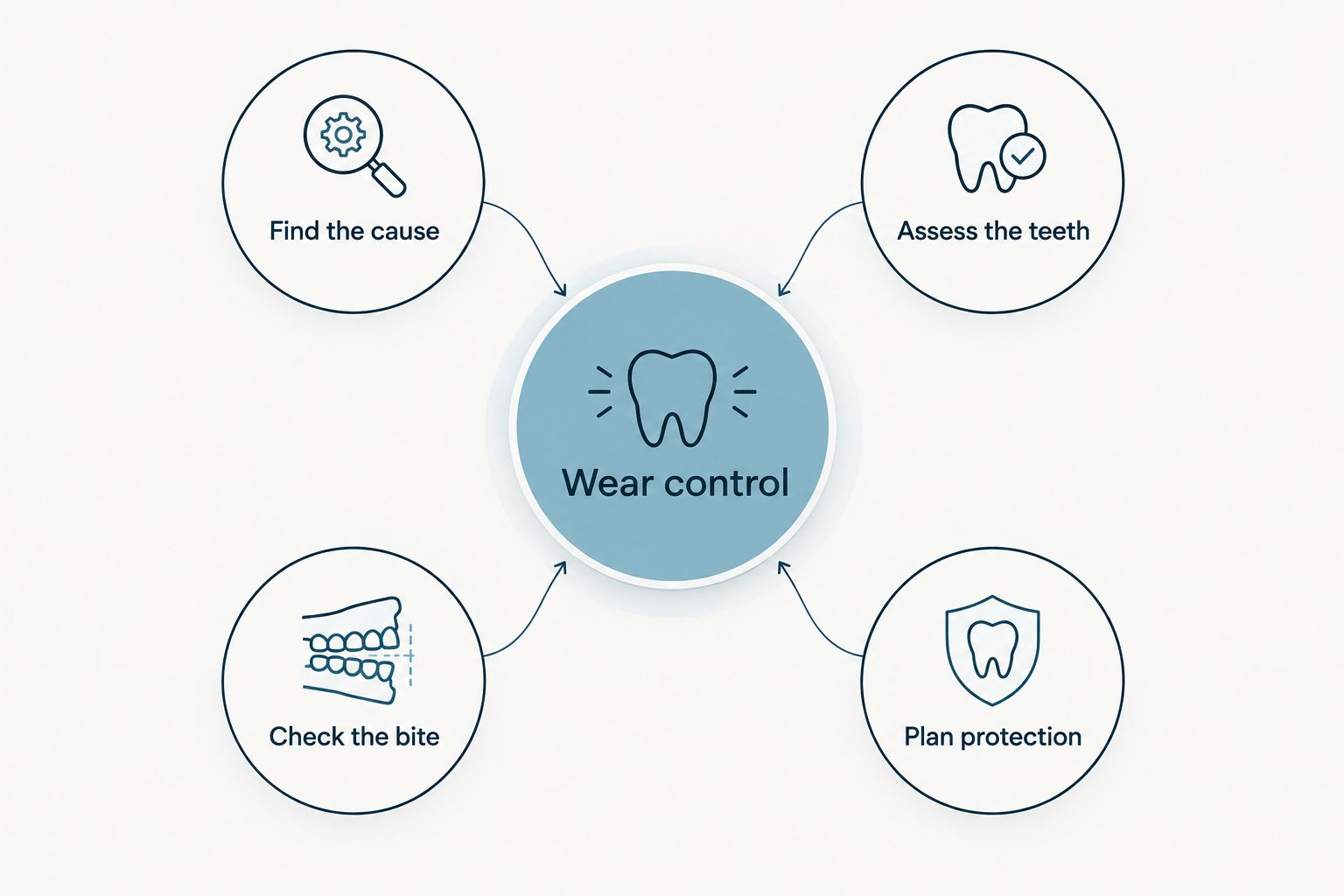
A useful 2026 plan answers four questions before settling on the final repair:
- Find the cause: Discuss acidic drinks, reflux, vomiting, grinding, and other relevant habits or health conditions.
- Assess the teeth: Check remaining structure, sensitivity, cracks, decay, and tooth nerve health.
- Check the bite: Identify where teeth contact and whether those contacts threaten the proposed repair.
- Plan protection: Set out preventive care, appropriate grinding protection, and follow-up.
These steps work together. A night guard can protect against mechanical wear in suitable cases, but it does not treat acid erosion; reducing acid exposure does not correct every harmful biting contact.
At home, follow established oral-hygiene guidance: brush for 2 minutes, 2 times per day, with fluoride toothpaste, and clean between your teeth 1 time per day. These habits support oral health, but they do not rebuild enamel already lost to erosion.
The American Dental Association’s patient guidance supports fluoride toothpaste and daily interdental cleaning. For acid-related wear, also discuss the source of the exposure with your dentist; repeated reflux or vomiting warrants medical attention as well.
Which restoration should you choose?
For limited wear, start the discussion with composite bonding—not automatically with crowns or veneers. For a worn back tooth, ask whether an onlay can preserve useful walls. For an extensively weakened tooth, ask whether crown coverage is necessary.
Starboard Dental is a local option for patients seeking general, restorative, and cosmetic dental care in Kennebunk, York, and Saco, Maine. Bring your concerns about sensitivity, appearance, and chewing so the conversation starts with your goals.
Explore your dental care options
Learn about general, restorative, and cosmetic dental care at Starboard Dental.
FAQ
What's the best restoration for worn teeth?
Composite bonding is a conservative option for limited wear, while onlays and crowns address more extensive structural damage. The best choice depends on remaining tooth structure, the bite, and the cause of the wear.
Can eroded enamel grow back?
Enamel lost through erosion does not grow back. Fluoride supports remaining tooth surfaces, but missing structure requires monitoring or restoration depending on the damage.
Is bonding better than crowns for worn teeth?
Bonding is better suited to some limited defects, while crowns suit teeth that need broader coverage and protection. Neither is the right choice for every worn tooth.
Are veneers a good option for teeth worn down by grinding?
Veneers are not a stand-alone solution for teeth worn down by grinding. A dentist needs to assess the bite, remaining enamel, and protection needs before recommending them.
Do I need a night guard after repairing worn teeth?
A night guard can be part of protecting restorations when grinding or clenching is present. It does not treat acid erosion, and its suitability depends on your examination.
Does tooth sensitivity mean I need a crown?
Tooth sensitivity does not automatically mean you need a crown. Exposed dentin, decay, cracks, and problems inside a tooth can cause sensitivity and require different care.
Can I leave worn teeth untreated?
Some mild, stable wear can be monitored rather than restored immediately. Progressive damage, pain, or changes in chewing need assessment so the cause and treatment needs are clear.
Where can I discuss restorative dental care near Kennebunk?
Starboard Dental provides general, restorative, and cosmetic dental care for patients in Kennebunk, York, and Saco, Maine. The practice is led by Dr. Alex Kerbaugh and serves patients of all ages.
One last thing
A worn tooth does not automatically need drilling. Some repairs add material, while others require preparation to protect a weakened tooth. Before approving treatment in 2026, ask: What healthy tooth structure will this option preserve, and what will it remove?
That question keeps the discussion focused on your tooth—not just the name of the restoration.