Best overall: a tooth-preserving reconstruction plan when your teeth can be restored. Best for an entirely missing arch: a fixed implant-supported restoration when surgery is appropriate. Best nonsurgical replacement: removable dentures. The best full mouth reconstruction options in 2026 depend on which teeth can be saved, your gum and bone health, and how your bite works—not on choosing one treatment for every tooth.
- The best full mouth reconstruction options preserve restorable teeth and replace teeth that cannot be saved.
- Crowns and onlays rebuild damaged teeth; dental implants replace missing teeth.
- Fixed implant-supported teeth require surgery; removable dentures offer a nonsurgical replacement option.
- Starboard Dental provides general, restorative, and cosmetic dental care for patients in Kennebunk, York, and Saco, Maine.
Why this matters
Full mouth reconstruction is a coordinated plan to restore teeth, supporting tissues, and bite function. It is not a single procedure, and it does not automatically mean removing all your teeth.
A mouth with worn but restorable teeth needs a different approach from a mouth with widespread tooth loss. The right starting point is a diagnosis, not a commitment to implants or crowns.
Starboard Dental is a local starting point for patients seeking general, restorative, and cosmetic dental care in Kennebunk, York, and Saco, Maine. Learn about Starboard Dental before discussing your oral health goals with a dentist.
If you have facial swelling, fever, or worsening dental pain, seek prompt dental care rather than waiting to compare reconstruction options. Trouble breathing or swallowing requires emergency medical attention.
What makes the best full mouth reconstruction options?
Use these criteria to evaluate a proposed treatment plan in 2026:
- Tooth preservation: Does the plan keep teeth that have a reasonable outlook, rather than removing them simply to simplify treatment?
- Disease control: Are decay, infection, and gum disease addressed before definitive restorations?
- Bite function: Can you chew comfortably without placing damaging forces on individual teeth or restorations?
- Treatment suitability: Do your bone, gums, medical history, and preferences support the proposed approach?
- Daily maintenance: Can you clean the restorations and attend the follow-up care they require?
- Treatment burden: Do you understand the surgery, appointments, temporary teeth, and adjustments involved?
A cosmetic result matters, but appearance cannot substitute for healthy supporting tissues. Ask your dentist to explain why each tooth is being repaired, replaced, or monitored.
Full mouth reconstruction options at a glance
These are treatment categories, not interchangeable packages. A full mouth plan often combines several of them.
| Option | Best for | Standout feature | Key limitation |
|---|---|---|---|
| Crowns and onlays | Damaged teeth that remain restorable | Rebuilds tooth structure while retaining the tooth | Depends on remaining tooth structure and support |
| Individual dental implants | Separate missing teeth among healthy teeth | Replaces a tooth without using adjacent teeth as bridge supports | Requires surgery and suitable supporting bone |
| Fixed implant-supported arch | An entirely missing or non-restorable arch | Supports a connected replacement using implants | Surgical treatment with demanding cleaning needs |
| Tooth-supported bridges | A bounded gap with suitable neighboring teeth | Provides a fixed replacement without implant placement | Relies on supporting teeth and usually requires their preparation |
| Removable dentures | Extensive tooth loss without implant surgery | Replaces multiple teeth in a removable appliance | Movement, adjustment, and cleaning demands |
| Orthodontics with selective restoration | Misalignment contributing to wear or an unfavorable bite | Changes tooth position before final repairs | Does not replace missing tooth structure or treat active disease |
1. Crowns and onlays: best for saving restorable teeth
Crowns cover a prepared tooth; onlays cover selected damaged areas, including chewing surfaces or cusps. Both can rebuild teeth affected by substantial wear, fractures, or decay when enough sound structure remains.
For a full mouth reconstruction, the important distinction is not simply crown versus onlay. It is whether each tooth has adequate support and whether the proposed restoration can function within your bite.
Crowns and onlays pros:
- Retain natural teeth when those teeth have a reasonable outlook.
- Restore chewing surfaces and tooth shape.
- Allow different treatments for different teeth rather than a uniform approach.
Crowns and onlays cons:
- Require tooth preparation; crowns generally cover more tooth structure than onlays.
- Do not correct untreated gum disease or replace missing teeth.
- Can develop complications, including decay around restoration margins.
Best for: You have several damaged teeth, but their roots and supporting tissues remain suitable for restoration.
Material choice comes after the decision to save the tooth. The guide to dental crown materials compared explains another part of that discussion.
Verdict: Hold until each tooth's restorability is assessed; prioritize preservation when the outlook is reasonable.
2. Individual dental implants: best for separate missing teeth
An individual implant replaces a missing tooth root and supports a restoration, commonly a crown. Several individual implants can form part of a broader plan when missing teeth are separated by healthy natural teeth.
Implants do not need neighboring teeth to serve as bridge supports. However, implant placement depends on the condition of the bone, gums, and surrounding structures, as well as your medical history.
Individual dental implants pros:
- Replace missing teeth without preparing adjacent teeth solely for support.
- Provide a fixed replacement rather than a removable appliance.
- Can be combined with repairs to remaining natural teeth.
Individual dental implants cons:
- Require surgery and a healing period.
- Sometimes require additional treatment to prepare the site.
- Remain vulnerable to inflammation and loss of supporting tissues.
Best for: You have separate missing teeth and otherwise useful natural teeth that should remain in place.
For a 2026 treatment decision, ask whether each space needs an individual implant or whether another restoration better fits its location. More implants do not automatically mean a better plan.
Verdict: Hold until implant suitability and the alternatives for each missing tooth are established.
3. Fixed implant-supported arch: best for an entirely missing arch
A fixed implant-supported arch replaces the teeth in an upper or lower arch with a connected restoration supported by implants. It is not removed by the patient for routine cleaning.
This option belongs in the discussion when an arch is already toothless or the remaining teeth cannot reasonably be restored. It should not be the default simply because several teeth need treatment.
Fixed implant-supported arch pros:
- Provides fixed replacement teeth across an arch.
- Avoids relying on remaining natural teeth as restoration supports.
- Can restore chewing function after extensive tooth loss.
Fixed implant-supported arch cons:
- Requires surgery and suitable implant sites.
- Cleaning beneath and around the restoration takes specific techniques.
- Repairs, maintenance, and professional monitoring remain necessary.
Best for: You need replacement of an entire arch and are a suitable candidate for implant treatment.
Ask how you will clean beneath the replacement teeth and what happens if a component needs repair. Fixed teeth are not maintenance-free teeth.
Verdict: Hold until the need for full-arch replacement and suitability for surgery are confirmed.
4. Tooth-supported bridges: best for a gap with suitable supports
A tooth-supported bridge replaces missing teeth using neighboring teeth as supports. Those supporting teeth usually receive crowns that connect to the replacement tooth or teeth.
A bridge can form one part of full mouth reconstruction rather than replacing an entire arch. Its suitability depends on the size and location of the gap, the supporting teeth, and the forces in your bite.
Tooth-supported bridges pros:
- Provide a fixed replacement without implant placement.
- Can make sense when neighboring teeth already need crowns.
- Restore continuity across a suitable gap.
Tooth-supported bridges cons:
- Usually require preparation of supporting teeth.
- Need cleaning beneath the replacement teeth.
- Problems with a supporting tooth can affect the connected restoration.
Best for: A missing-tooth gap has neighboring teeth that can safely support a bridge, particularly when those teeth also need restoration.
Do not evaluate a bridge only by how it fills the space. Ask about the outlook for each supporting tooth and whether an independent replacement would better preserve healthy neighbors.
Verdict: Skip when supporting teeth are unsuitable; consider a bridge when the supports and bite justify it.
5. Removable dentures: best for replacement without implant surgery
Complete dentures replace all teeth in an arch; partial dentures replace some missing teeth while other natural teeth remain. Both are removed for cleaning.
Conventional removable dentures do not require implant placement. They still need careful planning, and any remaining teeth, infection, or diseased tissues need attention before the final appliance is made.
Removable dentures pros:
- Offer tooth replacement without implant surgery.
- Can replace several teeth or an entire arch.
- Can be removed to clean the appliance and underlying tissues.
Removable dentures cons:
- Can move during eating or speaking.
- Often require adaptation and adjustments.
- Fit can change as supporting tissues change.
Best for: You need extensive tooth replacement and want or need an approach without implant placement.
Removable does not mean unimportant or temporary. A well-planned denture is a valid treatment choice, and your comfort with a removable appliance belongs in the decision.
Verdict: Hold until fit, support, and daily-use expectations are discussed; do not dismiss dentures solely because they are removable.
6. Orthodontics with selective restoration: best for misalignment
Orthodontic treatment moves teeth. When tooth position contributes to uneven wear or an unfavorable bite, movement can sometimes create a better foundation for selected restorations.
This approach is not a substitute for repairing decay, treating gum disease, or replacing missing teeth. It addresses position; other treatments address damaged or absent structure.
Orthodontics with selective restoration pros:
- Addresses tooth position rather than disguising every alignment problem with restorations.
- Can create appropriate space for planned replacement teeth.
- Can be combined with targeted repairs rather than automatically crowning every tooth.
Orthodontics with selective restoration cons:
- Adds an active tooth-movement phase to treatment.
- Requires ongoing hygiene and appropriate retention afterward.
- Is unsuitable as a first step when uncontrolled disease needs treatment.
Best for: You have maintainable teeth, but their position contributes to the problems your reconstruction must address.
Ask whether movement would change the extent of restorative work. The answer should relate to your bite and tooth structure, not appearance alone.
Verdict: Wait until disease is controlled and the dentist establishes whether tooth movement improves the restorative plan.
How these options are ranked
This 2026 comparison ranks treatment categories by their clinical role, beginning with preservation of restorable teeth and moving to replacement options. Orthodontics appears separately because it changes position rather than replacing damaged structure.
The ranking is not a claim that one treatment performs best for every patient. Tooth support, disease control, bite function, maintenance, and treatment burden determine which option belongs in your plan.
Which reconstruction approach should you choose?
Choose the plan that explains each tooth before it proposes a full-mouth solution. Ask for the reasoning in plain language, including what can be saved and why a tooth would need removal.
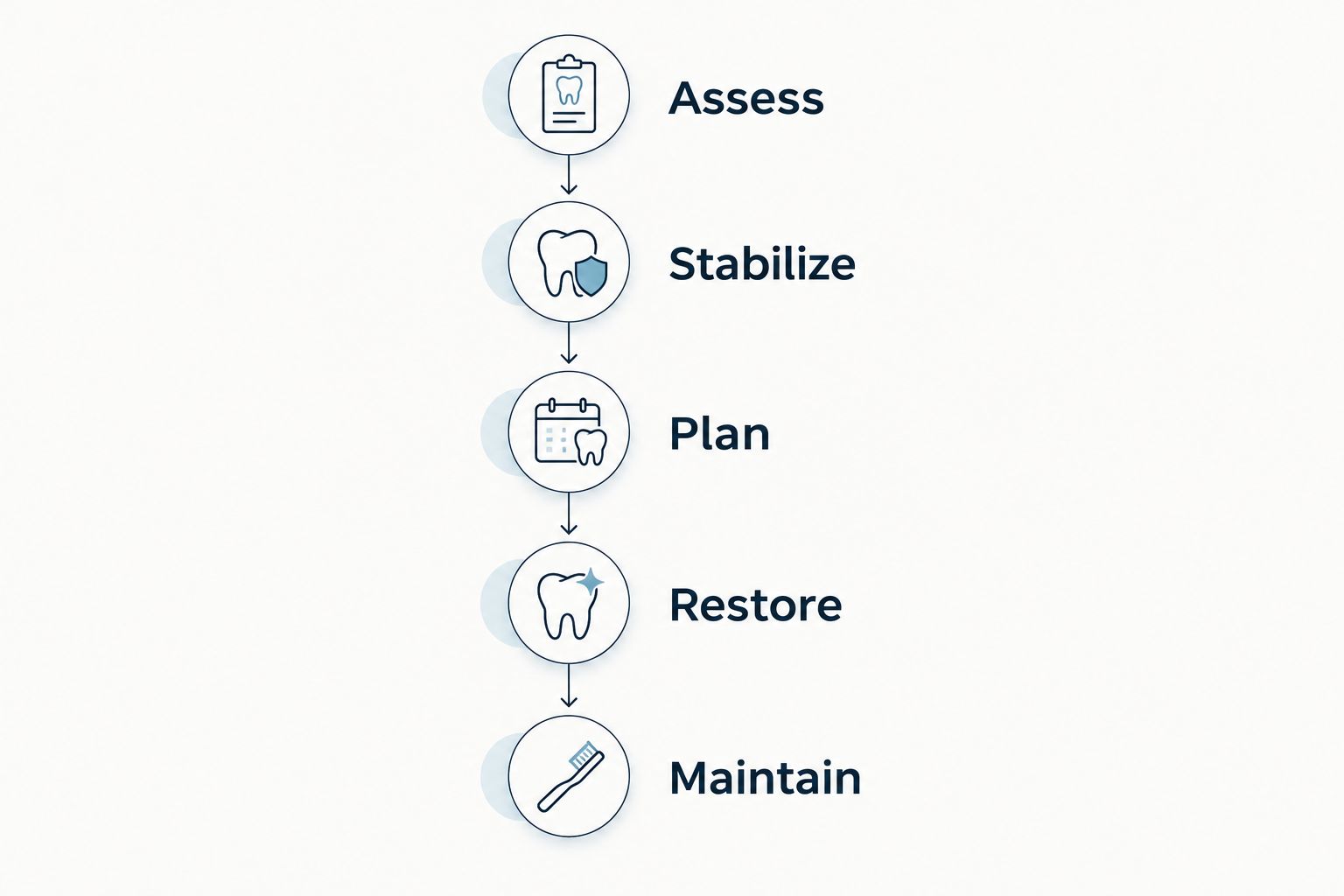
A useful discussion follows this sequence:
- Assess: Identify decay, infection, gum problems, missing teeth, and bite concerns.
- Stabilize: Treat active disease and urgent problems.
- Plan: Compare repair, replacement, and tooth-movement options.
- Restore: Complete treatment in the agreed sequence.
- Maintain: Clean the restorations and arrange follow-up care.
Before agreeing to a 2026 treatment plan, ask how you will eat during treatment, whether temporary restorations are needed, and how maintenance differs between options. You should understand the sequence—not just the finished smile.
Discuss your dental care goals
Learn about general, restorative, and cosmetic dental care at Starboard Dental.
FAQ
What's the best full mouth reconstruction option?
The best option is a coordinated plan that preserves restorable teeth and replaces teeth that cannot be saved. Crowns, implants, bridges, dentures, and orthodontics serve different purposes, so an examination determines the right combination.
Does full mouth reconstruction mean removing all my teeth?
No, full mouth reconstruction does not automatically require removing all your teeth. Teeth with a reasonable restorative outlook can remain part of the plan, while teeth that cannot be saved require a separate replacement discussion.
Are dental implants better than crowns?
Dental implants and crowns are not direct substitutes: implants replace missing roots, while crowns can restore existing teeth or attach to implants. A restorable natural tooth needs a preservation assessment before extraction is considered.
Can I have full mouth reconstruction without implants?
Yes, full mouth reconstruction can use natural-tooth restorations, bridges, or removable dentures without implant placement. The appropriate combination depends on your remaining teeth, supporting tissues, and bite.
Is a fixed implant-supported arch the same as dentures?
No, a fixed implant-supported arch stays in place for routine use, while removable dentures are taken out by the patient. Both need cleaning and professional maintenance, but their support and daily care differ.
Can gum disease affect my reconstruction options?
Yes, gum disease can compromise the support needed for natural teeth and affect implant planning. Active disease needs assessment and treatment before definitive reconstruction.
How long does full mouth reconstruction take?
The timeline depends on the treatments and healing your plan requires. Ask for a phased schedule that separates disease treatment, surgery if needed, temporary restorations, and final restorations rather than relying on a generic completion promise.
How do I care for my teeth after reconstruction?
Brush twice daily for 2 minutes with fluoride toothpaste and clean between teeth daily using methods appropriate for your restorations. Bridges, implants, and dentures need additional cleaning instructions tailored to their design.
One last thing
A tooth with an old crown is not automatically a tooth that needs removal. The condition beneath the restoration and the health of its supporting tissues matter more than its appearance alone.
For your 2026 consultation, bring a short list of what interferes with daily life: chewing, sensitivity, loose teeth, or discomfort. Starboard Dental provides general, restorative, and cosmetic dental care; those practical concerns help frame the conversation around your oral health goals.