Best overall for healthy teeth that need repositioning: orthodontic treatment. Best for a small cosmetic gap: composite bonding. Best for changing tooth shape as well as spacing: porcelain veneers. This 2026 guide compares the best options for closing a gap between teeth, including when a missing tooth needs replacement rather than cosmetic gap closure.
- The best options for closing a gap between teeth depend on tooth position, tooth shape, and gum health.
- Clear aligners and braces move teeth; composite bonding and porcelain veneers change their visible shape.
- Starboard Dental is a local starting point for discussing cosmetic dental care in Kennebunk, York, and Saco.
- A new or widening gap needs a dental examination before cosmetic treatment.
Why this matters
A gap between teeth is not automatically a dental problem. Some people like their spacing and need no treatment. If you want to close it, the important distinction is whether your teeth need to move, become wider, or be replaced.
A new gap deserves particular attention. Gum disease, tooth loss, and changes in tooth position can create spacing that a cosmetic repair alone will not address. Bleeding gums, loose teeth, or a changing bite are reasons to arrange an examination before choosing a treatment.
Starboard Dental is a local starting point for patients seeking general, restorative, and cosmetic dental care in Kennebunk, York, and Saco. The practice is led by Dr. Alex Kerbaugh; you can explore Starboard Dental before discussing your oral health goals.
What makes the best gap-closing treatment?
Use these criteria to compare your options in 2026. A treatment should fit your mouth, not just produce a narrower space in a photograph.
- Cause of spacing: Tooth position, small teeth, missing teeth, and gum problems call for different treatment plans.
- Bite fit: Closing the visible gap should not create tooth contacts that interfere with chewing.
- Tooth preservation: Healthy enamel matters. Compare moving teeth or adding composite with procedures that remove tooth structure.
- Proportions: Making teeth wider can close a gap, but the final width must suit the surrounding teeth.
- Daily commitment: Removable aligners require consistent wear; braces and restorations require careful cleaning.
- Maintenance: Orthodontic treatment needs retention. Bonding, veneers, and replacement teeth also need ongoing care.
A useful consultation compares the simplest suitable option with its alternatives. Ask what each treatment changes, what it leaves unchanged, and what you will need to maintain afterward.
Gap-closing options at a glance
| Option | Best for | Standout feature | Key limitation |
|---|---|---|---|
| Clear aligners | Suitable spacing with a preference for removable orthodontics | Move teeth without fixed brackets | Depend on consistent wear and case suitability |
| Composite bonding | A small gap between otherwise well-positioned teeth | Adds tooth-colored material to reshape edges | Can stain, chip, and need repair |
| Fixed braces | Spacing combined with more complex tooth-position or bite problems | Fixed appliances support controlled tooth movement | Cleaning around brackets takes extra attention |
| Porcelain veneers | Gaps accompanied by tooth-shape or color concerns | Change the visible surfaces and proportions of teeth | Usually involve irreversible enamel preparation |
| Dental implant restoration | A gap caused by a missing tooth with suitable supporting bone | Replaces a tooth without relying on adjacent teeth for support | Requires surgery and individual eligibility assessment |
| Dental bridge | A missing-tooth gap when a fixed, tooth-supported restoration fits | Replaces the missing tooth using neighboring support | Conventional bridges require preparation of supporting teeth |
The table separates cosmetic spacing from a missing-tooth space. Bonding and veneers reshape existing teeth; they are not substitutes for replacing a missing tooth.
1. Clear aligners: best for removable gap-closing treatment
Clear aligners are a series of removable trays that gradually move teeth. They address spacing by changing tooth position rather than making the teeth wider. A dentist must assess whether the planned movement fits your bite and supporting tissues.
Clear aligners are a strong starting point when your teeth are healthy, their proportions already look appropriate, and the spacing is suitable for aligner treatment. They are not automatically the right choice for every gap.
Clear aligner pros:
- Move teeth instead of covering the space with restorative material.
- Come out for meals, brushing, and flossing.
- Avoid fixed brackets on the front surfaces of teeth.
Clear aligner cons:
- Require consistent wear according to the prescribed plan.
- Some cases need attachments or other supporting procedures.
- Require retainers after treatment to help maintain tooth position.
Best for: Patients with suitable spacing who can follow a removable-appliance routine.
Ask whether closing the gap will improve the position of all the relevant teeth, not just the front pair. Verdict: Buy into a professionally supervised aligner plan when tooth movement is appropriate and you can follow the wear instructions.
2. Composite bonding: best for a small cosmetic gap
Composite bonding adds tooth-colored resin to the teeth bordering a gap. The dentist shapes and polishes the material to change the visible contours. Bonding closes selected spaces by making the teeth wider; it does not move their roots or correct a bite problem.
This distinction makes bonding useful when tooth position is already acceptable but tooth shape leaves a small space. If the gap is too large for the surrounding proportions, adding material can make the teeth look unnaturally broad.
Composite bonding pros:
- Often preserves more natural tooth structure than veneers.
- Allows targeted changes to tooth edges and contours.
- Can often be repaired when a small area chips.
Composite bonding cons:
- Can stain or chip over time.
- Does not correct underlying tooth-position problems.
- Needs careful shaping to preserve a cleanable contact between teeth.
Best for: A small, stable gap between healthy teeth with an acceptable bite.
Ask how the added width will compare with neighboring teeth and how you should clean the new contact. Verdict: Buy into bonding when a modest shape change closes the gap without making the teeth look oversized.
3. Fixed braces: best for spacing with complex alignment needs
Fixed braces use brackets and wires to move teeth. They can address spacing alongside rotations, crowding elsewhere in the mouth, or bite problems. The appliance stays attached, so treatment does not depend on remembering to insert removable trays.
That does not make braces maintenance-free. You still need to clean thoroughly, attend appointments, and follow instructions about foods and any additional appliances.
Fixed braces pros:
- Address tooth position rather than simply altering tooth width.
- Support a range of controlled tooth movements.
- Stay in place throughout treatment.
Fixed braces cons:
- Make brushing and cleaning between teeth more involved.
- Can cause temporary soreness or irritation.
- Still require retainers after active treatment.
Best for: Patients whose gap is part of a broader alignment or bite problem.
The choice between braces and aligners should follow an examination, not appearance alone. Verdict: Buy into braces when the treatment plan calls for fixed-appliance control; skip cosmetic gap coverage as a substitute for needed tooth movement.
4. Porcelain veneers: best for gaps with tooth-shape concerns
Porcelain veneers cover the front surfaces of teeth. They can change visible shape and color while closing selected gaps. Unlike orthodontics, veneers do not reposition the roots.
Veneers deserve a different conversation from bonding because preparation usually removes enamel. If your only concern is a small gap between otherwise healthy, attractive teeth, compare less invasive options first.
Porcelain veneer pros:
- Address tooth shape and color together.
- Provide a porcelain surface that resists staining better than composite resin.
- Allow planned changes to visible tooth proportions.
Porcelain veneer cons:
- Usually require irreversible tooth preparation.
- Can chip or fracture and need eventual replacement.
- Do not treat gum disease or correct root position.
Best for: Patients with both spacing and broader concerns about the appearance of existing teeth.
Ask to discuss the proposed tooth widths and bite contacts before committing to preparation. Verdict: Hold until bonding and orthodontics have been compared; choose veneers when the wider cosmetic goal justifies the tooth preparation.
5. Dental implant restoration: best for an eligible missing-tooth gap
A dental implant restoration replaces a missing tooth rather than closing a space between existing teeth. The implant is placed in the jawbone, and a restoration replaces the visible tooth. Supporting bone, gum health, and overall health affect the treatment plan.
An implant is not a cosmetic shortcut for a natural gap between two present teeth. It belongs in the comparison only when a tooth is missing.
Dental implant restoration pros:
- Replaces the missing tooth without using neighboring teeth as the main support.
- Provides a fixed restoration after the planned treatment is complete.
- Addresses the absence of a tooth rather than widening adjacent teeth.
Dental implant restoration cons:
- Requires a surgical procedure and healing.
- Some patients need additional treatment before placement.
- Needs ongoing cleaning and monitoring of the surrounding tissues.
Best for: A missing-tooth space in a patient whose examination supports implant treatment.
Ask how bone condition and nearby structures affect the plan. Verdict: Hold until implant eligibility is confirmed; skip implants as an answer to ordinary spacing between existing teeth.
6. Dental bridge: best for selected tooth-supported replacement
A dental bridge replaces a missing tooth with an artificial tooth supported by neighboring teeth. A conventional bridge uses crowns on the supporting teeth. Its suitability depends on those teeth, the bite, and the location of the space.
A bridge deserves consideration when adjacent teeth already need substantial restoration. Preparing otherwise intact neighboring teeth is a different trade-off and should be discussed directly.
Dental bridge pros:
- Provides a fixed replacement for a missing tooth.
- Does not require implant placement surgery.
- Can combine missing-tooth replacement with restoration of supporting teeth.
Dental bridge cons:
- Conventional bridges require preparation of neighboring teeth.
- Cleaning beneath the replacement tooth requires specific techniques.
- Problems with a supporting tooth can affect the bridge.
Best for: A missing-tooth gap where neighboring teeth provide suitable support and the restorative trade-offs fit.
Ask which teeth will support the bridge and what treatment they need. Verdict: Hold until the supporting teeth are assessed; choose a bridge when tooth-supported replacement makes sense for the whole area.
How the options are ranked
This 2026 ranking prioritizes the cause of the gap, preservation of healthy teeth, bite fit, and maintenance. Orthodontics leads when tooth position needs correction; bonding leads for a small shape-related gap. Veneers serve a broader cosmetic goal, while implants and bridges address missing teeth.
The order is a decision guide, not a claim that one treatment works for every mouth. Your examination determines which branch applies.
Which gap-closing option should you choose?
If you are undecided in 2026, start with the cause of the gap, not a preferred procedure. Bring these questions to your appointment:
- Check the cause: Is the space longstanding, or has it appeared or widened recently?
- Check the gums: Are the supporting tissues healthy enough for the proposed treatment?
- Choose the approach: Do the teeth need repositioning, reshaping, or replacement?
- Plan maintenance: What cleaning, retention, repairs, or monitoring will follow?
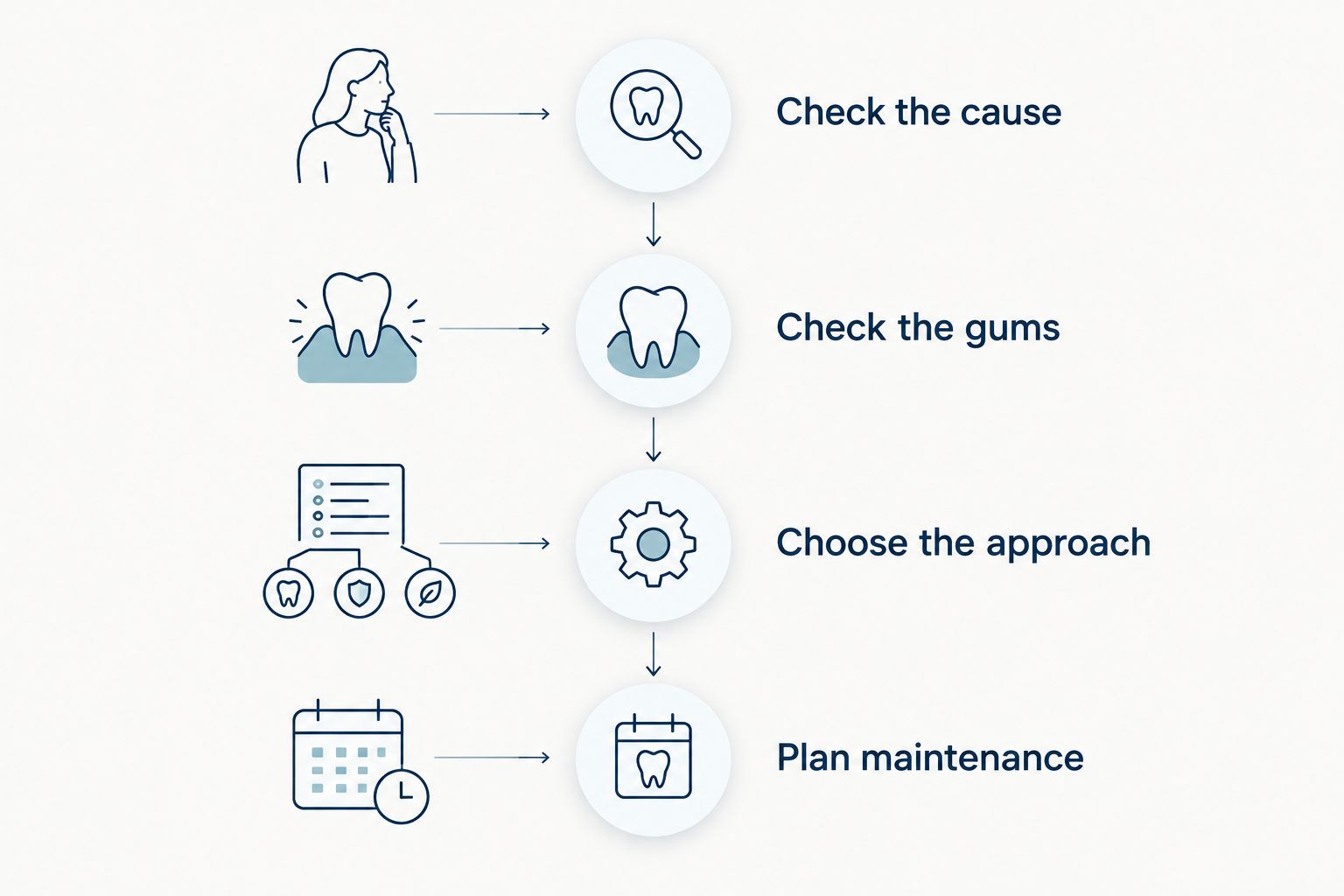
Your consultation at Starboard Dental should begin with your goals: what bothers you, whether the space has changed, and whether you have discomfort or bleeding. Ask which options fit your mouth and whether referral is appropriate for the proposed treatment.
Discuss your gap-closing options
Start with an examination and a conversation about your oral health goals.
Protecting your result
Closing a gap does not replace everyday dental care. Brush for 2 minutes per session, 2 times per day, using fluoride toothpaste, and clean between your teeth 1 time per day. Follow individualized instructions for braces, bridges, implants, or newly shaped tooth contacts.
After orthodontic treatment, wear retainers as prescribed. Teeth can shift after treatment; the retainer plan is part of maintaining the result, not an optional extra.
Report a changing bite, a loose restoration, or renewed spacing. Do not try to move teeth with homemade elastic bands: uncontrolled movement can damage gums and supporting tissues.
FAQ
What's the best option for closing a gap between teeth in 2026?
Orthodontic treatment is the best starting point when a gap results from tooth position and the teeth and gums are healthy. Composite bonding suits selected small shape-related gaps; an examination determines which approach fits.
Is bonding better than braces for a small gap?
Bonding is better suited to a small gap that can be closed by changing tooth shape without compromising proportions or bite. Braces move teeth and are more appropriate when position needs correction.
Can clear aligners close a gap between front teeth?
Clear aligners can close suitable gaps between front teeth by moving them. A dentist must assess the bite, gum health, and planned movement, and retention is needed afterward.
Do veneers close gaps without moving teeth?
Veneers can close selected visible gaps by changing tooth width and shape rather than moving teeth. They usually involve irreversible preparation, so compare bonding and orthodontics before choosing them.
Should I worry if a new gap appears between my teeth?
A new or widening gap needs a dental examination. Tooth movement, missing teeth, and gum problems can cause spacing, especially when bleeding, looseness, or bite changes occur.
Can a gap between a child's front teeth close naturally?
Some childhood gaps change as permanent teeth erupt and dental development progresses. A dentist should assess the child's stage of development before recommending treatment.
Will my gap reopen after treatment?
A gap can reopen if teeth shift after orthodontic treatment or if an underlying cause remains untreated. Follow the prescribed retainer plan and keep dental reviews; bonding and veneers also need maintenance.
Where can I discuss a tooth gap near Kennebunk, York, or Saco?
Starboard Dental serves patients of all ages in Kennebunk, York, and Saco, Maine, with general, restorative, and cosmetic dental care. Discuss the cause of your gap and which treatment options or referrals fit your oral health goals.
One last thing
A closed gap is not automatically a better smile. The right 2026 treatment preserves healthy teeth, supports a comfortable bite, and creates a result you can clean and maintain. If closing the space would make the teeth too wide, moving them deserves consideration before adding material.