Dentures last several years, but they need replacement when wear, damage, or changes in your mouth prevent a comfortable, stable fit. Adjustments, repairs, or relining can sometimes keep an otherwise sound denture useful; this 2026 guide explains how to tell the difference between a fixable problem and a denture that needs replacing.
- How long do dentures last? Fit, chewing ability, and condition matter more than a fixed replacement date.
- A denture reline improves the fit against your gums; it does not replace worn artificial teeth.
- Persistent soreness, slipping, cracks, or difficulty chewing deserve a dental evaluation.
- Starboard Dental provides general and restorative dental care for patients in Kennebunk, York, and Saco, Maine.
Why this matters
A denture does not have to break to stop working well. Your gums and the bone beneath them change after tooth loss, while the denture itself does not change shape to match. A once-comfortable appliance can gradually become loose, rub your gums, or make eating harder.
The useful question is not just how old your dentures are. It is whether they still fit and function safely. For your 2026 dental visit, bring up changes in comfort, chewing, speech, and adhesive use rather than waiting for a visible crack.
Starboard Dental provides general, restorative, and cosmetic dental care for patients of all ages in Kennebunk, York, and Saco, Maine.
How long do dentures last before replacement?
There is no single replacement deadline that applies to every denture. The artificial teeth, denture base, supporting gums, and any remaining natural teeth all affect how long the appliance remains useful. A dentist needs to examine both your mouth and the denture before recommending replacement.
A newer denture with significant damage can need replacement sooner than an older appliance that still works well. Conversely, age alone does not prove that a denture is unsafe or unusable.
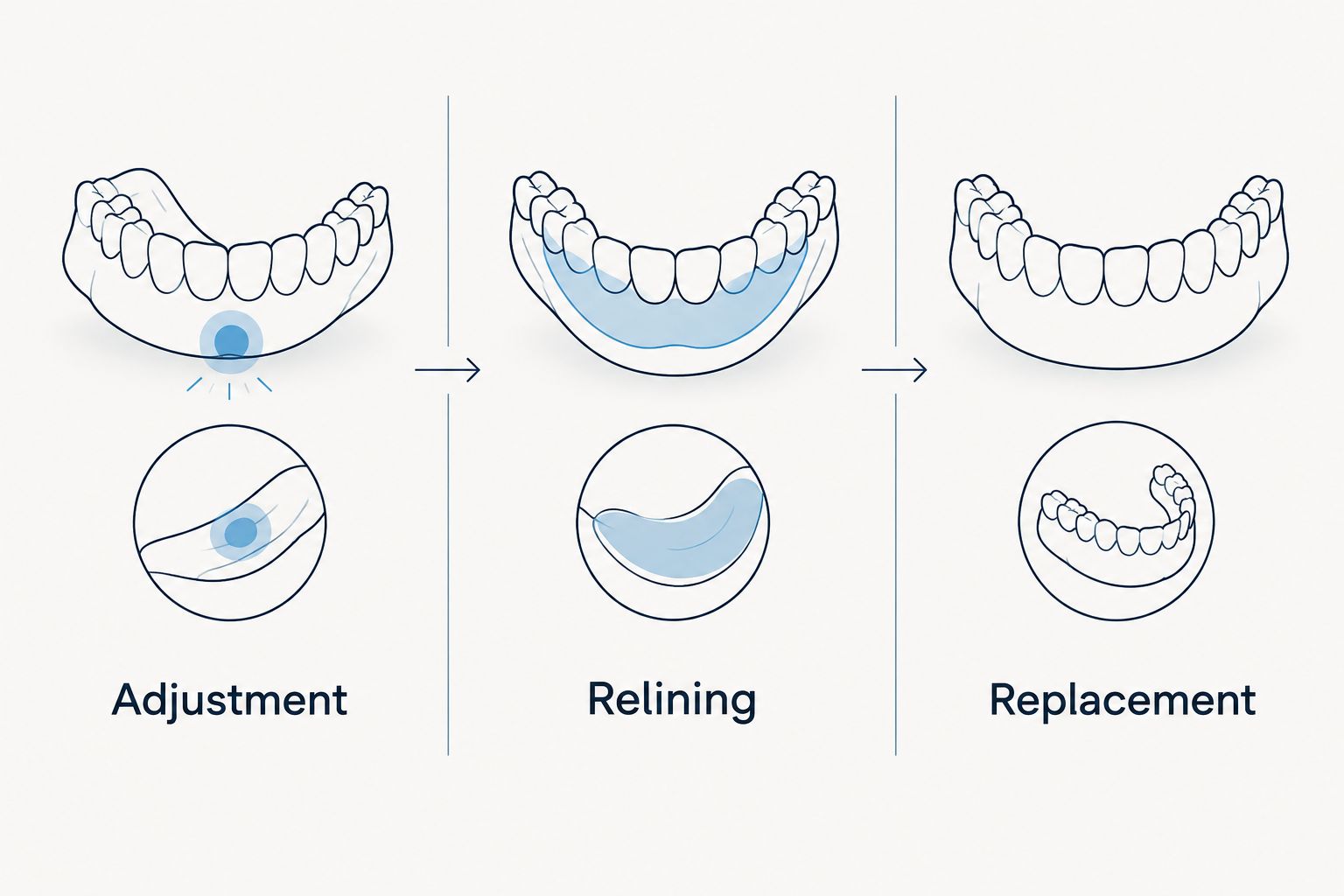
The next step depends on what has changed:
| Option | Best for | What it addresses | Main limitation |
|---|---|---|---|
| Adjustment | A localized pressure spot or minor bite problem | Reshapes selected areas to improve comfort or contact | Does not correct extensive wear or major loss of fit |
| Relining | A sound denture that no longer closely fits the gums | Renews the surface that rests against the gums | Does not restore worn artificial teeth |
| Repair | Certain isolated fractures or broken denture teeth | Restores a damaged part when repair is appropriate | Does not solve an underlying fit or bite problem |
| Replacement | Extensive wear, repeated damage, or an appliance that cannot be made functional | Creates a new appliance based on the current mouth and bite | Requires fitting and adjustment; does not stop future mouth changes |
Choose the treatment that solves the cause, not just the visible symptom. Repairing a crack without checking why the denture cracked leaves the fit or bite problem unaddressed.
What about full dentures?
Full dentures replace all the teeth in an upper or lower arch. Their useful life depends on the condition of the artificial teeth and base, along with the shape and health of the supporting tissues.
A full denture can look intact while fitting poorly underneath. Rocking, repeated sore spots, or difficulty keeping it steady are reasons to have the fit checked rather than judging its condition by appearance alone.
What about partial dentures?
Partial dentures depend on the remaining teeth as well as the gums. Changes in those teeth, including decay, gum disease, or tooth loss, can affect the appliance even when its artificial teeth still look fine.
Tell your dentist if a partial denture becomes difficult to seat or remove. Do not bend its clasps yourself: changing a clasp can damage it or place unwanted pressure on a supporting tooth.
What about implant-supported dentures?
Implant-supported dentures still need maintenance. The denture teeth, base, and attachment components are separate from the implants, so a loose attachment does not automatically mean an implant has failed.
The benefit is additional support or retention when this treatment suits your mouth. The limitation is that neither the denture nor its attachments are maintenance-free, and the tissues around the implants still need professional assessment.
Why denture lifespan varies
Daily care matters, but it is not the only factor. Even careful denture wearers experience changes in their mouths that affect fit.
- Changes in gums and bone: The ridge beneath a denture changes after tooth loss. A mismatch between that ridge and the appliance creates movement and pressure points.
- Wear on artificial teeth: Flattened or damaged chewing surfaces affect how the upper and lower teeth meet. A reline cannot reverse that wear.
- Condition of supporting teeth: A partial denture relies on the health and position of the natural teeth that support or retain it.
- Cleaning and handling: Abrasive products, excessive heat, and accidental drops can damage denture surfaces or change their shape.
- Biting forces: Grinding, clenching, or an uneven bite can place stress on the appliance. Repeated fractures call for an assessment of the cause.
- Follow-up care: Dental visits give your dentist a chance to identify tissue changes, damage, and fit problems before they become harder to manage.
For denture care in 2026, treat a change in function as useful information—not a personal failure. Needing a reline or replacement does not necessarily mean you cleaned or cared for the appliance incorrectly.
What signs mean your dentures need attention?
Some changes appear gradually enough that you adapt without noticing. You might stop eating certain foods, chew on one side, or hold your mouth differently to keep a denture steady.
Watch for these patterns:
- Your dentures slide, rock, or click during ordinary use.
- Sore spots return after apparently healing.
- Chewing takes more effort or feels less effective.
- Your bite feels different, or the teeth no longer meet comfortably.
- The base has a crack, a sharp edge, or repeated repairs.
- You need increasing amounts of adhesive to feel secure.
- Your partial denture no longer seats normally.
A change in appearance can also justify a conversation, but appearance alone does not reveal whether replacement is necessary. Your dentist should assess the teeth, base, bite, and supporting tissues together.
Do not keep wearing a broken appliance that cuts your mouth or has loose pieces. Contact a dentist for instructions, and keep any broken pieces to bring to the appointment.
Can a reline make dentures last longer?
A reline can extend the usefulness of a denture when the artificial teeth and base remain suitable but the gum-facing surface no longer fits well. It changes that surface to better match the current shape of your mouth.
The advantage is that a serviceable appliance can sometimes be retained. The limitation is just as important: relining does not renew worn teeth, repair every fracture, or correct every bite problem.
An adjustment addresses a smaller issue, such as a localized pressure spot. Replacement becomes the more appropriate discussion when the appliance has several problems that an adjustment or reline cannot resolve.
What happens at a denture evaluation?
A useful denture assessment checks the appliance and the mouth together. The dentist needs to understand when the problem occurs, not simply whether the denture looks damaged.
For a 2026 denture evaluation, prepare to explain what has changed and bring the appliance with you, even if you have stopped wearing it.
- Describe the problem. Explain whether the denture slips during meals, hurts in a particular place, changes your speech, or feels loose throughout the day.
- Review the appliance. The dentist examines the base, artificial teeth, prior repairs, and any clasps or attachments.
- Check your mouth. The gums and other oral tissues need examination. Remaining teeth and implant sites also need attention when present.
- Assess the bite. How the teeth meet helps distinguish a localized fit issue from broader wear or alignment problems.
- Discuss the next step. Ask what an adjustment, reline, repair, or replacement would solve—and what it would leave unchanged.
Bring any adhesive or cleaning product you use if you are unsure whether it is suitable. Also mention dry mouth, new medications, recent extractions, or changes in your health that affect eating or oral comfort.
Starboard Dental is best for patients seeking general, restorative, and cosmetic dental care in Kennebunk, York, and Saco, Maine. A general dental assessment is a starting point; the treatment recommendation depends on your examination.
You can contact the practice to discuss an appointment and explain the denture concerns you want evaluated.
How can you help dentures stay useful?
Good care protects the appliance and the tissues beneath it. It does not prevent every future reline or replacement, but it helps avoid damage that has nothing to do with normal mouth changes.
For your 2026 home-care routine:
- Clean daily. Use a denture brush or soft brush with a suitable nonabrasive denture cleaner, following the product and dental instructions.
- Avoid hot water. Heat can distort denture materials. Do not boil dentures to clean or reshape them.
- Handle carefully. Clean over a folded towel or a basin of water to reduce damage if the appliance slips.
- Care for your mouth. Clean your gums, tongue, and any natural teeth. Dentures do not remove the need for oral hygiene.
- Follow overnight instructions. Unless your dentist directs otherwise, remove dentures overnight and store them as instructed for their material.
- Keep review appointments. An appliance that feels comfortable still does not replace an examination of your mouth.
Avoid household glue, home repair kits, and filing rough areas yourself. Those changes can damage the appliance, affect its fit, or complicate professional repair.
Should you wait until dentures break to replace them?
No. A denture can need replacement because it no longer functions well, even if the base has not broken. Persistent soreness, extensive tooth wear, and poor stability are reasons for an assessment before a fracture occurs.
The opposite is also true: a repairable break does not automatically require a completely new denture. The decision should account for the appliance's overall condition and the reason it failed.
Does using denture adhesive mean you need new dentures?
No. Adhesive use alone does not establish that a denture needs replacement. However, needing more adhesive than before or using it to manage persistent slipping deserves a fit assessment.
Follow the product directions rather than adding extra adhesive to compensate for looseness. Adhesive cannot rebuild worn teeth or correct a damaged denture base.
FAQ
How long do dentures last before you need new ones?
Dentures last several years, but there is no replacement deadline that fits everyone. A dentist checks fit, tooth wear, damage, and oral tissues to decide whether adjustment, relining, repair, or replacement is appropriate.
Can old dentures still be safe to wear?
Older dentures can remain usable if they fit comfortably, function properly, and remain in suitable condition. Age alone does not establish safety; persistent soreness, instability, or damage needs an examination.
Is relining dentures the same as replacing them?
No. Relining renews the surface against your gums, while replacement creates a new appliance. A reline does not restore worn artificial teeth or solve every bite problem.
Can I sleep with my dentures in?
Unless your dentist gives different instructions, remove dentures overnight to give the supporting tissues a rest. Follow specific instructions after extractions or when you receive a new appliance.
Why are my dentures loose even though they are not broken?
Dentures can loosen because the supporting gums and bone change shape after tooth loss. A dentist can assess whether an adjustment, reline, or replacement addresses the mismatch.
Should I repair a cracked denture with household glue?
No. Household glue is not a substitute for professional denture repair and can damage the appliance. Keep the pieces and contact a dentist for instructions.
Do I still need dental visits if I have no natural teeth?
Yes. Dental visits remain important for examining the gums and other oral tissues and checking denture fit and condition. Report sores, lumps, persistent redness, or other changes rather than assuming dentures explain them.
One last thing
A denture can look fine on the bathroom counter and still fit poorly in your mouth. Before your next visit, note which foods cause trouble, where rubbing occurs, and when the appliance moves. Those details are more useful than trying to decide its remaining lifespan yourself.
For your next denture conversation in 2026, ask: “What is causing the problem, and will the proposed treatment fix that cause?” That question helps keep the decision focused on comfortable function—not replacement for its own sake.