
Yes, dentures can be adjusted after they’re made to relieve pressure spots, improve the bite, or correct an edge that rubs your gums. An adjustment cannot fix every fit problem: loose dentures sometimes need a reline, while damaged or badly worn dentures need repair or replacement.
- Can dentures be adjusted? Yes—professional adjustments can relieve rubbing and improve how denture teeth meet.
- A denture reline improves the fit against your gums; it does not replace worn teeth.
- Never file dentures yourself or use household glue to repair them.
- Starboard Dental provides general and restorative dental care for patients in Kennebunk, York, and Saco, Maine.
Can dentures be adjusted after they’re made?
Yes. A dentist can adjust a finished denture, but the right treatment depends on what is causing the discomfort. A small pressure spot is different from a denture that rocks because its base no longer matches your gums.
Use this comparison to understand the options before your appointment. These are treatment categories, not a way to diagnose the problem yourself.
| Treatment | Best for | What it changes | Main limitation |
|---|---|---|---|
| Denture adjustment | A localized sore spot, rubbing edge, or uneven bite | Selected areas of the base or biting surfaces | Does not correct a broadly loose fit |
| Denture reline | A denture whose gum-facing surface no longer fits closely | The surface that rests against your gums | Does not replace worn denture teeth |
| Denture rebase | A denture that needs a new base but has usable teeth | Most or all of the denture base | Only appropriate when the existing teeth remain suitable |
| Denture replacement | Extensive wear, damage, or a fit that cannot be corrected adequately | The complete denture | Requires a new fitting process and another adjustment period |
Why this matters
Pain is not something you have to accept as part of wearing dentures. Persistent rubbing can injure the tissues under the denture, and a loose fit can interfere with eating and speaking.
If you are looking for dental care in coastal Maine in 2026, Starboard Dental provides general and restorative care. Explain whether your main concern is soreness, slipping, chewing, or visible damage so the dental team understands why you are calling.
Denture adjustment: best for a specific pressure spot
A denture adjustment removes or reshapes a small amount of material where the dentist identifies a problem. The dentist checks the fit in your mouth rather than simply trimming the area that looks uncomfortable.
For example, an edge that extends too far can rub when your lips or cheeks move. A bite that contacts unevenly can also place extra pressure on one area, even when the denture base appears to fit.
Choose a professional assessment for a recurring sore spot rather than repeatedly cushioning it with adhesive. The benefit of a targeted adjustment is that it addresses a specific problem without replacing the entire denture. Its limitation is equally important: removing material cannot restore missing support beneath a loose denture.
Tell the dentist exactly when the discomfort happens. Pain during chewing, pain while speaking, and discomfort immediately after inserting the denture give different clues about the cause.
Denture reline: best for a changing gum fit
A reline changes the inside surface of a denture so it fits more closely against the tissues supporting it. Dentures themselves do not adapt as the shape of your gums and underlying jaw changes.
This is especially relevant during healing after tooth removal. A denture that fit earlier can become loose as the tissues change, even if you have handled it carefully.
A reline can improve contact and stability when the rest of the denture remains suitable. However, it cannot make badly worn teeth new again or correct every problem with how the upper and lower teeth meet.
Ask whether the denture needs more support, not just less material. That distinction helps explain why a dentist recommends a reline instead of another adjustment.
Denture rebase: best for replacing the base
A rebase replaces the denture’s base while retaining teeth that are still suitable for use. It is a different procedure from trimming an irritating edge or adding material to the fitting surface.
The advantage is that usable denture teeth can remain part of the restoration. The limitation is that keeping those teeth only makes sense if their condition and arrangement still meet your needs.
A rebase is not automatically the next step after an unsuccessful adjustment. The dentist first checks whether the problem involves the base, the teeth, the bite, or a combination of these.
Denture replacement: best when corrections are not enough
Replacement becomes relevant when a denture has extensive wear, repeated damage, or problems that adjustments and relining cannot adequately correct. A new denture allows the dentist to reassess the fit and tooth arrangement together.
The benefit is a fresh starting point rather than continuing to modify a denture with several problems. The drawback is that a replacement requires fitting and getting used to a new appliance; it is not simply an instant version of your old denture.
Do not assume that an older denture must be replaced solely because it is uncomfortable. Equally, do not assume that every uncomfortable denture can be saved with another small adjustment. Its condition matters more than that assumption.
Why denture adjustment needs vary
Two people describing “loose dentures” can need different treatment. The dentist considers the denture itself and the tissues supporting it.
- Healing after extractions: Changes during healing can alter the fit of a denture made around the time teeth were removed.
- Changes in supporting tissues: Gums and the underlying jaw can change shape over time, leaving space beneath the base.
- Uneven bite contacts: Teeth that meet unevenly can tip the denture or concentrate pressure.
- Denture edges: An edge that rubs moving tissues can cause a localized sore spot.
- Wear or damage: Worn teeth, cracks, and distorted components require a different response from simple rubbing.
- Type of denture: A partial denture also depends on its relationship with remaining teeth and any supporting components.
These factors explain why a photograph or a description alone cannot determine the right adjustment. The dentist needs to assess the denture in your mouth and examine the tissues beneath it.
What happens at a denture adjustment appointment?
For a denture visit in 2026, bring the appliance and describe what has changed since it last felt comfortable. If you have previous dental records or know when the problem started, share that information too.
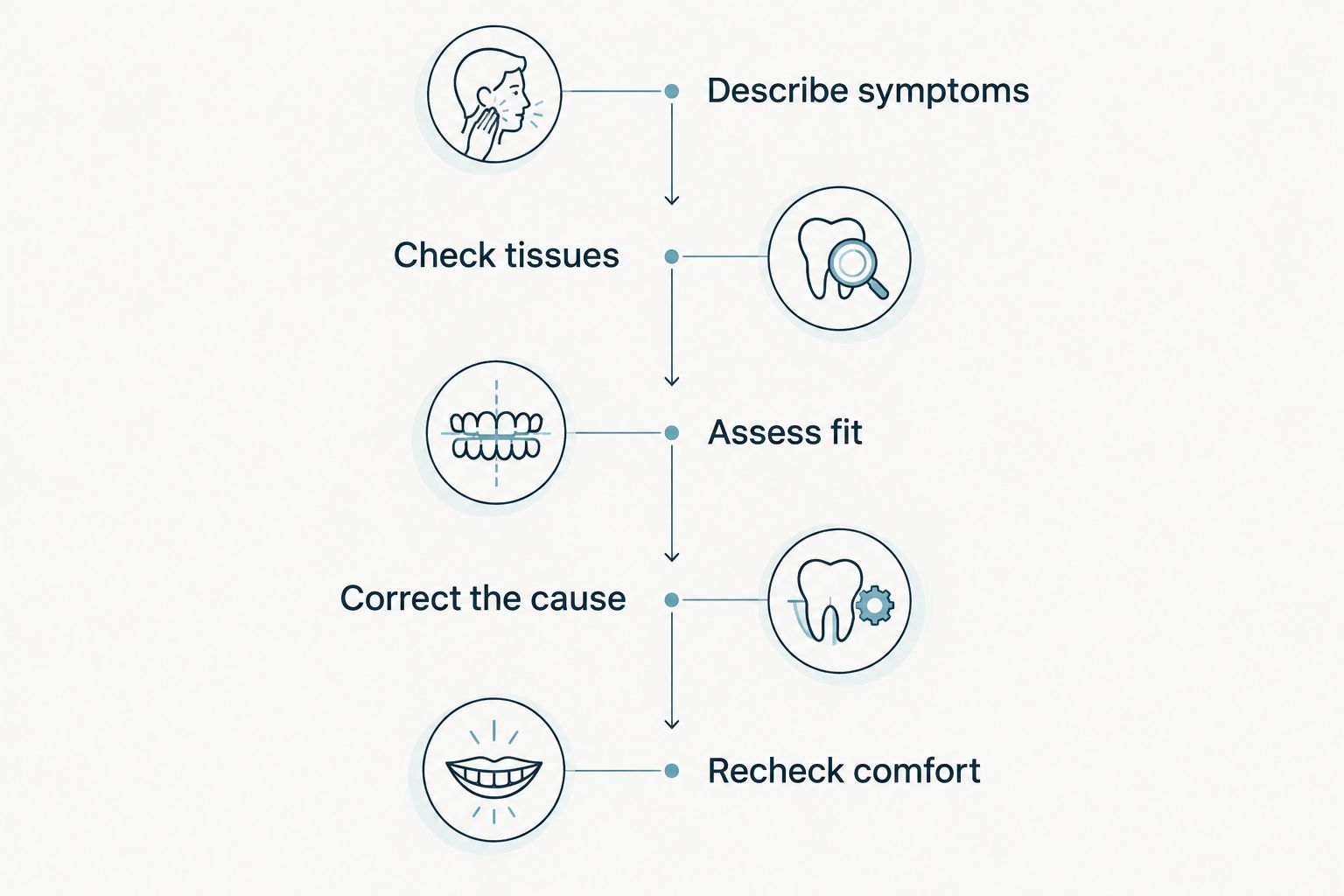
The assessment generally follows this sequence:
- Describe symptoms. Point out where it hurts, when it slips, and whether eating or speaking triggers the problem.
- Check tissues. The dentist examines your mouth for sore areas, inflammation, and other possible causes of discomfort.
- Assess fit. The dentist checks how the denture sits, moves, and contacts the opposing teeth.
- Correct the cause. Treatment might involve a targeted adjustment or planning a different procedure.
- Recheck comfort. The dentist reassesses the fit and explains what to watch for afterward.
The goal is not simply to make the denture feel looser. It is to reduce harmful pressure while preserving the support and contact the denture needs to function.
Ask the office whether you should wear the denture before your appointment. Instructions depend on your symptoms; do not force yourself to keep wearing an appliance that causes significant pain or injury.
Can I adjust my dentures at home?
Do not file, sand, heat, bend, or glue your dentures at home. Removing material is irreversible, and changing one area can affect the fit elsewhere.
Household glue is not a substitute for dental repair. Likewise, bending a partial denture’s clasp yourself can damage the component or change how it loads a supporting tooth.
Denture adhesive also has limits. Used according to its directions, it can help with retention, but it does not correct a damaged appliance or replace a professional fit assessment.
If your denture suddenly feels different, check for visible damage without trying to repair it. Put it somewhere safe and contact your dental office for instructions.
Can dentures be adjusted if they are old?
Yes, older dentures can sometimes be adjusted or relined if their condition supports it. Age alone does not tell the dentist whether the base, teeth, and bite are still suitable.
Bring up repeated repairs, increasing adhesive use, and changes in chewing. Those details help distinguish a small fit problem from a denture that needs more extensive work.
What if my dentures still hurt after an adjustment?
Persistent pain after a denture adjustment needs another assessment rather than repeated home fixes. Tell the dentist whether the original sore spot remains or whether the discomfort has moved.
Discomfort can come from fit, bite pressure, irritated tissues, or a separate mouth problem. Repeatedly trimming the denture without reassessing the cause is not the answer.
Seek prompt dental advice for a persistent ulcer, bleeding, swelling, or a red or white patch. Trouble breathing or swallowing requires emergency medical care, not a routine denture appointment.
Caring for your mouth between appointments
Your 2026 denture-care routine should protect both the appliance and the tissues underneath it. Follow the cleaning instructions for your denture material, and avoid hot water that can distort the appliance.
Clean your dentures daily and gently clean your gums, tongue, and palate. If you have remaining natural teeth, the American Dental Association recommends brushing 2 times a day for 2 minutes with fluoride toothpaste and cleaning between teeth at least 1 time daily.
Ask your dentist about removing dentures overnight and how to store them safely. Follow any specific instructions given after extractions rather than assuming the usual routine applies immediately.
Getting help locally
Starboard Dental is best suited to patients seeking general and restorative dental care in Kennebunk, York, and Saco, Maine. Dr. Alex Kerbaugh leads the practice, which serves patients of all ages.
When you contact the practice, explain whether the denture is new or longstanding and mention any cracks, sores, or sudden changes. Ask what to bring and whether the appliance should stay out until you are seen.
FAQ
Can dentures be adjusted after they’re made?
Yes, a dentist can adjust finished dentures to address pressure spots, rubbing edges, or uneven bite contacts. A loose overall fit can require a reline or another treatment instead.
Can a dentist adjust dentures made somewhere else?
A dentist can assess dentures made by another provider, but whether an adjustment is appropriate depends on the appliance and your mouth. Ask the office about its process before booking.
How many denture adjustments will I need?
The number of denture adjustments depends on your symptoms, tissue healing, and the condition of the denture. There is no single visit count that applies to every patient.
Can dentures be adjusted if they are too loose?
Loose dentures can sometimes be improved, but removing material usually does not solve a gap beneath the base. A dentist checks whether a reline, repair, or replacement better addresses the cause.
Should I keep wearing dentures that cause a sore spot?
Do not force yourself to wear dentures that cause significant pain or injury. Call your dental office for instructions, including whether to wear them before the assessment.
Can I use more adhesive instead of getting dentures adjusted?
More adhesive does not correct a poorly fitting or damaged denture. Use adhesive only as directed and arrange an assessment if you increasingly depend on it.
What should I ask before a denture adjustment in 2026?
Ask what is causing the discomfort and whether the proposed treatment changes the bite, the edges, or the gum-facing surface. Also ask what symptoms should prompt another visit.
One last thing
A sore spot does not always mean the dentist should trim the spot directly above it. Uneven tooth contact can tip a denture and create pressure somewhere else.
For your next dental visit in 2026, describe the movement that triggers the discomfort rather than only pointing to the painful area. Share those details with Starboard Dental so the conversation starts with what you are experiencing, not a guess about the repair.