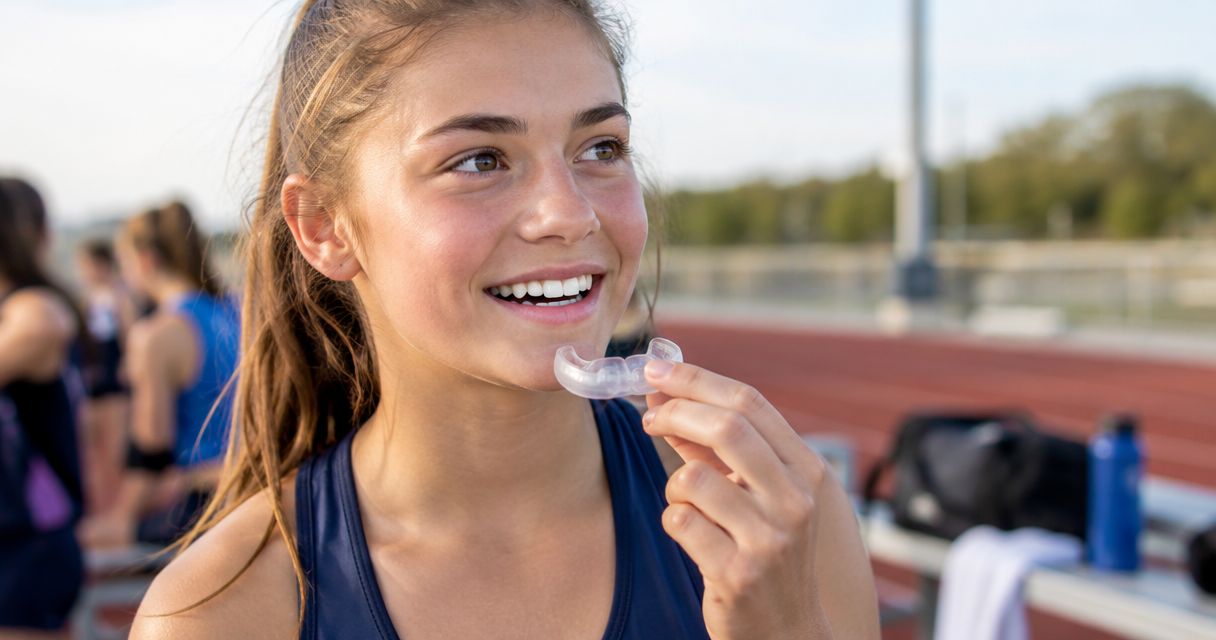
Student athletes’ custom mouthguards are individually fitted sports appliances designed to help protect teeth and surrounding tissues during play. This 2026 guide explains how to choose and care for one when growing teeth, braces, school schedules, and different sports all affect the fit.
- Custom mouthguards for student athletes should stay seated without constant clenching and allow comfortable breathing.
- Starboard Dental is best for Maine families seeking general dental guidance before choosing a sports mouthguard.
- Braces and erupting teeth require professional fit advice; do not force an old mouthguard into place.
- A sports mouthguard and a night guard serve different purposes and are not interchangeable.
Why mouthguard protection matters for student athletes
A ball, elbow, fall, or collision can injure teeth even during an ordinary practice. A sports mouthguard cushions contact around the teeth and helps protect nearby soft tissues, but it does not make an athlete injury-proof. Do not treat a mouthguard as protection against concussion.
Students face a particular challenge: their mouths change while their sports routines continue. Newly erupted teeth, orthodontic adjustments, and a busy school calendar all affect whether a guard fits and gets worn consistently. The useful question is not simply which guard to buy, but which guard your student can wear correctly throughout activity.
Starboard Dental provides general, restorative, and cosmetic dental care for patients of all ages in Kennebunk, York, and Saco, Maine. A dental discussion can address tooth development, existing dental work, and questions to take to a mouthguard provider.
For the 2026 season, check both the sport’s rules and your student’s dental needs. A rule-compliant guard still needs to fit the person wearing it.
How to choose and maintain a student athlete’s mouthguard
Check the sport’s requirements before choosing a guard
Start with the free, practical work: read the school or league’s equipment rules and ask the coach when protection is required. Include practices, drills, and scrimmages in that conversation rather than assuming the rule applies only to competition.
Tell the dental professional what your student actually does. Basketball contact, a hockey helmet, and gymnastics falls present different circumstances. Mouthguard selection should reflect those circumstances without replacing other required protective equipment.
If your student already owns a guard, bring it to the discussion. Its fit and condition are more useful than a description of its packaging.
- Check the current school and league rules for 2026.
- Identify practices and activities that require protection.
- List every sport your student plays.
- Mention helmets, face protection, and other required equipment.
- Bring the existing guard if there is one.
Review braces, growing teeth, and dental work
You can begin by asking your student about rubbing, looseness, or a change in bite. Look for visible damage to the guard, but do not trim or reshape it to solve a fit problem without appropriate instructions.
A dental professional can assess factors that a home inspection cannot, including erupting teeth, restorations, and orthodontic movement. Starboard Dental’s general dental care provides a starting point for that conversation; confirm mouthguard services and fabrication arrangements directly with the practice.
For students with braces, fit advice should come from the treating orthodontist or dentist. A guard that fits tightly around teeth today can become unsuitable as those teeth move. Avoid home molding over braces unless the product instructions and treating clinician specifically support it.
- Report braces, retainers, and planned orthodontic changes.
- Mention loose baby teeth and newly erupting teeth.
- Identify crowns, fillings, or previous dental injuries.
- Describe sore spots or changes in how teeth meet.
- Ask who should reassess the guard as the mouth changes.
Test whether the guard stays seated comfortably
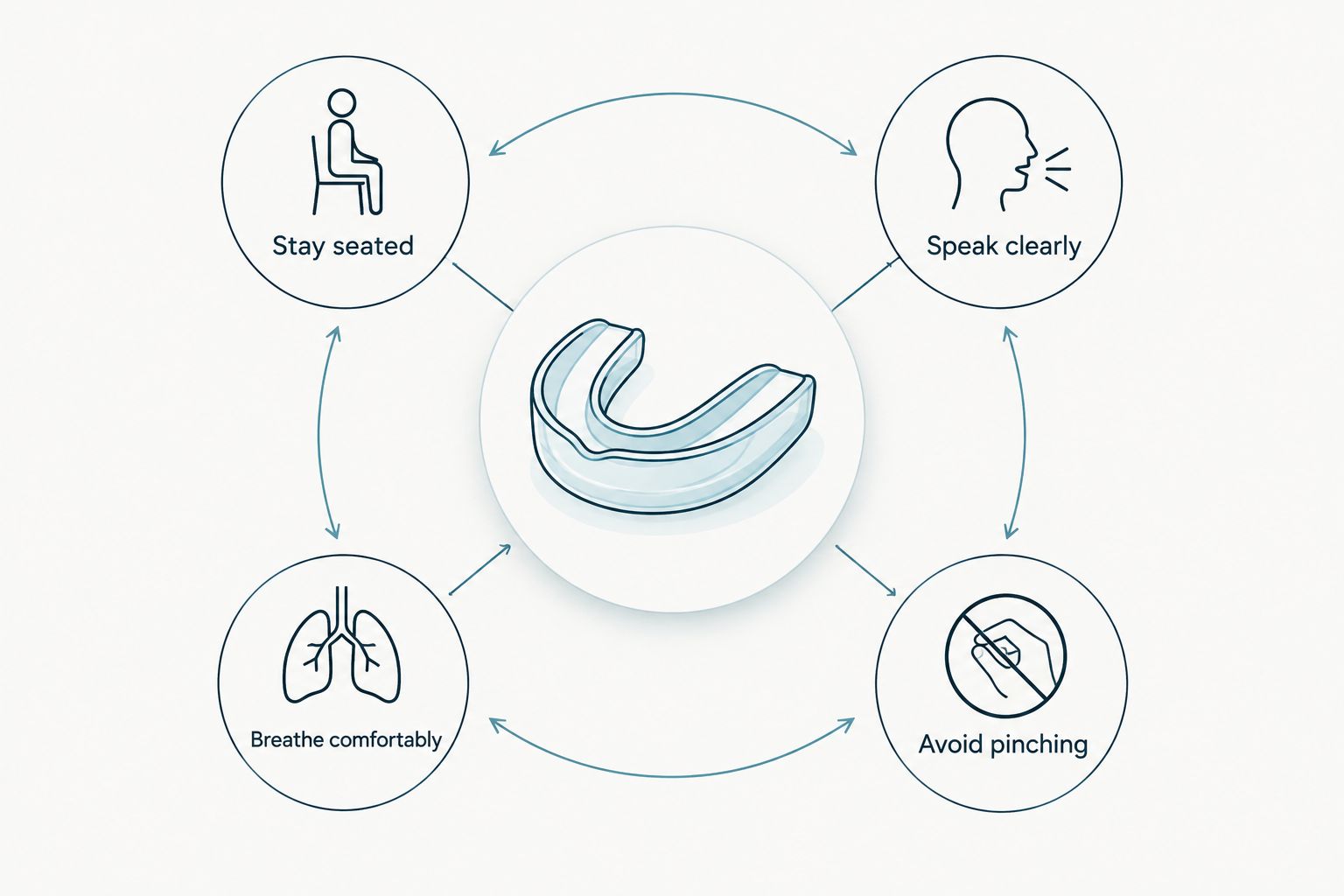
Begin with a simple check while your student is awake and sitting still. The guard should feel secure without continuous biting to hold it in place. Ask the student to speak and breathe normally, then report any gagging, sharp edges, or pressure.
A custom guard is made from an impression or scan of the teeth and adjusted for the wearer. That individualized process is its main advantage, but the label alone does not establish a good fit. The finished guard still needs evaluation, and a growing student can outgrow it.
Use the following comfort checks to prepare for a professional fit review. They are not a substitute for that review or a reason to deliberately test the guard with an impact.
- Stay seated without constant clenching.
- Speak clearly enough to communicate during activity.
- Breathe comfortably while wearing the guard.
- Avoid pinching against gums or braces.
- Report gagging or difficulty swallowing.
Choose the option that matches your student’s needs
Use fit, dental development, and the sport’s requirements as your decision criteria. Do not choose solely by appearance or assume a thicker-looking guard automatically suits the athlete better.
A stock guard offers a ready-made shape. A boil-and-bite guard allows home molding according to its instructions. A custom guard uses an impression or scan and professional fitting. Each has a place, but each also has limitations that matter for students.
Custom fitting is the strongest match when individualized retention and comfort drive the decision. It does not guarantee that the guard will remain suitable through tooth eruption or orthodontic movement. For braces, the treating clinician should guide the selection rather than the athlete choosing independently.
- Compare retention before appearance.
- Follow the exact instructions for a home-molded guard.
- Ask about suitability for braces and erupting teeth.
- Confirm how fit adjustments are handled.
- Avoid substituting a grinding appliance for a sports guard.
Build mouthguard use into every sports routine
The manual approach is straightforward: put the guard in the sports bag, keep its case beside the other protective equipment, and have the student check it before leaving. A well-fitted guard cannot help while it stays in a locker.
In your 2026 routine, connect mouthguard use to an existing habit, such as checking shoes or a helmet. Parents and coaches can support the routine, but the student should recognize signs that the guard is no longer comfortable or secure.
Keep the guard in place during activities where protection is needed. If it repeatedly comes out for talking, breathing, or relief from soreness, treat that as a fit problem rather than a discipline problem.
- Pack the guard and its case with sports equipment.
- Inspect the guard before activity.
- Wear it during required practices as well as games.
- Tell the coach when fit problems interrupt use.
- Stop chewing the guard as a nervous habit.
Clean the guard and protect the teeth underneath
Start with the manufacturer’s cleaning instructions and any directions from the dental professional. Rinse the guard after use, clean it as directed, and allow it to dry in a ventilated case. Keep it away from heat that can change its shape.
Mouthguard care does not replace everyday dental care. The American Dental Association recommends brushing for 2 minutes, 2 times per day, using fluoride toothpaste, and cleaning between teeth 1 time per day. Those habits remain important throughout the sports season.
Do not share a mouthguard, and keep its case clean as well. If the guard develops persistent odor, rough surfaces, or damage, ask whether cleaning or replacement is appropriate rather than adding harsh cleaners.
- Rinse after use and follow the cleaning directions.
- Let the guard dry before storing it.
- Use a protective, ventilated case.
- Keep it away from hot water and direct heat.
- Brush and clean between teeth consistently.
- Keep the guard out of reach of pets.
Recheck the fit after changes or an injury
A student’s dental development is more useful than an arbitrary replacement date. Reassess the guard when teeth erupt, braces change, new dental work is completed, or the guard becomes loose or damaged. Do not assume last season’s fit still applies.
For the 2026 school year, add a fit discussion to sports preparation and bring the guard to an appropriate dental visit. Ask the clinician what changes should trigger an earlier review for your student.
After a mouth injury, a guard that looks intact does not prove the teeth are unharmed. Pain, looseness, bleeding, a changed bite, or a broken tooth needs prompt dental advice. Suspected concussion also needs medical assessment.
- Recheck after orthodontic adjustments or new dental work.
- Report looseness, rubbing, tears, or distortion.
- Bring the guard when discussing a dental injury.
- Seek urgent care for a knocked-out permanent tooth.
- Get emergency help for trouble breathing or uncontrolled bleeding.
Compare mouthguard options for student athletes
The useful comparison is how each option fits your student’s mouth and routine. No option removes the need for correct use, cleaning, and reassessment as teeth change.
| Option | Best for | Main advantage | Key limitation |
|---|---|---|---|
| Stock sports mouthguard | Students whose ready-made guard fits securely and meets sport rules | No molding process | The fixed shape can compromise retention, speech, or comfort |
| Boil-and-bite sports mouthguard | Students without complicating dental needs who can follow molding instructions | Allows some adaptation at home | Fit depends on molding; braces require clinician guidance |
| Custom sports mouthguard | Students who need individualized fit and professional evaluation | Made from an impression or scan and adjusted for the wearer | Requires a fitting process and reassessment as the mouth changes |
| Braces-compatible sports mouthguard | Students in orthodontic treatment, with treating-clinician approval | Designed to account for orthodontic equipment | Compatibility and space for tooth movement still need checking |
Choose the guard your student can wear correctly, not the one with the boldest claims. For braces or a complicated dental history, professional guidance takes priority over an independent home fit.
A night guard belongs outside this comparison. It addresses a different purpose and should not be used as a substitute for sports protection unless the treating dental professional specifically directs otherwise.
Common mouthguard mistakes student athletes make
Keeping a guard after the teeth change
A guard that fitted before new teeth erupted or braces were adjusted can become tight, loose, or irritating. Do not force it into place or keep using it because it still looks clean. Ask for a fit review when the mouth changes.
Removing the guard during contact drills
Students sometimes associate protection with games rather than training. Contact can happen during drills and scrimmages too. Follow the activity’s protection requirements throughout the session, and address discomfort that causes the student to remove the guard.
Treating chewing damage as harmless
Chewing can damage the guard and change its shape. Inspect worn edges, tears, and distorted areas rather than dismissing them as ordinary use. A damaged guard needs professional advice about whether it remains suitable.
Confusing sports protection with nighttime grinding care
A sports mouthguard and a grinding appliance are not interchangeable just because both fit over teeth. Discuss each problem separately. Using the wrong appliance avoids neither the fit issue nor the need to address the original concern.
Assuming a guard rules out injury
A mouthguard reduces risk; it does not make pain or a loose tooth safe to ignore. In the 2026 season, teach your student to report a changed bite, tooth tenderness, or bleeding after a hit. A coach’s equipment check is not a dental examination.
FAQ
What is the best mouthguard for a student athlete?
The best mouthguard fits securely, allows comfortable breathing, and suits the student’s sport and dental development. Custom fitting is useful when individualized retention and comfort are priorities; braces require guidance from the treating clinician.
Are custom mouthguards better than boil-and-bite guards?
Custom mouthguards offer individualized fabrication and professional fitting, while boil-and-bite guards depend on home molding. The right choice depends on the finished fit, dental needs, and the sport’s requirements rather than the label alone.
Can my child wear a sports mouthguard with braces?
Yes, but the treating orthodontist or dentist should guide the choice and fit. Do not force a tight guard over braces or mold one around them unless the product instructions and clinician support that approach.
How often should a student athlete replace a mouthguard?
Replacement depends on fit, condition, and changes in the student’s mouth rather than one universal timetable. New teeth, orthodontic movement, dental work, tears, or looseness are reasons to seek a fit review.
Does a mouthguard prevent concussions?
A mouthguard should not be relied on to prevent concussion. Its role is dental and soft-tissue protection; follow the sport’s safety rules and seek medical assessment after a suspected concussion.
Can my student use a night guard for sports?
A night guard is not a substitute for a sports mouthguard. The appliances serve different purposes, so ask the treating dental professional about appropriate sports protection.
What should I do if a tooth hurts after a game?
Contact a dentist promptly when tooth pain follows an impact, especially with looseness, bleeding, or a changed bite. A knocked-out permanent tooth needs urgent dental care, and breathing difficulty or uncontrolled bleeding needs emergency help.
One last thing
Ask your student to explain why the guard comes out. Breathing trouble, gagging, rubbing, and trouble communicating are useful clues about fit—not reasons to tell the student simply to tolerate it.
Before the next practice, have your student put the guard in and describe what feels wrong. Starboard Dental can discuss general dental concerns and help you identify questions for a mouthguard fitting. The goal is protection your student can use consistently, with a plan for changing teeth.