
Yes, bad breath can be a sign of a dental problem, including gum disease, tooth decay, or a dental infection. Persistent odor deserves a dental exam, especially when you also notice bleeding gums, tooth pain, swelling, or a lingering bad taste. This 2026 guide explains which symptoms need attention and what you can safely do at home.
- Can bad breath be a sign of a dental problem? Yes—persistent odor warrants a dental exam.
- Starboard Dental provides general dental care for patients in Kennebunk, York, and Saco, Maine.
- Bleeding gums, tooth pain, and recurring bad taste help distinguish dental concerns from temporary food odors.
- Trouble breathing or swallowing with dental swelling requires emergency medical care.
Can bad breath be a sign of a dental problem?
Bad breath that keeps returning despite regular cleaning needs an explanation, not just a stronger mint. Bacteria on your tongue, between your teeth, and around your gums break down material in your mouth and produce unpleasant odors. Dental disease can create places where those bacteria and food debris collect.
At Starboard Dental, general dental care serves patients of all ages in Kennebunk, York, and Saco, Maine. A dental examination is the appropriate starting point when you cannot explain persistent breath changes.
The following patterns help you describe the problem. They do not establish a diagnosis.
| Possible cause | Clues you might notice | What the clues mean |
|---|---|---|
| Temporary food odor | Breath changes after garlic, onions, or certain drinks | A food-related episode does not by itself indicate dental disease |
| Tongue coating or trapped food | Visible coating or debris between teeth | Cleaning these surfaces addresses material that supports odor-producing bacteria |
| Gum disease | Bleeding, swollen gums, recession, or persistent bad taste | Your gums need assessment; pain is not required |
| Tooth decay or damaged dental work | Food trapping, sensitivity, or a rough or broken area | A dentist needs to check the tooth and surrounding restoration |
| Dental infection | Tooth pain, swelling, drainage, or a foul taste | Prompt dental assessment is necessary |
| Dry mouth | Sticky mouth, reduced saliva, or frequent thirst | Reduced saliva can contribute to odor and increase decay risk |
Why this matters
Bad breath is uncomfortable to discuss, but it is a symptom—not a character judgment. Brushing harder or hiding the smell does not tell you whether your gums and teeth are healthy.
The useful distinction in 2026 is still temporary odor versus a recurring change. Morning breath that improves after normal care is different from odor that returns throughout the day alongside bleeding or discomfort. Focus on the pattern and accompanying symptoms rather than trying to judge how strong the smell is.
Gum disease: bad breath with bleeding or swollen gums
Gum disease can cause persistent bad breath even when your teeth do not hurt. Plaque collects along the gumline, and more advanced disease creates pockets around teeth that are difficult to clean at home.
Look for bleeding during brushing or flossing, puffy gums, gums pulling away from teeth, or changes in how your teeth feel when you bite. Loose teeth also need assessment. No pain does not mean no gum disease.
For people with bleeding gums, the best next step is a dental examination rather than a change in breath freshener. Home cleaning supports gum health, but it cannot remove hardened tartar. Treatment depends on whether inflammation is limited to the gums or involves the tissues supporting your teeth.
Tooth decay or infection: bad breath with a problem tooth
A cavity, broken tooth, or damaged restoration can trap food and make cleaning difficult. Odor alone cannot tell you which tooth is involved, and a cavity does not always hurt early on.
Pay attention to sensitivity, pain when biting, a recurring foul taste, or food repeatedly catching in the same spot. Tell your dentist exactly where it happens. Do not use a sharp object to investigate the area yourself.
A dental abscess is an infection that needs prompt professional treatment. An abscess that drains and temporarily hurts less still needs care. A dentist determines whether the tooth needs restorative treatment, root canal treatment, extraction, or another approach; breath odor cannot make that decision.
Dry mouth: bad breath without obvious tooth pain
Saliva helps wash away food particles and supports the mouth's natural defenses. When saliva is reduced, odor can become more noticeable, and your risk of tooth decay increases.
Dry mouth can accompany medication use, dehydration, mouth breathing, or certain health conditions. Tell your dentist about sticky saliva, waking with a dry mouth, trouble swallowing dry foods, and any medicines or supplements you take. Do not stop a prescribed medicine on your own.
For people with a dry mouth, regular sips of water and sugar-free gum can help with comfort; gum is appropriate only if you can chew it safely. These steps do not identify the cause. Persistent dryness deserves assessment, particularly when you are developing new cavities or struggling to eat comfortably.
Why bad breath varies
Bad breath varies because several conditions can affect the same mouth at the same time. A 2026 dental visit should consider the full pattern rather than treating every case as a brushing problem.
- Food and drink: Garlic and onions can affect breath without indicating disease. Tell your dentist whether odor follows particular meals.
- Tongue coating: The tongue's surface can retain debris and bacteria even when your teeth look clean.
- Gum health: Inflamed gums and periodontal pockets provide areas that ordinary brushing cannot fully reach.
- Saliva flow: Dryness changes how effectively your mouth clears food particles and contributes to decay risk.
- Cleaning access: Crowded teeth, dental appliances, and damaged restorations can make some areas harder to clean.
- Tobacco use: Tobacco affects breath and increases the risk of gum disease. Include smoking and other tobacco use in your health history.
What should you do about persistent bad breath?
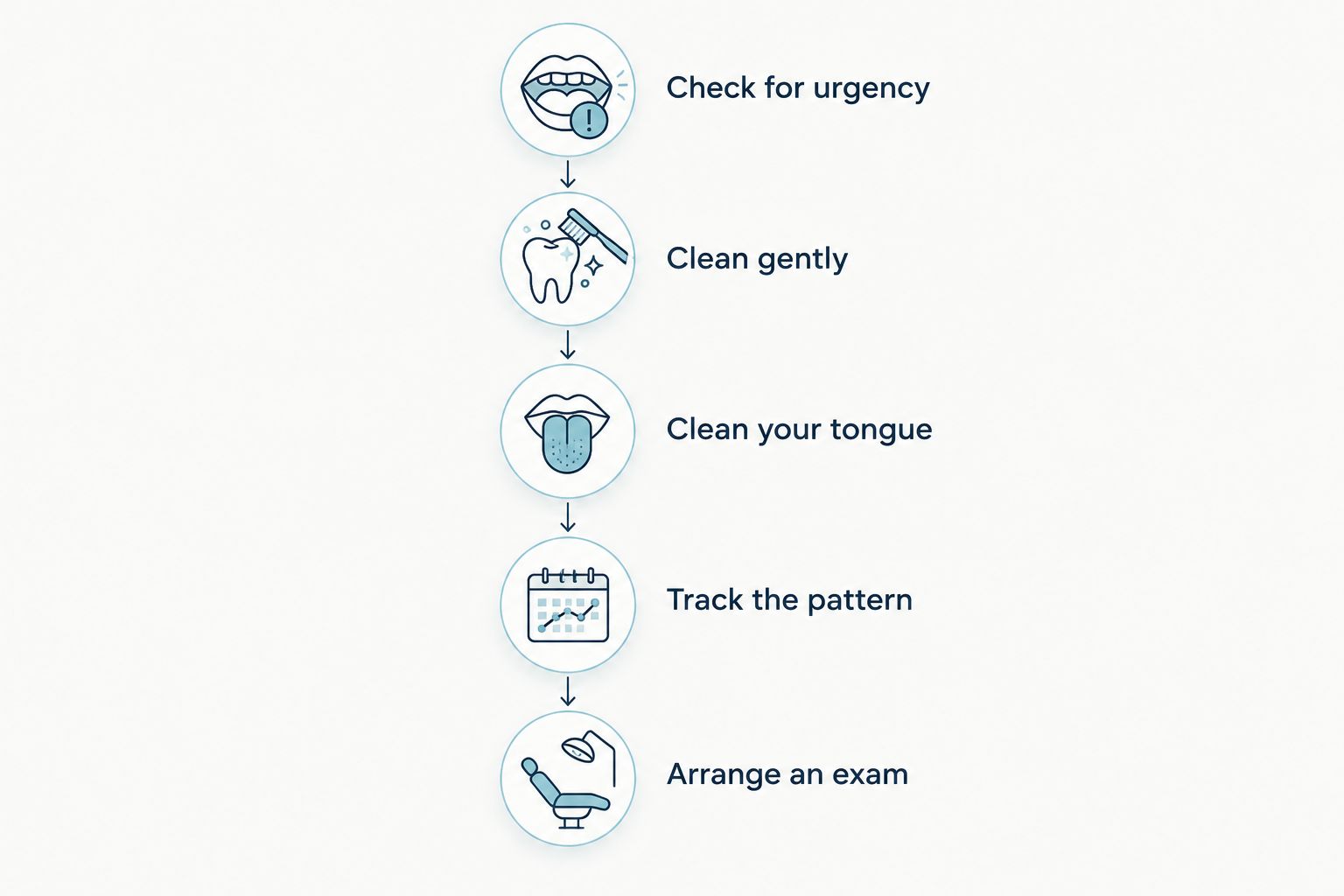
Use this 2026 action plan to separate safe home care from symptoms that need professional attention. Home care supports treatment; it does not replace an examination when symptoms persist.
- Check for urgency. Look for swelling, fever, severe pain, or trouble breathing or swallowing before focusing on breath fresheners.
- Clean gently. Brush with fluoride toothpaste for 2 minutes, 2 times a day. Clean between your teeth 1 time a day using floss or an appropriate interdental cleaner.
- Clean your tongue. Gently brush the tongue or use a tongue cleaner without pressing hard enough to cause pain or bleeding.
- Track the pattern. Note when odor occurs, whether your mouth feels dry, and whether the same tooth or gum area bothers you.
- Arrange an exam. Contact your dental office when odor persists despite routine care or accompanies bleeding, pain, swelling, or a recurring bad taste.
These brushing and interdental-cleaning habits follow established American Dental Association home-care guidance. If you wear a removable dental appliance, clean it according to your dentist's instructions rather than improvising with household cleaners.
Which home-care options help, and what are their limits?
Choose a home-care tool for the task it performs, not simply for a fresh taste. None of these options can rule out a cavity, gum disease, or an abscess.
| Option | Best for | Benefit | Limitation |
|---|---|---|---|
| Fluoride toothpaste | Daily tooth cleaning | Removes plaque with brushing and helps prevent cavities | Does not clean every space between teeth |
| Floss or an interdental cleaner | Cleaning between teeth | Reaches areas a toothbrush misses | Requires a tool and technique suited to your teeth |
| Tongue cleaner | Removing tongue coating | Removes surface debris from the tongue | Does not treat disease around teeth or gums |
| Sugar-free gum | Short-term saliva stimulation | Encourages saliva while you chew | Does not address the underlying cause of persistent dryness |
| Mouthrinse | Supplementing a dentist-directed routine | Some formulations help control plaque or odor | Does not replace brushing, interdental cleaning, or necessary treatment |
When is bad breath an emergency?
Trouble breathing or swallowing with mouth, jaw, or neck swelling requires emergency medical care. Do not wait for a routine dental appointment. Rapidly spreading swelling is also a reason to seek emergency help.
Contact a dentist promptly for tooth pain with swelling, fever, pus, or a recurring foul taste. When you call, describe the swelling and any fever rather than mentioning bad breath alone; those details help the office assess urgency.
Bad breath without those warning signs generally calls for a dental appointment rather than an emergency department visit. There is no safe smell-based test for an abscess, so do not wait for odor to become stronger before asking about other symptoms.
What happens at a dental visit for bad breath?
Your dentist reviews when the odor started, your cleaning routine, dry-mouth symptoms, tobacco use, and relevant medical history. The examination can include your tongue, gums, teeth, existing restorations, and dental appliances. X-rays or additional evaluation depend on the findings.
Starboard Dental is a fit for patients seeking general dental care in Kennebunk, York, and Saco, Maine. A general dental visit provides a place to discuss persistent breath concerns, although some causes require medical evaluation beyond dentistry.
Bring your medication list and describe any symptoms you have already noticed. You do not need to buy a special breath product before the appointment. Clear information about bleeding, pain, dryness, and timing is more useful than temporarily hiding the odor.
Discuss your breath concerns
Talk about persistent odor, bleeding gums, tooth pain, or dry mouth during a dental visit.
Can bad breath happen even if I brush regularly?
Bad breath can persist despite regular brushing because a toothbrush does not fully clean between teeth or treat gum disease. Tongue coating, dry mouth, and food trapping around dental work can also contribute.
Keep brushing, but do not scrub harder. Review your interdental cleaning and tongue care, then arrange an examination if the odor continues.
Can bad breath come from something outside my mouth?
Bad breath can have causes outside the mouth, including certain nose and throat conditions or reflux. Breath odor alone cannot identify a digestive problem or another medical condition.
A dental examination helps assess oral causes. If your teeth and gums do not explain persistent symptoms, discuss the next evaluation with your dentist or medical clinician.
FAQ
Can bad breath be a sign of a dental problem even without pain?
Yes, bad breath can signal a dental problem without pain, particularly gum disease. Persistent odor, bleeding gums, or a recurring bad taste warrants a dental examination.
Does bad breath mean I have a cavity?
Bad breath does not prove that you have a cavity. Decay, gum disease, tongue coating, and dry mouth can all contribute, so an examination is needed to identify the cause.
Will mouthwash get rid of bad breath permanently?
Mouthwash does not permanently resolve bad breath caused by untreated dental disease. Some rinses help control odor or plaque, but they do not replace cleaning or necessary dental treatment.
Should I stop flossing if my gums bleed and my breath smells?
Do not abandon gentle interdental cleaning simply because your gums bleed. Arrange a dental examination for recurring bleeding, and ask your dentist to check your technique and recommend an appropriate cleaning tool.
Can a dental infection cause a bad taste and bad breath?
A dental infection can cause a bad taste and bad breath, particularly when drainage is present. Contact a dentist promptly; trouble breathing or swallowing with swelling requires emergency medical care.
Can Starboard Dental help me discuss persistent bad breath?
Starboard Dental provides general dental care for patients of all ages in Kennebunk, York, and Saco, Maine. Describe persistent odor and any bleeding, pain, or dryness when arranging a dental visit.
One last thing
A mint can change how your mouth tastes without changing what is happening around your teeth. For your next dental visit in 2026, bring a short symptom note: when the odor returns, whether your gums bleed, and whether your mouth feels dry. The goal is to find the cause, not to cover it up.